



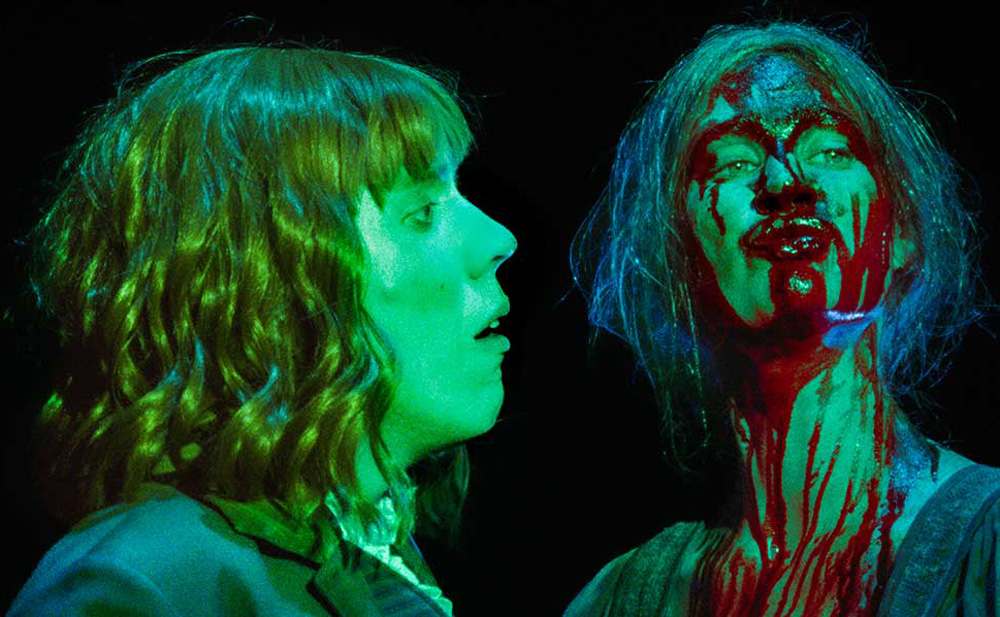

Grace Glowicki seems to specialize in characters that require an extra bit of effort to love, so it made sense as “Dead Lover” started to develop that she’d gravitate towards the Gravedigger, a heroine said to have an odor so off-putting that it’s prevented much company from ever being around. Not that the cemetery worker can expect anyone around to begin with, working the night shift where she’s relatively content talking to the corpses, but when she’s a woman with certain needs, she spends her off-hours concocting a perfume that she hopes will attract a mate, ultimately reeling in someone who she can finally call Lover (Ben Petrie), though he’d rather not have anything get in the way of her stench that comes naturally, declaring, “I want to lick your stink to taste your foulness.”
Like the Gravedigger, “Dead Lover” may not be for everyone, but those who fall in love with it will fall deeply and while the lead contends with feeling isolated, particularly when Lover is called away shortly after the two meet with no obvious return in sight, you will know you’re in good company when Glowicki has made a habit of stopping the timid at the door with her bold swings and richly rewarding those that seek out the exotic. The multihyphenate has been a force of nature in front of the camera for years, first grabbing our attention in her partner Ben Petrie’s early short “Her Friend Adam,” but has quickly distinguished herself behind it, starting with her completely fearless debut “Tito,” in which she swapped genders to play a shut-in who makes a strong case that the outside world is darker than her dimly lit home, and now “Dead Lover,” quite literally filmed inside of a black box theater where the splashes of vibrant lighting offer the kind of pungency that you’d expect of the smells that might not be transferred in a visual medium. (Though the filmmaker has found a solution to that as well, producing a scratch-n-sniff card in the spirit of John Waters, available for every theatrical screening of “Dead Lover” so audiences can get a whiff for themselves.)
In “Dead Lover,” there may be no more romantic words than Lover’s plea to the Gravedigger, “Don’t wash,” and by extension, it feels as if Glowicki has somehow gloriously made it through the filmmaking process unadulterated when her latest feature has the raw energy of live theater but feels right in a cinema where the inspired use of all the tools at her disposal, from frenzied editing that feeds on the passion Lover and the Gravedigger trade in letters to one another upon their separation to a score that can overwhelm in the best ways, create a singular space. Ever since “Dead Lover” premiered at Sundance a year ago, it’s turned any theater it’s played in into such an enchanting place and with the film now starting its U.S. theatrical run, Glowicki and Petrie spoke about their creative process and how it’s informed by their work on productions outside of their own (recently, the two also starred in Dusty Mancinelli and Madeleine Sims-Fewer’s “Honey Bunch”), creating a broad collection of characters to be played by just four actors in their latest and delivering an unexpectedly sexy time at the movies.
 How did this crazy thing come about?
Grace Glowicki: It came about in a weird way. The initial kernel of it was I really romanticized what I imagined an SNL writer’s room to be like or the guys that made Monty Python and [thought] what was that like when they were spitballing and world building together? I decided I would try my own version of that and together with my friend that’s a therapist, Ben, and two other filmmakers — Haya Waseem and Harry Chepka — and we would talk every week and spitball [ideas] and from those spitballs of just trying to make each other laugh and to find interesting anecdotes, that’s how the story came to live in its first form. Then we would take it into a dance studio with a clown, a puppeteer and a a theater maker and redrafted it to put it on its feet and then Ben and I took that and then did the final script. So there was no single inspiration other than wanting to collaborate and hang out with my cool friends.
How did a therapist get in the mix of that?
Grace Glowicki: I just thought it would be so smart because I [thought] he’ll understand why people do the things they do and so often when you’re an actor looking at a character, you [think] “okay this my character has problems with control or they’re running away from their relationship with their mom in this strange way,” so I thought having his brain in there would be cool for offering us insight about why our characters would behave in the ways that that they that they do.
Just generally, at what point do the two of you share a story idea with one another?
Grace Glowicki: We’re different in this way.
Ben Petrie: I’m much more clenched and constipated with my idea sharing. And Grace is much more like a popcorn machine with her idea sharing.
Grace Glowicki: Yeah, I’m always like, lying in bed and [saying things] like “Wouldn’t it be cool if this kind of thing [happened]…” Whereas I think we were in our house maybe three years before I read or knew anything about what Ben was making. So it’s very different.
I heard about “Dead Lover” that you actually didn’t decide on who was playing what characters until like three weeks before shooting. What was it like making those decisions?
Grace Glowicki: It was cool. In the rehearsal process we all played each role. [For instance] Ben would be Gravedigger, and I would be Lover, so we could decentralize the rehearsal. I thought it would bond us more as a troupe, soften our egos, and allow us to see the the movie we were part of from different vantage points because I find often, especially if there’s no rehearsal, I’ll show up as an actor onto a movie set and everyone is entrenched in their own silos of their own character working in different ways. There’s something so isolating about that and and if we could all really jive together, I thought it would create a stronger sense of chemistry between the group of us. I don’t remember how many weeks before shooting I asked [everyone] which characters do you want to play? But they each happened to like different main characters and then we allocated the sub-roles based on who could be in what scene [with] the other roles they were playing.
Ben Petrie: Yeah, it was really interesting to see that there was no conflict for any role. Nobody was in competition, like “Oh, I want to play this role.” There was a character for each of us to express some kind of throbbing desire inside that we wanted to get out, so it was a very intuitive process of everybody finding the character that was right for them.
 Did you have any trepidation about taking on seven characters?
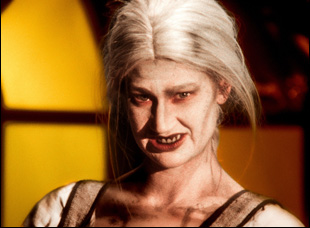
Ben Petrie: There was trepidation, for sure, but it was also freeing [because] focusing on one character across a whole movie can be a lot of pressure. You really want to nail that character and you have one shot to follow their arc and get it exactly right. Whereas in this case, knowing that you were going to be transitioning into a different wig in 45 minutes kept us fluid and spontaneous and light and nimble, going between so many different characters. But I was also extremely afraid at other points.
Grace, what led you to thinking about a black box theater as the type of environment to film in?
Grace Glowicki: I started acting in a black box theater in Montreal. It’s where I really fell in love with performance and also there’s more of a tactile quality with theater and often you can see the fringes of the aesthetics because it’s low budget. They can only do so much, but also there’s this creative genius that happens when it’s like, “We’re in a black box and we have four actors and we have to do a shipwreck scene, and all we have is fabric and and lights.” I always just thought that was so impressive, so I wanted to bring my love and my nostalgia for that, but also my admiration for that low budget creativity to a cinematic space. I’d seen some Kenneth Anger movies and I heard about “Dogville,” which I still haven’t seen, but I thought this [spare set] is enough because when I go to a theater and I’m looking at an actor in a spotlight with one prop, it’s enough for me visually because I love performance.
Ben Petrie: Whenever Grace and I would go to see a theater show together, we’d inevitably walk out of it and go, “Man, those people are the real deal. That’s punk rock. They’re doing so much with so little.” We always felt like hacks and phonies in the movie world whenever we would go to see like a a really great theater show.
Grace Glowicki: And there’s so little glory in theater. It’s so collectivist and you don’t get paid, at least in Toronto if you’re making independent theater. The budget you have to work with is nothing, so there’s just a raw passion that they’re all fueled by. Whereas in film it becomes more of an ego game, [where you think] maybe I could break through. There’s more individualism in film culture.
Ben Petrie: Yeah, whether or not it’s always true, the bonding of the cast in theater [seems stronger] because in a movie as an actor, you’re just responsible for acting and so many other people are orchestrating the rest of the machine. Whereas a theater, especially a small theater, a lot of the time the cast is picking up the objects, moving them, setting them up for the next scene and that sense of collectivism you can get from a low-budget theater troupe and was really compelling to us and Grace.
How much are the costumes and makeup a part of the early process of developing the characters?
Grace Glowicki: It was huge. And as an actor I always love so much when I need to have some kind of costume piece or hair piece or makeup thing to make me feel like I have a character and it’s not me. There’s just something there and in more realistic movies, it’ll be small — the territory I carve out for myself is like I have a ring or something and [I think] thank God at least I have the ring. Or a director will let me do a slight shift of my posture that’s unnoticable, but it’s just something I need to hook onto. So then when I get to take the director’s steering wheel. I’m like, “Let’s fucking have as much of that shit as we can.”
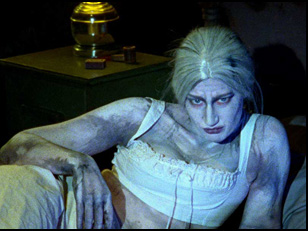
As an actor, my performance comes from makeup, hair, and costume. It’s just the way I work — it shows me what the character is. So I just wanted to ramp that up to a 12 out of 10 and extend it to all these guys. And I tried to be really collaborative with the costume designer, the hair artists, and the makeup artists for all of their ideas and [said], “Guys, we get to go crazy. Let’s really go there for Ben’s dead swimmer character. Let’s paint him blue. He’s dead. Let’s go blue blue, not subtle blue but cartoon blue.” It was a really fun and liberating part of it that comes from this impulse of just knowing how much it can help the performance.
Ben Petrie: Yeah, it really can’t be overstated how much the performances were fed by the artistry of the makeup and costume team. Also when you’re behind such a thick layer of makeup. It’s a lot easier to be a fool.
 Was there anything that you may not have thought of going in that you could get really excited by once it started to develop?
Grace Glowicki: Yeah, there’s so much in the rehearsal process that was changing and then even in shooting, one of the characters that we really could never put our finger on were the sailors. Everything was more or less discovered in rehearsal, but then these sailors, we like left it to the morning of [shooting] and we still didn’t know who these characters were. We’ve got to shoot them in an hour and the actors put on their costumes and makeup, and then I said, “Okay, you guys just have to pick characters. Like what are they?”
And Leah [Doz] just did this patois accent. Half of her family is Jamaican, so she started talking about her grandpa Reggie, doing his voice and Ben started doing this alcoholic incoherent thing and Lowen started to be Mickey Mouse. So on the day there was this spontaneous stuff that would happen that was the same in rehearsal where it was the way that the actors and myself engage with the material and I try to encourage us to follow our impulses together, keep our brains open. If you had an idea, I wanted to hear it because that was a part of the fabric of the thing. I really tried to just create an environment where brains would be firing and all the brains were so brilliant, I wanted to poke them. I wanted to hear their ideas because I needed them to make the movie good, so that ethos went through to shooting because we had the liberty of time, but it still it happened on the day.
Ben Petrie: Another thing I remember being a surprise when we started shooting was how sexual the material actually felt. It might’ve been the first day we shot a scene where the Gravedigger and the Lover character have a sex scene and on paper, we’re writing it and we’re laughing and and it is funny. But then when we actually got into it, we’re trying to commit to the performance and Rhayne [Vermette] has this incredibly red sensual lighting, it started to take on a surprising quality. Gravedigger’s character in our minds had been this lcharacter who everyone is revolted by and is very funny, but suddenly it became clear, ‘Yo, this girl’s got a libido as well. This girl is very horny and loves sex.” And that was a a surprise.
Grace Glowicki: Somehow we were surprised, even though it was in the material.
Ben Petrie: And even still afterwards, after showing the film and seeing reviews about it, we’re still surprised by how sexual the movie actually is.
The postcard scene is pretty erotic and it’s just words sending the Gravedigger and the Lover into a tizzy. What was that like to cut those letters back and forth with such passionate energy?
Grace Glowicki: Ben wrote those postcards and they always get such big laughs in every screening. But Ben’s just really good at writing and the heart of that sequence comes from Ben’s writing of those postcards that just slap every time it plays. Then Lev, the editor, has a really strong sense of pace and story. He’s really rigorous and really wants to keep things moving, keep things tight, and keep things making sense, which was actually a really beautiful pairing for footage like this and a brain like mine that’s a little more fluid and free. We’re very different, but he was a key part of making the movie have the energy, the pace, and the clarity that it needed in order to be accessible and watchable because it is so wacky.
What was it like to put music on this?
Grace Glowicki: Yeah, Meg [Remy, of U.S. Girls] is amazing. First we had to figure out what different parts we had that we could put music on. We ended up deciding we were going to use public domain wax cylinders from pre-1920, and [with] character improvs, Meg did a couple different instruments and this one track that that she had, “You Got Everything.” So from these little piles of collaging, we’d say, “Okay, what if we put this piece here and that piece there? Oh, I can see a pattern emerging” because we did a public domain there and there and then we’re doing this [original] piece here and there. We basically would just stick shit onto the timeline and pass it back and forth between each other, creating this Frankenstein score that’s made up of these different kinds of things.
That seems really fitting for this. What’s it been like to see this get out into the world?
Grace Glowicki: It’s been crazy. It felt scary to let it out into the world because it’s been in our tender loving care for for many years and at first, it’s like “oh my God, is it ready? Is it done? What are people going to think? So it was a little scary at first, but then as we started to hear people’s reactions where they love it and it’s really resonating with a certain group of people, it’s very rewarding and affirmative because we had so much fun making it. It’s so nice to hear people have fun watching it because I would always think if you have fun making it, it’ll be fun to watch it and as simple as that sentiment is, it’s profound as well. I always believed in it and it’s so nice to have that affirmation. People are laughing, having fun, and so did we.
“Dead Lover” is now open at the IFC Center in New York and opens on March 28th in Los Angeles at the Laemmle Glendale.