
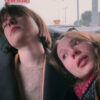




Every time Maisie (Jake Junkins) asks for something in “Gender Studies,” you wonder if it’s a little too much. She has set her sights on a classmate Rachel (Fannie Massarsky), who is currently embroiled in a fling with Aaron (Austin Cassel), the teacher’s assistant in their English lit class together, and what starts out as a modest request to borrow lip gloss starts to appear a little more sinister when Maisie steals Aaron away to talk about the end of the book they’re reading in class, Edith Wharton’s novel “Summer,” as he’s trying to make plans with Rachel for their off-hours.
Although it’s clear that Maisie has taken away some misguided ideas from her reading assignment as she tries to make conversation with Aaron, writer/director Jamie Kiernan O’Brien shrewdly inserts Maisie into a narrative that she wouldn’t expect to find herself in as a trans woman, thrust into what becomes a psychosexual thriller as she seduces Aaron for what will be one of her first sexual encounters since transitioning. Still, when luring the 28-year-old teacher’s assistant away from one unprofessional affair to another, the anxiety Maisie faces isn’t from the fear of getting caught or facing the wrath of her classmate, but living up to her own expectations of who she should be as a woman, with the skittish violins of Makenna Lyric’s intense score acting as much as a reflection of her overactive nerves as her aggressive conquest of Aaron. What might usually read as playful dirty talk becomes something else when Maisie is led to ask if she’s as much of a slut as Rachel, and O’Brien cleverly envisions sex as hardly a romantic pursuit when she really demands an answer for affirmation, not able yet to trust herself in her new body.
The film may run just 11 minutes, but it’s bound to have audiences thinking about it a lot longer with its sharp interrogation of the psychological process of adjustment that continues well after physically transitioning and in fact it’s already sparking conversations that have carried over from its premiere earlier this year at Sundance to SXSW where it recently was a standout of the shorts section. O’Brien graciously took the time away from a busy schedule in Austin to talk about how a background in classic English literature led to thinking about this most modern drama, finding a strong trio of actors to center it and how gratifying it’s been to reach all audiences with the film.
How did this come about?
I’m in grad school, so I had to make a a film as part of my second year project and I had a lot of ideas that were more like coming of age. I felt in some ways I was leaning into what I thought festivals and stuff really wanted [instead of] what I should be doing. Then I had this idea for this love triangle film, originally [with] the same lead character, but it was between two guys and [I rethought it with] this idea of envy and sex as a status symbol as opposed to [being] just about desire [which is what was] driving me. Through a lot of script rewrites, slowly but surely it became the film that it is right now. I put it all together eight weeks, and we made it all happen from there.
What I connected to deeply was being the type of person that gets caught up in whatever I’m reading at the time and impressing my own issues onto whatever the narrative is, no matter how far from my own life and experience it is. I understand you were a lit major, so was this kind of misguided immersion something that was sitting in your mind for a while?
Yeah, I had the idea she would be college age, so in between of being a teenager and an adult [when] sex is still this very unsorted out thing, and the only thing I knew from undergrad was English [literature] and I was going to these classes and talking about all of this stuff in the way that it of course would reflect my personal life, but also that’s a trope in movies sometimes. A lot of high school movies, they’re learning about a book that thematically corresponds to their life, so I wanted to lean into that trope a little bit as well and have her be a girl who takes the wrong lessons from the book they’re reading. I actually had read that novel “Summer,” specifically, a year before we made this film and I was really struck by how modern it felt despite I mean that book being from 1917. It’s about a 17-year old girl learning about sex and it reminded me very much of the kind of book they would have you read in a feminist literature class. So the combination of that and this girl who lives in her head a lot, [where] not only is she learning about femininity through watching other girls, but also through the media she’s consumed and the books she’s read, that’s all she knows and when she actually has sex, it’s a very different experience in real life than it is in all of that media.
What was it like to find Jake Jenkins to play your lead?
I got so lucky. I was terrified of casting that role because it’s pretty specific. I was looking for a trans girl who could play a 21-year-old college student. I had a vision for what this character would be and on my budget, I didn’t even have a casting director, so I didn’t know if I had the capabilities to find what I need, but I texted my friend and just said, “Do you know anyone? And she actually texted me, “Just cast Jake.” And I said, “Okay, who is that?” And she responded, “Just cast Jake.” Three days later, she came in for one audition and I was like, “Oh… obviously.” She was such perfection to work with and I loved our collaboration
The other two roles were actually harder to find because for Rachel, I wanted someone who looks like [that character does now], so I needed to wait until I had the lead and then could cast around and it took me a second to figure out and I was figuring out the nuances of who those characters were through casting, so I was seeing a lot of different kinds of people. I was veering all around with many different kinds of people. I ended up finding Austin [Cassel] for that role and and Fannie [Massarsky] for the role of Rachel. I got lucky with not only how talented they are, but just like how genuinely wonderful they all are to work with. I never had a single issue and that was like by far the most joyous part of the experience was directing the actors.
Did seeing the actors engage with one another change ideas about what this was or after casting change the idea of the characters?
What it really comes down to is that a lot of these characters could have different kinds of people with different backgrounds who make the same decisions, but [for instance] the TA who’s sleeping with the undergrad girls — that could be many different kinds of guy who might do something like that, so [it was thinking about] the little nuances and auditioning all these people who have very different vibes and and backgrounds.
I was able to be really rigorous in the casting so that on set I had full trust in all of them, [knowing] exactly what they bring to the table naturally as well as their talent. Working with them on set was more about playing with different ideas as opposed to feeling like I was trying to get them somewhere that they weren’t at yet. I felt because I trusted all their instincts, I could just throw things at them and we could play around. Every take, I could say “I don’t know if this is going to make any sense, but let’s try something else just to see if a little look would be different” and it was such a playground because I didn’t have to worry about whether or not they were going to give me what I needed. They always did that on the first take and I was like, “Okay, let’s just play then.” It was so magical for that reason.
How did you find the right visual style for it?
I worked with one of my best friends, Sophie [Seyd], who shot the film and I already worked with her on a school project where she was shooting and I was the first [assistant camera] and she just had such a specificity and so particular about the visuals in a way that I knew I needed so I could fully trust that was being handled on set and I could focus on things like working with the actors. Then when we started working together, we were talking a lot about different references and for me, it always just comes back to faces. I’m just so enamored with the human face and wanting to focus on that as intensely as possible, especially for a film like this that’s so internal.
I feel it’s a challenge to make a film that is so much about the characters’ mindset and interiority, but a big thing we were thinking about is making her feel a bit trapped in her own skin while also wanting to show that the world really is outside of her mind doesn’t necessarily matter that much because the film in some ways takes place in her head. It’s so rooted in her perspective and the ways in which she sees these dynamics. Originally, we were going to shoot in a slightly wider aspect ratio because I didn’t want to fully commit to 4:3 [academy ratio], but then we [thought], why wouldn’t we just fully do it? So we ended up shooting in 4:3 and again I got so lucky that I had someone like Jake who I never had to worry for even a second that she wouldn’t be able to fully handle the frame being that intense. I just wanted it to feel claustrophobic, so we’re never really allowed to leave the small field of view she has about the world. That’s also why there’s no exteriors. They’re always in these smaller spaces and doors, so it was about that tight interiority.
The score really amplifies that feeling. What was it like to put music on it?
The score for me really plays into the idea I was always interested in, thinking what sort of movie does she think she’s in right now and how her idea of sex and putting herself out there for male validation all comes from not only what she’s assuming based on Rachel’s life, but also the movies she’s seen and the books she’s reading. So from the beginning, I knew I wanted a pretty heavy-handed score to really put you in the mindset that it’s an erotic film that she thinks she’s stepping into and then I wanted to suck all of that out once the sex is actually happening because she enters the “real world,” and it’s not like that. There’s no score playing when you’re actually living life and [the musical accompaniment] really showcased the division between when we are locked in her head and the way she fantasizes about her own life versus when she’s actually in the real thing and has to confront the truth and the truth doesn’t have that score behind it.
What’s it like to start showing it to the world?
It’s so funny because I have been sitting with it and and working on it for a pretty long time — the original nugget of the idea was July 2024, so for a short that’s only 11 minutes long, that’s such a long time to have spent with it. And I have to constantly remind myself that it’s new to everyone else. That’s a dissonance that I find interesting and it’s been really cool. I genuinely didn’t make this thinking about festivals. I really wanted to just experiment with what I hope my voice to be and the things that interest me, both in terms of content and form. So it’s been really surreal to lean into all of my instincts and have it be rewarded in that way and validated in these spaces that I’ve always dreamed of being in. It’s really surreal and really powerful. I’m also very grateful that people are connecting with it beyond the trans experience because that’s always been a goal of mine — to have films that don’t shy away from that experience because I never would want to cover that part of my identity up, but I also do hope it can transcend just that identity group because what makes all really powerful storytelling is using the specific to get at the universal. That desire has been validated by this experience, so it’s been really magical.
“Gender Studies” does not yet have U.S. distribution.