



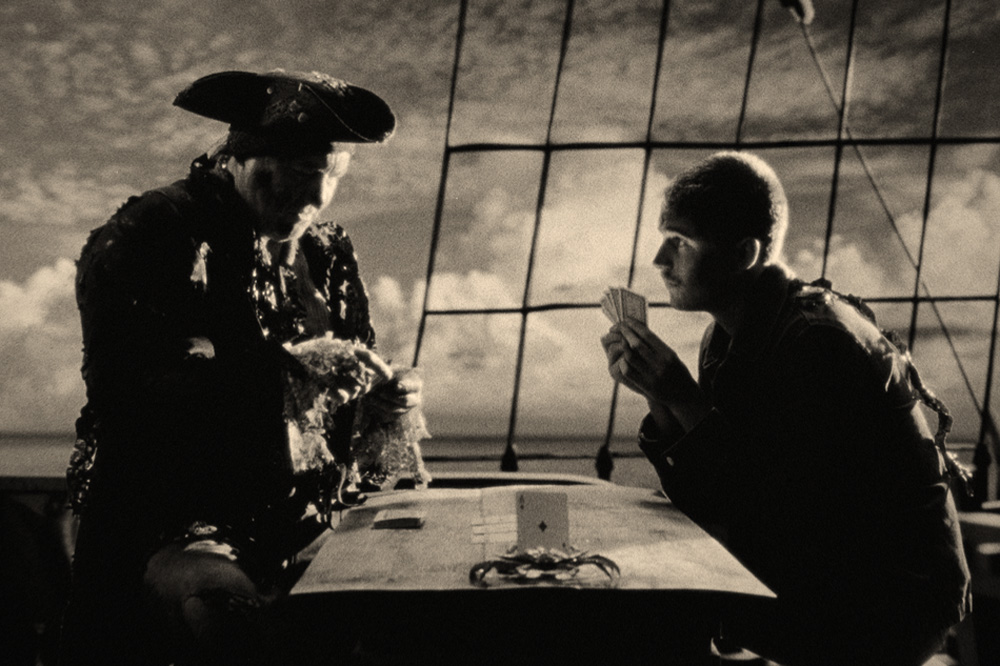

There’s a lot more information in the opening credits for “The Peril at Pincer Point” than usually is the case, promising a cinematic adventure merely from listing the names for the film you’re about to see. The main cast all get top billing, but is quickly overshadowed by a collection of supporting actors listed collectively as “The Crustacious Choir” and associate producer Daniel Sved gets the additional detail of being a crab wrangler. Most notably, the four sound recordists on the film aren’t relegated to fine print, but receive the same bold type treatment as the film’s star Jack Redmayne when in fact they all have the same role in the plucky comedy, imagining a below-the line crew member named Jim Baitte who is sent out to a mysterious island to collect aquatic murmurings for a the much anticipated new film from rising auteur P.W. Griffin (Os Leanse).
The fictional film in question doesn’t appear to be shaping up as a masterpiece, but it sure seems like co-directors Jake Kuhn and Noah Stratton-Twine are onto something themselves as they follow Jim, with his maritime experience limited to having been on a few dinghies, dipping into treacherous waters in pursuit of a woman with Griffin insists has a voice of an angel on the island, though the put-upon production assistant discovers immediately that the mysterious siren is the subject of missing persons flyers posted all around and the salty strangers he meets around the fishing village aren’t inclined to help him. Still, all that recording equipment he has to lug around isn’t completely useless as he busies himself collecting all the strange, organic sounds that he is able to find right right in front of him, including some that are generally unnerving when it comes to suggest that there’s plenty going on beneath the surface of the sandy retreat.
“The Peril at Pincer Point” may not offer much escapism to him, but the boldly original comedy provides it in spades to everyone else with the filmmakers turning a low budget into ingenuity around every turn, filming in black-and-white in a style akin to William Castle, but interrogating the filmmaking process with such panache both on screen and off that it leads to new sensations. Naturally, the sound is a major part between the evocative atmosphere that Jim goes about recording, but also Stratton-Twine’s boisterous score that makes it feel as if the sound recordist’s work is the most important professional calling imaginable despite the fact that he is clearly the lowest person on the totem pole even within his own production. One gets the sense that no one feels that way on a That’s the Fish set – the scrappy production outfit Stratton-Twine and Kuhn formed – where they have begun to develop a regular company of players behind the scenes and in front of the camera and the films play bigger than they are because of everyone’s individual contribution.
As the filmmakers make a splash in Austin this week with the premiere of what is actually their second feature to hit the festival circuit in the past 12 months following the Manchester Film Fest Jury Prize winner “Two Big Feet” (and apparently another on the way soon), Kuhn and Stratton-Twine spoke about creating a framework to be as creative as possible, moving quickly after inspiration struck with “The Peril at Pincer Point” and turning the seaworthy endeavor into quite the catch.
How did this come about?
Jake Kuhn: Basically, Noah and I went and wrote in this small town on the east coast of England, and every single time we went to write there, we [thought], we should set a movie here. The town is very famous for crabbing and they’ve got one pint of beer on draft called Ghost Ship, so we [thought], we need to make something that’s about ghost ships and it’s about crabbing. We went there one weekend and the idea of it just wrote itself. We were making each other laugh more than anything and after we wrote it, about three weeks later we went back and we shot it. The majority of it was improvised. All of the actors are great friends of ours and incredibly talented and open to the process of doing of this script that was just absolutely insane.
Noah Stratton-Twines: What we shot was a very ragtag, improvised amalgamation of things that we found funny and then there was a very intense effort in the 16 months of post-production on it to develop some mythological tropical world [with the idea] that potentially this this could happen and really double down on the adventurism of the 1940s and ‘50s movies that we’re trying to emulate.
From what I understand about your process, it heavily relies on the backend as far as figuring out what it is, but ideas build as you move through the process, especially with something like the score, which is usually done at the end of the film, but you may have knowledge of at the beginning. What’s it like to think about those processes simultaneously?
Noah Stratton-Twines: For me personally, I was in music before I was in film or that I realized that music could contribute to movies, so I always think of music first over visuals, potentially to a fault. Which means that the majority of the themes were written for this movie before we even started shooting. I send that to actors and apparently it’s helpful to them. I can’t imagine how it would inform a performance, but it’s cementing that idea that these movies are by nature improvised and we’re trying to do everything in our best effort with all the post-production to make it feel like, sure it’s improvised, but we don’t want it to feel like the actors are leading the story onwards in a way that you can reinforce a structure, which I think is what most improvised movies lack.
We were trying to evoke these movies of the ‘40s and ‘50s where the soundtrack is always there, whether you notice it or not, and it guides you scene by scene, so we had some music recorded beforehand when we were trying to formulate these improvised scenes shot/reverse shots to make it feel like these could be an old-fashioned back-and-forth exchange between people and then doubling down, we’d have a soundtrack reinforcing that these decisions must have been premeditated. Then a lot of the soundtrack is improvised, just like the dialogue is. It’s just piano spatterings that we would refine over months and months. It’s the same with the performances and the lines of dialogue.
Jake Kuhn: We really like saying that the improvisation didn’t stop after the shooting was done. The improvisation continued into the post. We were constantly finding ways to make it funnier in the sound design and the music and to push it a little bit further.
Was these anything you really didn’t predict in the beginning that you could lean into in any regard?
Jake Kuhn: One of the things that was funny is the way the casting happened because a lot of it was from our friends and then we shuffled roles all the time, so it’d be like, oh, we had this person for this [role] and then we put them in a different role. For example, the character of P. W. Griffin, the director in the movie who is this maniacal dictator of a filmmaker who we hope that every single filmmaker can relate with in some way, just having been or been on the other end of it, that actor [Os Leanse] coming into that role just completely transformed that — something about his delivery and the choice of words that he goes for just completely elevates it from what we have written down in our in our treatment. Like the [scene where the] main character Jim walks into a bar and asks, if someone will record some sounds for him, that was turned into a scene by people just being there and being open. That’s the beauty sometimes with improv is getting someone super talented and just letting them go.
Noah Stratton-Twines: Yeah, with just a rough treatment, you don’t know how it’s going to go. There’s another character Teddie Drunch, with our friend Dash [John Blanchett Upton], who is essentially is the doting, whispering in the ear sort [for the director P.W. Griffith], pushing things towards [certain ends] like Grima Wormtongue in “Lord of the Rings” and that character didn’t exist prior to twelve hours before we shot the movie. Even as we were assembling it, we had no idea how it was going to feel as a whole thing, particularly when we were shooting it. We were aspiring for a certain aesthetic. We certainly didn’t expect it to be as broad of a comedy as it ended up being.
Jake Kuhn: We also shot it in two [separate] blocks. We shot all the stuff on the island first, then all the stuff in London second and because the stuff in London comes before the stuff on the island [in the story], it basically meant that we could thread through things that we found funny from the footage, things where if me and Noah are laughing every time we hear someone say something, we’d [say], “Let’s thread that more throughout the movie” and suddenly it feels like it was something very intentional and it was there from the beginning, but really it’s just picking up where the actors left off, which is really fun.
It seems like you really did a deep dive into movies of the ‘40s and ‘50s, not just looking at them, but really investigating the techniques in which they were made with the use of lighting and transitions. Were you spending a lot of time going back?
Jake Kuhn: I can’t speak for Murray Cohen, an incredibly talented cinematographer who I have to say was literally the only person on the camera team for all of the island stuff. We had a few great gaffers come in on the London [shoot]. But he basically did everything with one lantern, and I cannot say whether he went back and watched [films], but we did the homework. A lot of it was very instinctual, but Noah and I went away for a weekend and just marathoned Roger Corman movies like “Attack of the Crab Monsters” and “Creature from the Haunted Sea” and there’s so many that we watched in that time that they all feel like a blur, but that was in our minds. It wasn’t so formal a process to [say] “We’re going to do it exactly this way, but what felt natural to us when we were shooting it.
This was my introduction to your work, but it was amazing to learn how prolific your production company That’s the Fish has been in the past year. Have you created a sustainable way of working?
Noah Stratton-Twines: Yeah, we’ve done three [features] and we’re about to do our fourth. I think it’s the practice which has been employed in America and the West in general —anywhere outside of the UK where we’ve got a very hard-edge funding and production system where it just takes a lot of time to get anything done the “proper way,” emphasis on the quotations. We’re merely emulating the successes that we’ve seen going back all the way to the old masters and what they are willing to do. There’s no excuse why people like John Ford were able to do three movies a year and now when we’ve got all this camera equipment accessible to us, it’s like why aren’t we able to do, at the very minimum, one a year? Thankfully, we’re surrounded by a bunch of people who are happy collaborators and we understand that making a feature is in itself something that is this object where people take you far more seriously than if you have a short, and it’s this step up where a lot of people feel like the gate to entry is so beyond them when it’s realistically not. You just have to shoot for a little bit longer or reconfigure your brain into a way that you’re able to think in long form.
Jake Kuhn: When you ask if it’s sustainable, I wouldn’t say it is entirely in the same way that you would have on a usual movie because it’s not like me and Noah are making any money off of doing this [currently]. But we have found a sustainable way of making movies that are ambitious and big, where we don’t have to spend hundreds of thousands or millions of pounds to get it on the screen. On “Pincer Point,” our main crew was incredibly tiny and that helped us be very light on our feet and move around a lot, and that is something we found is replicable. And the more money you bring into it, the more you can actually put on screen as opposed to what usually happens where you have like a £500 or 600,000 movie where it doesn’t look any more expensive than most shorts because they have to pay for all these support systems.
Noah Stratton-Twines: What we’re putting in is just trying to subvert what people expect from budgets that are so incredibly small. Our entire post team is three people and two of those are sound mixers. We just want to push people when they hear, “Oh, you’ve made a movie for this amount of money” that I recognize what those kind of movies feel like and in a way, “Pincer Point” was like a manifesto of what we can do ourselves to the a the absolute largest. That’s why hopefully our movie feels like it has a lot of scope.
It sure does. What’s it like getting the film to South By Southwest?
Noah Stratton-Twines: It’s bizarre. When we were writing it, three weeks before we started shooting it, and we had the concept, like the very rough punchline to the whole movie, we [thought], wouldn’t this be funny at South by Southwest? It’s one of those things where we always worked towards and we submitted it the final day of the deadline because we were working to get a version of the movie that was just applicable enough. We finally got through that and it was about four months of [thinking], “Oh wait, hang on a minute. It feels like they might be considering us.” We still didn’t quite believe it until we found out. So it’s complete amazement and bewilderment, and we’re extraordinarily grateful, especially to be one of the only Truly British films representing our film industry, done at such an independent level at such an incredible festival.
Jake Kuhn: Yeah, South by Southwest really feels like it encapsulates a lot of what we hold very dear in the moviemaking, which is very audience first. It feels like a very cine-literate festival where everybody there are fans of cinema but really wants to have a good time and we we really, really empathize with that. We’ve always wanted to go to just see the movies, so to get to be able to participate is honestly beyond a dream come true for us. We’ve been non-stop somersaulting since we found out, and I don’t think it’s going to stop any time this year.
“The Peril at Pincer Point” will screen at SXSW on March 18th at Alamo Lamar 7 at 10 pm.