



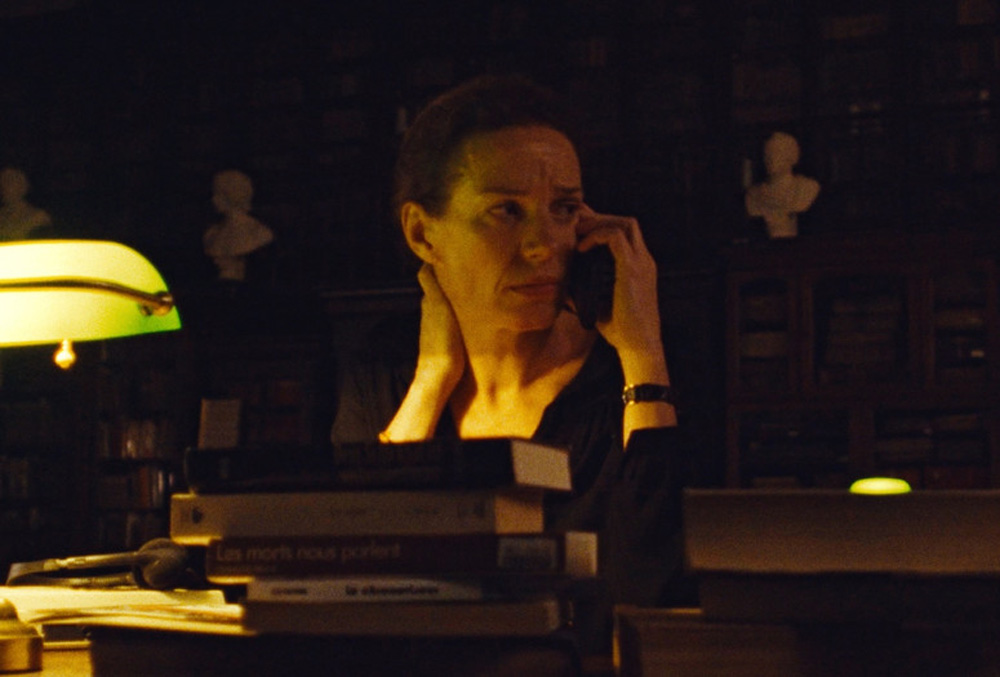

You hope Béatrice Courte (Anne Laure Sellier) finds what she’s looking for in “Chronovisor” before you even know what that is. The professor at Columbia (played by someone with that same pedigree) spends her evenings at the New York Public Library where she can be expected to be among the last to leave, having no more company than the glow of a banker’s light as the place goes dark yet hardly feeling alone when there are so many books to keep her occupied. A dinner with colleagues suggests a dialogue with the past is more engaging when an explanation of her relatively arcane studies leads even fellow academics to reach for the check, and as she thumbs through pages in one of the most ingenious films to come around in recent memory, the words come alive – in almost a literal way due to the technical playfulness of co-directors Jack Auen and Kevin Walker, but also in a deeper sense as they hold mysteries that you start to share Béatrice’s determination to uncover.
As it turns out, Béatrice is more or less chasing the same thing as the person she’s investigating, Pellegrino Ernetti, a Renaissance man whose broad interests in religion and music led him in the 1950s to invent the Chronovisor, a device that could take pictures of the past in the present using sound waves made visible by an oscilloscope. Any thoughts of this being a crazy pursuit is disabused by how absorbing it is when Auen and Walker are able to vividly summon history themselves as Béatrice pores over everything from Italian magazines to German medical journals to learn of the development and controversy that surrounded the device, her own efforts made all the more difficult by those wanting to erase any memory of the device from the record when Ernetti flirted with blasphemy, purportedly retrieving images from 36 AD to capture Christ on the cross. Any hint of what really happened in a stray remark or a telling detail from a report at the time that hadn’t been subject to an edit on the internet when it exists only on the printed page is bound to send Béatrice into a tizzy and the exhilaration is compounded for the viewer when any language barrier is erased by savvy subtitles, superimposed over any indecipherable text in such a way that it adds to the air of discovery.
Not only does Ernetti become a fascinating figure in spite of the fact that his visage is limited to the stray portrait accompanying a handful of the magazine clippings, but so to is Béatrice, who you only see slightly more when her head is often buried in books. The brilliant deployment of Gustav Holst orchestral swells to accompany her search, tracking both the highs and lows in soul-stirring fashion, can make even a shot of her back convey a world of excitement going on inside. (Cinematographer Leo Zhang’s sparse, evocative lighting and use of Super 16mm also conjures considerable frisson.) But Auen and Walker make her a captivating character in other ways, full of as many small surprises as her own excavation holds for her when a quest that takes her through international archives with gatekeepers who hardly share her interest in putting more about Ernetti out into the public sphere requires fluency in a variety of languages and a chameleonic appeal to what any situation calls for in other ways as the description of her area of studies at Columbia will change depending on who she’s talking to.
From its burned-in title cards over a journey through the streets of a nocturnal New York, “Chronovisor” can immediately present as a lost artifact as well from the 1970s and while it can take the shape of a paranoid thriller from the era when Béatrice’s hunt could look isolating, it is far more wily, too mischievous and mysterious to adhere to any prescribed form and much like its lead cloaked in history but feeling as if it’s onto something new. When the past can feel like quicksand in the Internet age, the film feels gripping in any number of ways as Béatrice can be overcome by the delight of epiphanies to be found in recordings that fell out of circulation long ago, bearing some wisdom perhaps but also a sense of adventure that seems sorely missing from a time when instant answers can feel lacking in substance. There may be a hazy conclusion awaiting Béatrice for her specific inquiry when there’s only so much that can be uncovered, but the rewards are clear when Auen and Walker find there is much to mine in our own collective curiosity about the generations that have come before as the actual history that survives.
“Chronovisor” opens on September 4th in New York at Film at Lincoln Center. A full list of theaters and dates in the month ahead can be found here.