



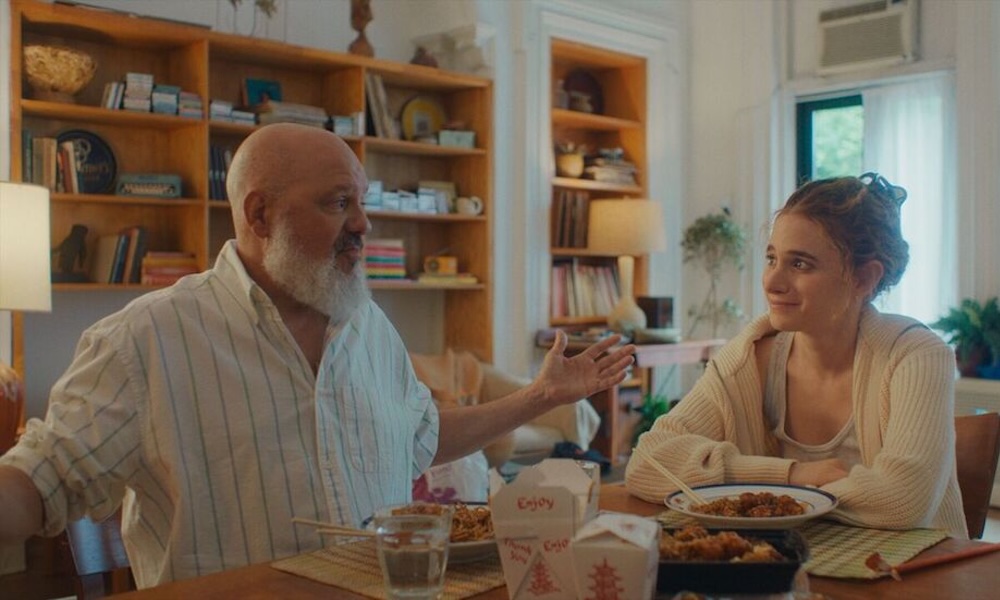

As quickly as it seems like everything is falling into place for the titular character (Ellie Sachs) in “Lucy Schulman,” all of it is actually falling apart as she puts together a party for friends with the skills she’s picked up as an assistant at a tastemaker bookstore, largely organizing events while she hopes her actual talent for editing might become conversation fodder with someone from the publishing world who drops by and moments before she plans to step out with her fiancee (Hasan Minaj), she learns of a series of texts on his phone as he’s getting ready that suggest this isn’t the man she’ll be spending the rest of her life with. (Naturally, her first instincts are to correct the grammar in some of the adulterous exchanges.) A subsequent move to her father Peter’s (David Cross) place where she’s always found comfort is just fine at first, but as both seek out new partners, some space might be nice and while she felt all alone, her friends can’t help but notice that she’s abandoned poker night, depriving them of her company and herself of anyone to really talk to.
The last time Sachs was at Tribeca where her endearing debut feature will premiere this week, it was with the 2023 short “Proof of Concept” (co-directed with Max Cohn) where the filmmaker showed a delicious sense of irony as a thinly veiled on-screen alter ego attempted to convince her father (Richard Kind) and uncle (Will Janowitz), a pair of commercial plumbers, to invest their hard-earned money in her vision where all the uncertainty they may have had could be cleared up by what was actually being expressed on screen in recounting this pitch. There’s more than a bit of that kind of humor in “Lucy Schulman” where as much as its heroine’s life is a mess, Sachs shows she’s already a complete package as a filmmaker, wryly observing Lucy suffer through a series of bad dates and increasingly fraught relationships with family and friends until she meets James (Thomas Mann) and his dog Doctor, allowing herself to start imagining a fairytale ending for herself that any literary editor might want to rewrite, thinking it’s too good to be true. However, the writer/director shows her own wisdom when a different kind of anxiety sets in for Lucy, realizing that she may have to get more comfortable with the idea that to succeed in either her personal or professional life, she has to take the time to get a better idea of who she is first.
From every apartment and New York City landmark that “Lucy Schulman” unfolds in with a casual authenticity to filling out even the smallest roles with the biggest of personalities, there’s an ease about the comedy that makes it a joy to sink into even before sparks starts to fly between her and Peter when the love is so strong that there is nothing off-limits between the father and his daughter and Lucy and James start to develop a similar level of trust. It doesn’t seem incidental that Sachs has a number of other multi-hyphenates around for a film where the energy never flags, from Stephen Adly Guirgis to Joanna Arnow to Annabelle Attanasio, and while Lucy is shown trying to find her place in everything, the director firmly establishes herself. Ready to make a triumphant return to Tribeca this week with the premiere of “Lucy Schulman,” Sachs graciously took the time to talk about how she just wanted to give herself something to laugh about at a low point in her life with the film, finding the right working dynamic with her cast including a four-legged friend and making something that charms in feeling a bit old and new simultaneously.
How did this come about?
Yeah, I started writing the script for “Lucy” around June 2024, I was a bit down in the dumps and I had these vignettes and little snippets of scenes, just writing about this messy New York City girl. I initially did it as a way to console myself and make myself feel better and just someone to laugh at a little bit and feel better through. But about two months into writing about “Lucy,” I [thought], “Well, maybe there’s more of a story here. Maybe this could be a movie.” So I kept going and then I had a finished draft in January and then suddenly it was all starting to happen.
This may be quite a reach, but should I read anything into the fact that this is your first project where you’re credited as a solo writer? I found that quite moving when you tackle codependency in this and recognizing when it can be unhealthy.
I certainly I have a lot of fabulous people that I that I co-write and co-direct with. Max Cohn, who I did “Proof of Concept” with, we’re actually working on something new together now, so we’re still very much in the mix. But when I was writing this script for “Lucy,” it just very much felt like a story about a young woman and I really wanted to to do this one by myself.
It seems like there was no one better, and the film feels quite lived in, in part of what appeared to be some great production design. What was it like to create the right environments for this world?
I’m born and raised in New York and have a lot of friends and people who were willing to let us shoot in their places, and to your point about it feeling lived in and real, like that’s very much from our locations. We got lucky and Anna Murphy needs a big shout out. She’s our fearless, incredible production designer who did such an amazing job. and brought so many unique and wonderful ideas. One of my favorite sets that she did is Lucy’s childhood bedroom. That was a real labor of love and for something that’s only in the movie for 30 or 40 seconds. It’s very much a “show, don’t tell” moment where this room is just filled with Lucy’s dad’s stuff and relics of like Lucy’s childhood, like here’s a girl who certainly hasn’t grown up yet and is just comfortable going back to her childhood bedroom.
It’s really elegantly conveyed with cinematography that feels quite casually beautiful. What was it like working with Barton Cartwright, the cinematographer?
Yes. Oh, I’m a big Bart fan. I first became really, really familiar with his work when I saw “The Feeling That the Time for Doing Something Has Passed,” one of my absolute favorite films. I’m a huge Arnow head. I love Joanna. I think she’s one of the finest filmmakers we have today. And Bart’s just a legend. I could just tell this guy is going to get this done and he brought a lot of really wonderful ideas to the story. One of the things that we did — there’s a lot of zooms in the movie — seems simple, but it feels so major. I wasn’t sure about them at first and Bart really pushed for them and I think that he understood the tone a little bit better than I did in that regard. He was like, “Trust me, you’re really, really going to like these, so there are some great zoom moments. It’s not funny to make such a big meal of it, but they really bring out what needed to be brought out in the cinematography and speaks to the sweetness, the levity, the fun and the warmth.
The film feels very modern and at the same time, you’ve got a bit of that old school feel, like the titles are obviously a ’70s style font. Was that attractive in general to strike balance?
I love ’70s movies in a very, very big way, [especially] a New York ’70s movie, so inadvertently or not, it’s a big part of what’s inspired me. And when we were thinking about the titles for the film, Chris Rubino, who did our titles, sent over the one that we [ultimately] picked from the first design round and I [said], “Wow, you really got inside my head.” He made it a little bit ’70s and I [thought] this is perfect.
You really show off the city. There’s a great walk-and-talk at night during what’s Lucy’s first real date. What was that like to pull off, shooting in public like that?
Well, I get a little misty-eyed and a little kind of woo-woo when I talk about New York City, and I’ve said this before and I’ll say it hopefully a million more times, but I really feel like New York City has your back. I have this undying belief that New York really shows up for you, especially when you’re making a movie. Obviously sometimes things happen that are unfortunate and annoying, but something so great about New York is that most people who live here, if they see something being shot, they’re just kind of like “whatever.” And this is a crazy city where crazy things happen all the time, so when you’re a movie production, people are just blasé about the whole thing, which is really good when you’re making a movie. You don’t get a lot of people staring into the camera and doing weird stuff. They just accept it and we certainly got lucky in that regard. We also got lucky that there was rain that was forecast that night, but it ended up only very slightly drizzling and you can’t even tell. It was just a lot of fun. That was probably one of my favorite days of production.
That may have been it, but was there anything that happened that you may not have expected, but you really like about the film now?
The dog [named] Doctor in the movie, I don’t know how much of it is in the final thing, but the real life dog is named Carmella and she’s very strong. She definitely was walking me at a few points when we were filming and she was a fun scene partner. She brought a lot of energy to our scenes together, and that was unexpected.
You’ve also got two pretty impressive human scene partners in David Cross and Thomas Mann. Once you got the script in their hands, did anything change when you felt what the dynamic would be?
Well, David is an absolute comic genius and such a wonderful, generous performer. I’m really big into improv and he was really game to do that, so there were plenty of moments where he’s just goofing around on set and being silly. At the end of the pilates scene, he’s got this little run where he’s like, “Do I need to zip-tie out?” and doing all this weird stuff. That’s him just having a great time and he really brought a lot of fun flourishes to the character, which was great. And then Thomas, I had a hunch about him when I cast him in the part. I could tell when I first met with him, he was really calm and I really liked that. I liked that even keel energy and I was happy when we got to set and when I saw the dailies, what a confirmation of that it was because he really is a wonderful counterbalance to Lucy’s frenetic, crazy, stressed out energy. He’s really, really mellow, which is really, really nice. So they both just really brought themselves to the characters and were really generous collaborators and I’m I was so thrilled with their performances in the film.
You have a wealth of experience from shorts, but was a feature different as far as getting to the end of it and having all this control over the performances and the story?
Yeah, having made a lot of shorts, I [thought] “Oh I got this, no problem.” But making a movie is very much like running a marathon. It’s an endurance test. It can be a long process, so it’s really just about reorienting yourself and being like, what is this about? What is the story I’m trying to tell? What is the tone? And just being rock solid on all of that and just keeping one’s stamina up is really, really important.
You haven’t quite reached the finish line with this, but what’s it like being at this point, knowing this is going to Tribeca and getting ready to share it with audiences?
I’m very excited. I’m really just looking forward to to celebrating with everybody and excited to share “Lucy” with the world. It’s a really big moment.
“Lucy Schulman” will screen at Tribeca at the Village East on June 5th at 5:30 pm, June 6th at 12:15 pm, June 8th at 9:15 pm and June 11th at 5 pm.