



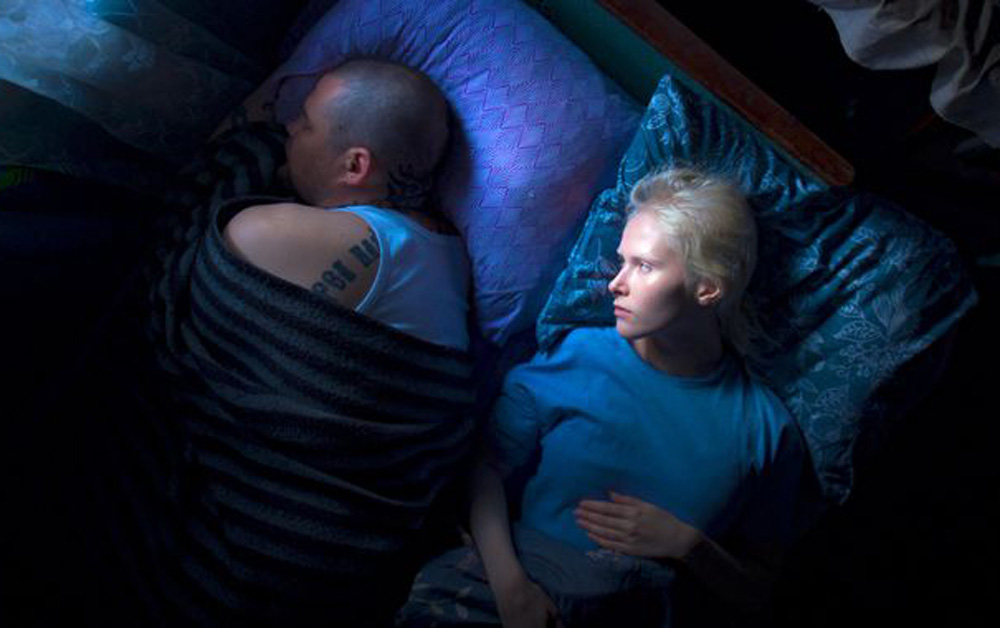

It would be as difficult for Masha (Marya Imbro) to explain why exactly she’s attracted to Misha (Mikhail Senkov) in “White Snail” as she is as it is to explain the magnetic pull of Elsa Kremser and Levin Peter’s strangely compelling drama. The film promises a rare glimpse inside Belarus, a country that rarely receives much attention on screen nowadays when tucked in between the warring Russia and Ukraine, but it is the exposure to different worlds that Masha and Misha provide entry to simply by going about their lives that proves intriguing when the latter works at a morgue and the former is an aspiring model whose albino complexion makes her appealing abroad.
Kremser and Peter will often follow Masha and Misha with the camera from behind through genuinely fascinating milieus that can’t help but come across as stale to them when it’s something they’ve felt they’ve had to settle for. At least Misha is well aware of the intrigue that his own line of work holds when he takes inspiration from the cadavers he works on for what he really wants to spend his time doing – painting – while Masha goes about attending a modeling academy by day and putting herself on tape for prospective employers. Not quite ready to join the professional world just yet, she is discontent from the moment we meet her, introduced at first as an unhappy patient at a hospital eager to remove a breathing tube, but revealed to be more suffocated by her family that’s been torn apart as her father hopes to build a life for all of them in Poland, though Masha’s reluctance to send her or her mother’s documents to apply for a visa, it’s clear she’s more interested in starting a life on her own than attempting to restart one with her parents.
While Masha doesn’t enjoy her stay at the hospital, it does arouse her curiosity about what goes on across the way at the morgue and she goes to visit under false pretenses of seeking of identifying a corpse and ends up locating a kindred spirit instead in Misha, who would seem to share a feeling that he isn’t where he should really be either. Although a romantic connection inevitably seems like a looming possibility, Kremser and Peter go after something slightly more unusual as Masha and Misha overcome a slight age difference to keep up an ongoing conversation, not always in sync, but more so than anyone else in their immediate surroundings, and although the filmmakers don’t overemphasize the point, the comfort between strangers could be nudged in part by the historical underpinnings of the moment when radio reports of military checkpoints may not make them flinch too much, but would seem to put parameters on their future as much as limits on their physical movement.
There are unexpected reactions throughout to living in such a state – a lack of reasonable options becomes the only way to comprehend the unusual remedies that Masha’s rarely seen mother Olga (Olga Reptukh) forces upon her daughter to treat her mysterious medical issues, such as the snails alluded to in the title that are deployed to sit on her face – and Kremser and Peter start to show how concern for another can relieve some of the anxiety of having to look out for yourself all the time. When it’s a difficult idea to wrap your head around in non-mawkish terms, both the characters and the film itself expresses it in peculiar and potentially alienating ways when cause and effect can be left a little vague when influence is naturally abstract, but Imbro and Senkov are engaging throughout and Mikhail Khursevich’s freewheeling camerawork, always a step ahead or a step behind the characters depending on what’s appropriate in the moment, keeps things lively. It actually does feel as if you’re able to walk in someone else’s shoes in “White Snail,” which not only allows a view from another set of eyes, but gives a different perspective on what empathy can look like.
“White Snail” will screen again at the Locarno Film Festival on August 10th at 9 pm at La Sala.