




Due to the vagaries of scheduling, Diego Cespedes had to save the exterior scenes for “The Mysterious Gaze of the Flamingo” for the very end of shooting, by which time it had turned especially chilly in the north towards the Andes where the filmmaker had found a long-abandoned mining town to film in at the height of winter. The area may have been bitter cold, but by then the cast and crew had become too close to notice, generating plenty of their own warmth.
“The inside of the cantina was shot close to the capital, but [for] the last part of the shooting, we went to the north, to the desert and at that moment, we didn’t feel that isolated,” Cespedes recalls. “We were all together and we went to the north with a lot of sun and a lot of emptiness, but in the last days of the shooting, it was like a family vacation.”
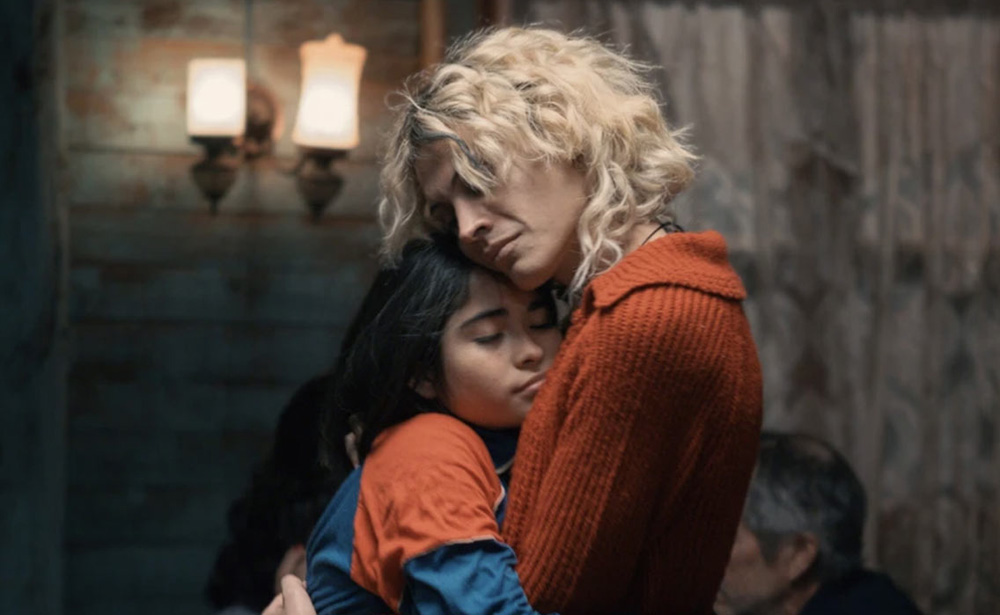
That feeling carries over to Cespedes’ bewitching debut feature undiluted, telling the story of a group of trans women that have taken refuge on the outskirts of Chilean society in 1982 as fear of AIDS spreads in the cities. In a place where only a few retired miners remain, Mama Boa (Paula Dinamarca) has built a cantina that can be called home, offering both beds to sleep in for all who come and enough entertainment in the evenings to have something to sleep off from wild nights of karaoke. Most of the women are in their thirties and forties, but there is one exception in Lidia (Tamara Cortés), an 11-year-old orphaned at birth and is fiercely watched over by the others, particularly Flamingo (Matías Catalán), who considers her a daughter. When the girl is mercilessly teased by a pack of local boys that roam around the area like wolves, they are chased away with far more fear than they could ever inspire in anyone else when the women ferociously circle them to attack, refusing to let anything interfere with this true oasis they’ve created for themselves in the desert.
However, when an aggrieved former lover of of Flamingo finds his way to the cantina, it is Lidia’s turn to take up arms and Cespedes has fashioned a lovely genre-bending tale where resistance and acceptance go hand in hand when the group of outsiders will go any length to protect one another and their strength comes from knowing what it’s like to be different, having great variety even within the house. The film rests on the very capable shoulders of Cortés, who has a stoicism well beyond her years and gradually can be seen forming her own perspective away from either the society she could feel abandoned by or the people that raised her so tenderly. When Cespedes underlines the bold ideas of the film with equally vivid colors and a persistent energy, she isn’t the only one walking away seeing things anew and the film picked up the top prize in the Un Certain Regard section at Cannes upon its premiere and has since been selected as Chile’s official entry to the Oscars. With the director in America this week to accompany the film for its Stateside release, hitting both coasts this week theatrically as well as being one of the initial titles made available to rent anywhere as part of the new Letterboxd Rental Store, he spoke about the film’s contemporary parallels, building such a terrific ensemble that really exudes compassion for one another and how he looks to the young for their wisdom.
 From what I understand, the story came from a number of different places. How did it start to take shape?
I always say that it’s like a painting and we have been working on them a lot of time, so I have a lot of different inspirations for this movie. One of them is that all my family comes from the suburbs in Santiago in Chile and during the AIDS pandemic, my family had a hair salon and [many of the hairdressers] were gay men and all of them died of AIDS. So it was a story that I always heard when I was growing up and I was really afraid of this mysterious disease. Even if my mother was close to all these men, she had a lot of prejudices that she transferred to me and an interest in telling this story comes a little bit from there. There was a lot of fear during that time, but the sad part is that we didn’t learn too much as a humanity from these horrible stories. Even today, we are keeping some prejudices and with this wave of hate that is coming back in the entire world, I wanted to tell this story again — and not mentioning AIDS [explicitly in the story], because I think that AIDS is not the problem. What is the problem is the ignorance that is behind the fear of society, that comes back every time and we are seeing in our times that it’s coming back in different shapes.
You find a great place to set the film as well. Did you have this location in mind?
Chile is a mining country, and even if a lot of people live in the capital, I heard a lot about the north and the desert as a child, so it’s very mythical for us. It shapes the Chilean culture in such a deep way and to set this story in an important part of Chile was very natural. During Pinochet, there was La Caravana de la Muerte where a lot of people were killed there and now it’s taking back drug cartels. There’s always things happening in the north — it’s a very particular space where the economy is growing, but at the same time the worst part of our society is growing, so it’s a very interesting place to set this story and [plant] these weird, beautiful flowers growing up in the desert.
 What was it like to get the right cast, particularly Tamara who gives such a great performance as Lidia?
The casting process was very long. We had different [kinds of actors] — non-professional, professional, children. I wrote all the characters thinking of the people that are close to me because they inspire me. For example, Lidia and Flamenco are [characters] inspired my own siblings and I wrote these characters thinking on how they [would act] in this fictional context. And Paula Dinamarca, who plays Mama Boa, is also a very close friend of mine and we created this character together in a way, so all of these little parts create this movie that I’m pretty sure is weird, but in a beautiful way because it has these characters that have a big, big soul.
Tamara was a character that I wrote thinking of my own sisters or cousins. It’s a very particular character because she’s like a child, but with an adult mind, very aware of what’s happening in the world, but at the same time with a very pure soul. I wrote her like that and different girls tried out [for the part]. We found Tamara in the middle of casting and she is from another city, not the capital, and it was very funny to see her acting because she was very natural. She wasn’t too [conscious of] the cameras. She wasn’t aware of it and she just took this like a game. That was exactly what we wanted. And the most important thing is that she didn’t have any prejudices with this community and that was a very important part for Lidia. We were very lucky because she’s very talented and she had never [acted] before, so we had to work a little bit with her. but she learned very fast how to play this game in the best way possible.
Casting was the most beautiful part of the film because in the production, it was like “Oh my God, this is such a big cast. We don’t know how it’s going to work.” But at the end of the day, when you work with these talented people that really want to do the film and really want to tell a story, it’s very easy. You [add] a lot of new things — some dialogue, some action, like the party scenes — it was very fun to shoot with them.
For lack of a better term, there are a number of fight scenes where the women swarm around someone to attack or defend themselves and you really feel both the passion and the violence at the same time. Were they interesting to choreograph to get such a unique feeling?
At the beginning, I thought that it would be more difficult because we had choreographies for the fight scenes, but during the shooting, it was actually very fun because we all wanted to learn. We had rules at the beginning and then we were just playing, so it was very cool to let [the cast] go with their emotions in the fight scenes — and with the emotional scenes too. It was a family reunion where we just play a game.
 The colors are very intense throughout in the costumes and the production design, which is a great contrast against the desert setting. Did the palette come to mind early on?
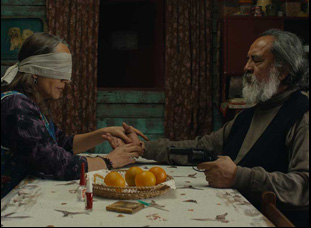
Yeah, I worked a lot with my production designer [Bernardita Baeza], who is the closest person that I have in the process of the film and we tried to give a sense of color to everything that we create and to make our own rules. We tried to create these weird, colorful flowers that grow up in the middle of the desert and every character had to have a detail [specific to them], like the red of Flamingo [to express] the blood, the passion, and Lydia, who [is adorned with] blue because it’s more calm. A lot of characters play with colors, [as well as other] details and textures, and that was work that we did with the art directors in [preproduction], but even when we were reading [the script together as cast and crew], we had some ideas, and it was just constructing things little by little.
What was it like to put music on this? It becomes a great element of moving between various tones.
I did a couple of shorts before this film, and I never had music, so the composition of the music was completely new for me. I really, really enjoyed it. It was like a third part of the writing process. Florencia [Di Concilio], the composer, was a very important part of this film. I met her when the movie was edited and we had some references, but [I told her] just to go with what the scenes gave us. It was very good because in the moment of composition, you connect ideas that you forgot in the middle of the shooting and you can bring back or you can create new things depending on what the feeling that the actors gave you. It was a very creative moment and the songs come from different places, but it was all from a moment of connection between me, her and the movie.
 Since you bring up your shorts, it’s interesting that all your films have been told from the perspective of children. Is it easy or difficult getting back into that place of curiosity?
That’s not something that I’ve thought. I think that when you tell the stories through the eyes of a kid, you find another kind of innocence. The eyes of a kid will always be more pure in how they are not so contaminated by the violence of the adult world, and this is very important because with these topics [that I’ve made films about], [where] a lot of people try to take away the rights that the community has and there’s a lot of hate speech, questioning if we should have those rights, when you see it through the eyes of a kid, you know the truth. You know that that hate doesn’t come from the human being. It just comes from the fear that the society gives you when you’re an adult, so to tell this story through the eyes of a kid is saying this hate is not an [inherent] part of the human being. It’s something that powerful people create to have more control, [using fear] to control of what we are. The children just make you come back to the pureness of the human soul.
That really seems to have resonated with this film. What has it been like to engage with audiences?
It has been really great. We’ve been showing the film around the entire world and now it’s the theatrical release in a lot of countries, including the U.S. Tthe connection with the audiences has been so warm and I really think the film brings out something good in people’s hearts. When you create a film, you are so lonely sometimes because we spend so many years doing this and when we are showing the film a lot, it really feels like a collective project and that people can connect with Mama Boa, with Flamingo, with Lidia and with the entire project, that really makes me proud.
“The Mysterious Gaze of the Flamingo” will screen on December 11th in Los Angeles at the Los Feliz 3, December 12th and 14th in New York at the Roxy Cinema, December 20th and 23rd in Edmonton at the Metro Cinema, January 2nd in Columbus, Ohio at the Gateway Film Center, January 8th in Bloomington, Indiana at the Cicada Cinema, January 15th in Portland, Maine at Space Gallery and February 5th through 8th in Seattle at the Northwest Film Forum. It is also available to rent via the Letterboxd rental store.