



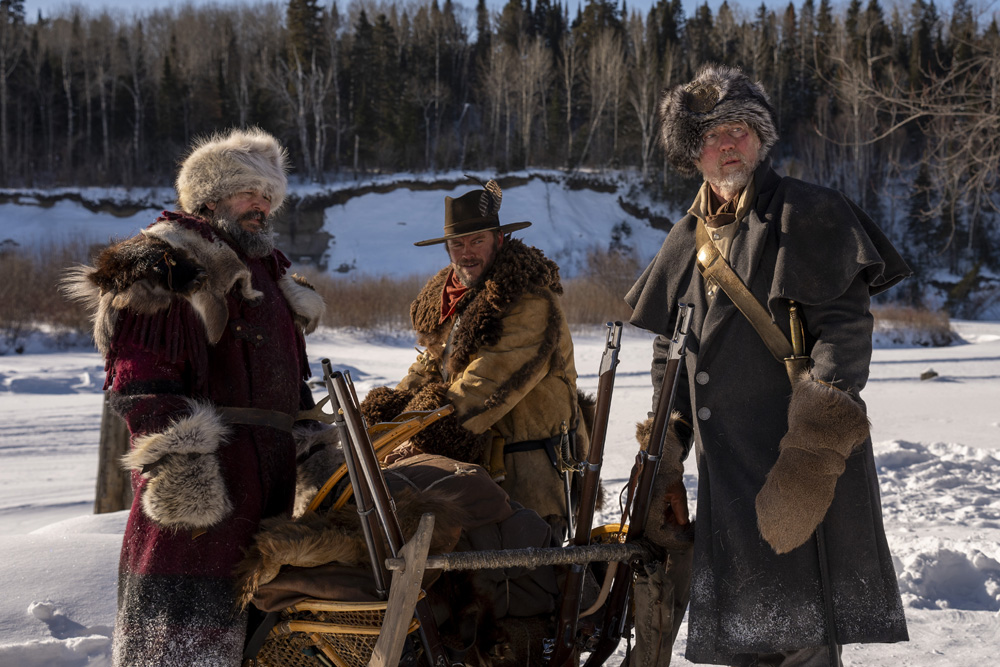

There isn’t any food that can be consumed in the northernmost reaches of Canada during the 19th century in “Ithaqua,” a fact of life that has brought the hunter Cole Franklin (Luke Hemsworth) out to suss out what he can by a group of British fur traders that haven’t had anything to hunt in months because of the bitter cold and their corn crops obviously didn’t fare any better. Cole doesn’t have much luck either, bringing back some tobacco for his mother-in-law (who complains it’s older than she is), but little else where the deer are just as eager to hide as the humans are. Yet when his employers grow impatient, a two-day trek is planned to go where surely the game is more plentiful, even if it means leaving loved ones already depleted in energy from the lack of sustenance to fend for themselves, and Cole, along with one of the Brits in Leftenant Walker (Kevin Durand) and another hired hand in the grizzled Quebecois guide Nicolette (Craig Lauzon), convenes a hunting party that takes them into parts unknown at the behest of Perkins (Michael Pitt), a masked man who is particularly eager to eat.
Their destination truly ends up being the wilderness in Casey Walker’s crazy third feature where the trio has as much to fear out in the arctic circle as they do should they return to their woefully desperate community that’s ready to eat just about anything, leaving little room for Cole and the others to be saviors when the hunger is insatiable. While food is hard to come by, Walker keeps an audience well-fed with a variety of potential threats to the hunters with evil spirits said to be out in the woods on top of the usual dangers that come with treading lightly on ice and the potential for the humans to become cannibals when there’s nothing lower on the food chain to feast on. As if that weren’t enough, Walker and co-writers Pascal Trottier and Peter Scott Vicaire set the action at a particularly precarious moment in history as tensions are exacerbated by the gradual power assumed by British colonizers over the indigenous community in Canada, a shift that proves at odds with the reality on the ground when it is the Native community that knows the land and by virtue of marrying in, Cole has a slight advantage over his counterparts as far as having an idea of what’s coming.
While it may be difficult to place “Ithaqua” (pronounced with a hard “T”) in any specific horror subgenre when it touches upon so many, it can be simply described as a good time when all hell breaks out and everyone just tries their best to survive the night in the most inhospitable conditions imaginable. It couldn’t have been that much more pleasant for the cast and crew making it when Walker clearly shot in real snow-covered locations and much of the film unfolds in the light of actual untamed fire, but it does yield plenty of fun when all that could go wrong for those on screen does yet all the mayhem is expertly executed by those off of it. With the film in the midst of taking the genre fest circuit by storm with premieres at Frightfest in England, Beyond Fest in Los Angeles and Sitges in Spain, Walker spoke about the perilous journey the survival tale actually took to get to the big screen in the first place, eventually upholding the mantle of the legendary Hammer Films label as its first production under new owner John Gore, and how enduring a brutal winter was all worth it in the end.
 From what I understand, this has been in the works for over a decade. How did you get started down this path?
Fourteen years ago I had done my first film and I was playing it for some friends and they [said], “Why don’t you come make a movie up here in northern Ontario?” And I [thought because of the winter], “That’s a stupid idea.” And then my friend said, “What about the fort? And the fort is a historic reenactment site in our hometown Fort William, a $50 million facility that closes in the winter.” Funny enough, I worked there during film school, so that idea started to percolate, and then a year later I had a script. I realized that script was like the kitchen sink of scripts where it was 102 million pages and there were so many more storylines. But I was put in touch with Peter [Scott Vicaire] and Pascal [Trottier], who became my writing partners on it, and we got to work. It’s not easy ever getting something like this in the marketplace — a practical, period horror creature feature — and it took a really long time for anyone to see it.
We had some false starts. We raised a bunch of money and got all our wardrobe and props and the rest of our sets built, then we had to shut everything down when Tthe second round of COVID started. I was actually a couple hours away from shutting it down for good. Then John Gore, the Broadway billionaire just recently bought Hammer, the prestigious British horror label and he said, “I want this to be the first one I do.” So it was a mad dash to get there — he gave me the green light on December 27th and we were filming by January 9th.
What attracted you to this particular moment in time to tell this story?
Winter was important for me because growing up in in that environment, the concept of anyone subsisting with very little resources in that time period was terrifying to me. But what was most important was that it was pre-industrial revolution. After the spice trade, the next colonialism push into North America was in the fur trade, and they were starting to see that die off, so that intersection of change that I found was very, very similar to the early 2000s where it was like hey, 200 years later, and shit hasn’t changed that much was where I wanted to exist.
 You’ve got a great character in Nicolette, the Quebecois tracker who is also native. What was he like to develop?
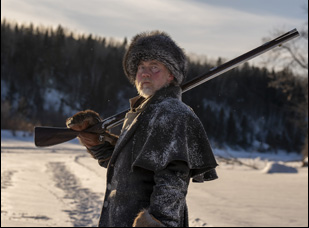
The character was [always] there, but he was not Métis yet. It was only after I’d worked with Craig [Lauzon]. Originally, [the character] was just a Frenchman from Quebec who happened to be the quintessential voyager of the time. But I knew I wanted to make him more of a soldier and have a little bit more of a past, looking for his fame and fortune at the wrong time in life. I’d been doing a television show with Prague and I [told Craig], “Hey, I think you’d be really good for this role” and he said, “Wouldn’t it be cool if this guy was half indigenous?” And I [said], “Okay, but that’s pretty brutal because you can’t go play a half-Indigenous guy” and he [said], “I am half indigenous.” And I never knew that. It’s not something that was at the forefront of his his work and his art, so we quickly worked together to talk about what it meant to him growing up that way and how we could insert that emotional arc for the character, but give him something to work off of.
It was a lovely transition. And a lot of the the actors early on, like Aaron Poole helped me with Henry, I wrote that for him. I wrote Lieutenant Walker for Kevin Durant because he and I went to high school together. The only ones that were really locked in tight [from the start], Luke [Hemsworth] really understood the character of Cole, so we didn’t have to change a lot. He was one of the first people to ever actually get that I wasn’t creating a hero, but someone that has heroic intentions, but is pretty much a shitty human being. And Michael [Pitt’s role] was one that just evolved with Michael doing what Michael does.
It seems like when you ask people to come on for a film like this, you really are asking them to go on an adventure as opposed to Just giving them a role. Were you looking for certain types of people as much as actors?
I’ll tell you this — Thunder Bay, where we shot that time of year, the warmest day was minus minus 38 degrees Celsius, and the coldest day was minus 52. Everybody thought they knew winter until they showed up and everyone was gung ho, but then when they showed up, the great thing was they didn’t let their fear come into it. We would complain about the cold, but everyone just knuckled down and went for it and were so supportive of each other. I know every filmmaker [says] we became a family, but we had to because we ran around outside in brutally life-threatening conditions all day and then we’re were ensconced at a hotel at night. We took over the entire hotel, so the lobby was our like rec room and we drank a stupid amount of alcohol in our downtime and went bowling because there was a bowling alley across the street. That was how we came together.
So people worked out their problems really early on, but they knew that for this to be the special thing it was, everyone needed to do it together. Luke, especially, was rallying everyone together because he went from 35 degrees Celsius to minus 32 degrees Celsius, so he did a 67 degree temperature shift and had the most to complain about [of] anybody, and he wasn’t that guy. That also meant that when someone else was acting on camera, he was behind the camera acting [against them] giving everything to them every time. That meant everyone started doing that together. So for everyone to sign up and go on this crazy journey with me, I couldn’t have done it without them everything is on screen for people to see.
 It looked like to really did embrace the elements as far as using available light. What was it like figuring out how to shoot this?
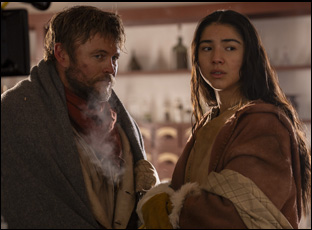
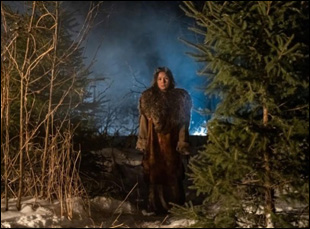
Yeah, anything that’s got fire in it is lit by fire. We had to make a bunch of triple and quadruple wick candles, just so the flames themselves would be larger. We did create one thing because you can’t have a fire in a fireplace burning all of the time to light a room. You can have it when you have the wide shots, but you have to be safety conscious and also there’s no control over fire. So we built this thing called “the abomination” and the abomination was like a trip to Lowe’s or Home Depot to buy a bunch of really cheap, crappy lights on a homemade little flicker dimmer that was just a twist of wires and gels. Then when we turned it on, it was just so random that it created the firelight. And we brought that in for close-ups. Because the last thing we want is a candle on the other side of the room lighting a room, but we needed to light someone’s face. We weren’t going to bring a flame right up to their face, so it was always a laugh, but you’d hear [the gaffers say] “Bring in the abomination!”
It really came off so beautifully. The production design, particularly the use of all the lumber and wood, was quite impressive – there was a thatch hut the men make during the hunting trip that looked particularly intricate. What was it like to put together?
I worked with two production designers that I’ve been friends with for a really long time. I did a lot of my pre-vis and design work before they even showed up, and it was very comprehensive, but then when they came, it was building off of a solid foundation to do even more with. Texture was really important to me with natural materials. There’s only one time we faked it, and it was [because of] economics and I’ll only tell later on in the the special features. But where the guys are on the first night of the odyssey, I picked that location the morning of because [I thought] “We’re going to be filming over here. I need to be able to walk to there in five minutes and be filming as soon as it’s dark.” Then the next thing I knew, I came back and [the hut] was built.
The [production designers] were like Boy Scouts half the time. They were having so much fun doing this stuff, running around like no one had a chance. We had used a chainsaw one day. The rest of the time everyone’s just got axes and machetes and they were doing it old school too, just getting in there and getting dirty and having so much fun. Usually when they’re like, “Hey boss, can we show you something?” I was [always excited to say] “Yes,” because I knew if they were excited to show me something, it meant it was going to be cool. They wouldn’t waste [time], knowing how busy I was being the writer, producer, and director with an ensemble cast. So it was great.
 Was there any day that was particularly crazy that you were excited to pull through?
Every day. There were only two days where it was people talking [in a scene]. Otherwise, every day with the elements, we would run fans and snow rigs when we needed and I wanted snow on the day and there wasn’t and some days it just snowed on its own. But there were practical effects and makeup effects, and we did stunts 18 days, [including] 14 days straight. It seems like a simple period movie, but every day was like 50 things. The fighting on a rooftop, we only had two hours to do that, and we had four hours to do a fireside fight with six people and five stuntmen and nudity in minus 47 degrees. So I’d go home every day and [think] I can’t believe we did that. I can’t believe we got away with it. I can’t believe we pulled it off. There’s no way we’re going to get away with it tomorrow. But everyone was into it and we managed to squeak by another day and manage. When you’re dealing with that kind of cold, it’s dangerous. Frostbite is right around the corner and some people wound up with nerve damage because they were so excited to be on set and working that they refused to address the fact that their body parts were shutting down and going inside and warming up.
I think the craziest part for me was on day four or five because John Gore said “Go” and we just had to go and it wasn’t until like day four or five of filming that I went, “Oh shit, I’m making a Hammer movie.” Because I was always making my movie and it still is my movie in the end, but the responsibility of working with a legacy brand like that and making sure that like you are being respectful for what came before, we’re not looking to redo the entire brand that came before us. It’s a new film and a new monster, but we needed to stay within the realm of what made Hammer successful, so as we progressed into the premiere in London, which is in Hammer’s backyard, it was terrifying. But now that I’ve come out the other side of this and people are like responding the way they are, it’s not anything I ever dreamed. I wanted to make my movie and I was so happy when that happened, but with the response From the Hammer fans and now as we expand out past the Hammer fans to an even wider audience, it’s humbling. It’s really humbling.
“Ithaqua” will screen at Beyond Fest in Los Angeles on September 27th at 7 pm at the Los Feliz 3 and will screen at Sitges on October 8th at 10:45 am at the Cinema Casino Prado and 5:45 pm at the Cinema Escorxador.