


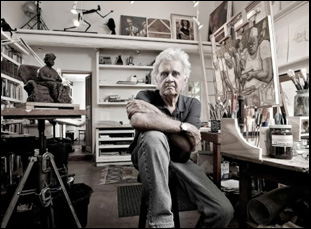
Pat Oliphant had a name people recognized in his native Australia before he could make one of his own, having been related to Mark Oliphant, one of the physicists that worked on the atomic bomb with Robert Oppenheimer. It was an association that Pat always shirked at, but as he found his calling as a political cartoonist, he would find a much less harmful way to go nuclear, first finding unused column space at the Adelaide paper The Advertiser to start satirizing the nation’s politicians and ultimately coming to America to work at the Denver Post where he began making finer points with his pen, becoming a legend in the field.
“A Savage Art: The Life and Cartoons of Pat Oliphant, Bill Banowsky’s vivacious profile of the satirist, now in his nineties, couldn’t come at a better time when the courage to say what others wouldn’t on the platform available to him seems to be in particularly short supply, especially as the profession that he became one of the all-time greats in is shrinking by the day with fewer newspapers in circulation and even less that have political cartoonists on staff. Diminishing eyesight would force Oliphant to retire in 2015, but he remains as feisty as ever and the cartoons live on as a parade of U.S. presidents may have all had their time in the barrel, with Oliphant cleverly finding an attribute unique to them to size up (or down) their job performance, but the sketches continue to reverberate in their sharpness, speaking to issues in world affairs and American society that still are unresolved.
With his signature character, a penguin called Punk, wandering through it all, the work becomes an alternative history of the 20th century that’s echoes linger well into the 21st and present-day practitioners of the form such as Ann Telnaes and Adam Zyglis are on hand to speak alongside Oliphant, drawing the eye to how it can be such an effective way to process the politics of the time and showing how vital a part it continues to be of a functioning democracy. Although it spans the entirety of Elephant’s career, the film marks an auspicious start of a new one for its director Banowsky, who had little previous experience behind the camera, but has been one of the great boosters of cinema in the U.S. as the one-time CEO of Landmark Theaters who went on to found Violet Crown Cinemas and cofound Magnolia Pictures, which will release “A Savage Art” in theaters this week. On the eve of this latest milestone in a remarkable career of his own, Banowsky spoke about honoring Oliphant’s, bringing all of his experience to ensure a good time at the movies with his feature debut and how “A Savage Art” only became more relevant as he continued to work on it over the years.
 How did this come about?
About 10 years ago, I met Pat when my wife and I moved from Austin to Santa Fe, and I had a movie theater at the time and I wanted to do a little five-minute portrait of interesting people in Santa Fe. He is certainly one of them, so I did an interview with him and we filmed it, and I realized almost immediately that there was a much bigger story here, so we just started digging in deep. This was in late 2018, and we made a whole lot of progress during 2019 with the intention of finishing the film in 2020. And then COVID hit when we were planning to come up to Charlottesville in the spring of 2020 to interview a lot of cartoonists who were going to be here for a convention. The world changed, and my project got derailed, and I was off to trying to save my cinema businesses at the time with COVID, and it just took a less urgent path, which ended up being a good thing for the film because I think this is a film that has become more meaningful in recent years as journalism and satire have become more under attack, and as Pat has stood out uniquely as a force against authoritarianism and all of the things that he highlighted for his 50 years. It took a number of different paths in terms of people that I collaborated with along the way.
There’s clearly some footage you shot with Pat of him drawing, but there’s some great archival material of him, drawing the presidents when he was younger. What was it like to dip into the archives?
We were very fortunate that University of Virginia started the Oliphant Archives right about this time when we were starting to make this film, so a lot of that archival footage they had collected. While we had to go elsewhere to license the footage, there was a database that had much of this footage in place, like the footage of him flying, and, you know, at the beginning of the film where he’s doing the stunt piloting, that’s from a WNET piece that they did on him many, many years ago, so we were able to lean on that. A lot of the footage of him drawing came from presidential libraries where he would talk about his drawings and draw in front of audiences, and we mimicked that a little bit with the large mural that he drew of Trump and Putin, which is one of his last drawings, actually. That’s the one where we show him in a gallery space drawing on a wall.
When you’ve got all of these cartoons, was it a challenge to find the right presentation for them?
Paul O’Bryan was my producing partner and he came on two years ago and really helped me structure it. He’s the one responsible for introducing the animation, the Punk character in between chapters, and really also bringing life to the cartoons. We show more than 300 Pat cartoons in this film, and some of them we allow the audience to linger with. That was a struggle Paul and I had always because we kept getting feedback from people who we’d show various versions of the film, [and they’d say] “I loved it, but I wish I could have a chance to really enjoy the cartoon.” So we tried to give a lot of time to many of the cartoons, and then we animated the cartoons with sound and with quick [camera] moves, zooming in to different corners of it and popping out, and then there’s the montages that allow you to see the breadth of the work, and then as well as many of the individual cartoons where you can actually enjoy the work itself.
We had a database with many, many, many thousands of cartoons of Pat Oliphant going back to 1960 through 2015, roughly, and what we found in going through that database is a lot of the issues that Pat was drawing about many years ago are the same issues that are happening today, whether it’s the issues that are happening in Gaza between Israel and the Palestinian state or there’s a great cartoon in our film about the Texas legislature, and it’s these two big cowboy sheriffs standing there and they’ve got a tree in the background with all these people hung by the tree, and they say, “Hey, if we keep hanging everyone with an IQ under 70, there’ll be no one left in the Texas legislature.” Well, that’s timely right now with what’s going on with the Texas legislature and that cartoon was done 20 years ago. What I really learned from going through this experience of looking at his work over the years is that the issues haven’t really changed.
 By championing all the films that you have as an exhibitor and distributor throughout the years, you clearly had an appreciation for all that went into making a film, but what was it like going through the process yourself as the director?
I didn’t know what I was getting into until I started trying to make this film and I’m glad to have done it. I’m proud of the way it turned out. But it was not something that came naturally to me. Having been in the business both on the exhibition side and the distribution side for as many years as I have, I did have an idea about what kind of documentary film could potentially find an audience, so that was a guiding part of my process — to make sure that it was watchable, to make sure that it was cinematic in the shots that we captured and to create a good soundtrack, which we were very pleased with what our composer Geneviève Gros-Louis created for this film.
Was there anything that happened that changed your ideas of what this could be as far as the story was concerned?
Paul O’Bryan really pushed me to go into the human side of Pat Oliphant, and that was a little bit of a challenge at first and the biggest surprise, seeing what happened about his first family and how when they moved to Washington, he left them. And to find that from talking to his daughter and his son, Grant, who is a really important narrator of the film, never went into any of that stuff, so it wasn’t until very much at the end of the process when I went out to Arizona to interview Susan Oliphant — at, by the way, a nudist RV camp where she was staying with her boyfriend at the time — when we started to learn some things that we hadn’t really baked into the film. That caused us to think hard about how to put that [information in about] his first wife and their origin story without doing disservice to the Pat Oliphant story of this legendary cartoonist that mattered so much over the last five decades. At the end of the day, we’re very sure that including the human element of Pat makes the film work much better than if it was just a piece about this guy and all his successes.
It’s also great that you’re able to highlight so many current cartoonists such as Ann Telnaes, particularly when so many are having to go it on their own as the newspapers they worked with are laying off people by the droves. What was it like to provide that showcase?
Yeah, we were seeing in real time the decline in print journalism and the consolidation of media where you have a situation like Ann Telnaes, who is a Pulitzer Prize-winning cartoonist who’s in our film. And when we interviewed her, which was the fall of 2019, she was with the Washington Post and it was only up until recently when she quit when the Post refused to publish a really great, powerful cartoon she drew making fun of Bezos and Zuckerberg sucking up to Trump. Fortunately, as a result of her quitting and showing the courage that she had to do that, that cartoon got seen, it went viral and it got seen much more widely than had the Washington Post simply published it.
 Not only is the film special on its own, but it seems particularly sweet that it’s being released by a distributor you co-founded and in theaters that you built. What’s all this like for you?
Well, it’s amazing. I was so thrilled when Magnolia agreed to take on this film. I only went to one film distributor when it was finished, and that was Eamonn [Bowles], who I started Magnolia with 25 years ago and while we created the company together, I abandoned the child early on and it was Eamonn’s to raise with the owners, Mark Cuban and Todd Wagner. And I knew because of my long friendship with Eamonn that he would take the 90 minutes on a weekend and sit uninterrupted and watch it, which he did. There was no way for me to know whether it would really resonate with him, but I knew this about Eamonn and anyone who’s known Eamonn for a long time will [know] Eamonn is going to say what Eamonn thinks and I would get a very honest reaction from him. And for him to love it, it just was incredibly gratifying. Then to be able to work with this big team at Magnolia that Eamonn has put together over the years and to feel like this is a film that really matters to them, it’s amazingly rewarding. For us to have the daily dialogue that we have now at this point in the process with the film before it’s released, to come up with different ideas about doing different things in different markets, it’s really wonderful. I know that I could not have gotten this experience or this level of care at any other film company.
“A Savage Art: The Life and Cartoons of Pat Oliphant” opens on September 5th in theaters across the country. A full list is here.