



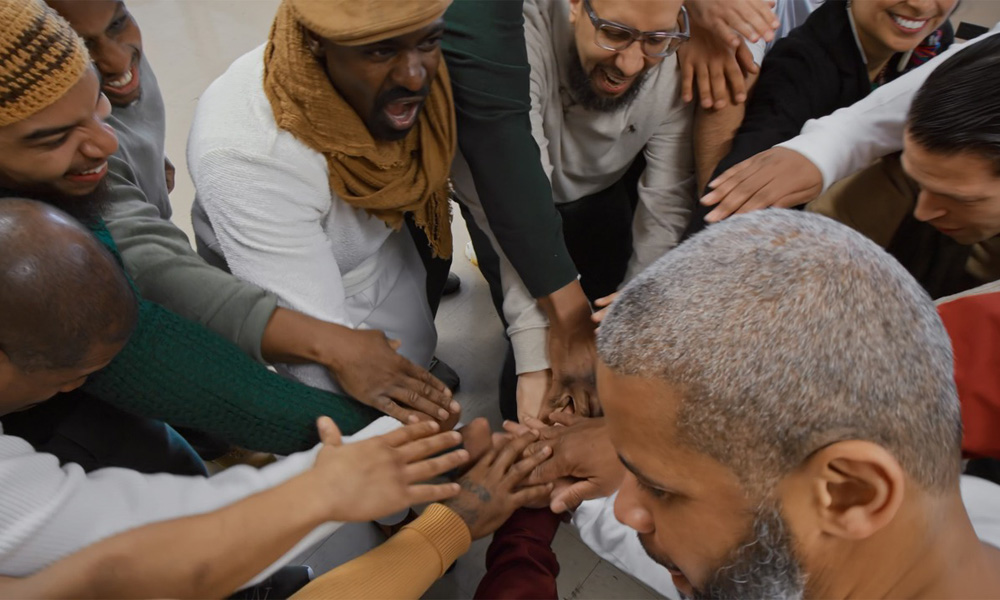

“That cell is either a cage or a chrysalis,” Mustafa, one of the men incarcerated inside Sing the Sing Sing Correctional Facility in New York says in “Beyond,” in one of the casual bits of wisdom he’s known to impart. In a meeting about Beyond the Block, an event started in 2023 to allow the men a forum for public speaking to express both their experience and the creativity that’s long lived within them, it’s fitting that someone may have to ask Mustafa for a definition of what “chrysalis” means, but still everyone in the room understands it from just how he says it.
In Asia Johnson and Michael Kleiman’s inspiring chronicle of the process leading up to the 2024 event, no further explanation is needed as you come to see the men working out personal testimonies where many go from having butterflies to turning into them, transcending their present surroundings to allow their mind to roam free as they speak. Their testimonies exceed even what was likely imagined by the educational organization Hudson Link when they first initiated the event, having previously worked with TEDTalks to give incarcerated men a chance to reflect on their time in prison and show off what they’ve learned as well as the often untapped potential that had been either overlooked or not encouraged. While those presentations were meant for the public to gain knowledge about what life was like inside, the empowering effect of simply being able to put together their thoughts for an audience when they rarely expected their voices were heard was undeniably visible and as Johnson and Kleiman are allowed into Sing Sing with a camera, observing the men setting up a speaking event themselves and preparing to pour their heart out on stage, they bear witness to a spiritual transformation.
When those incarcerated often become an anonymous statistic to the world at large, “Beyond” is careful to make sure no one is lost in the crowd as it affords a stage to the men before they formally take one to speak, finding some like Paul Cortez, who has long written music, to be natural performers while others such as the soft-spoken Etzer “Ellie” Esiverne have to overcome their shyness. In expressing themselves individually, they bring light to a justice system that can lack the nuance to properly assess a person’s readiness to rejoin society or their remorse for any crimes committed, often reduced to a short meeting with administrators with an endless stack of cases to consider with barely any time to look up from their file. As men like Salahuddin Townsley and Michael Tineo speak to their complicated family histories and attitudes towards recidivism where events long preceding their birth may have played a role in their present circumstances, the film supplies such necessary context effortlessly when for all the focus there is on locating the right words for the event, ironically none are needed to see how they’ve come to have a better understanding of themselves and all they’re capable of, now only for the good.
After premiering last week at DOC NYC where “Beyond” was a runner-up for the festival’s Audience Award, Johnson and Kleiman graciously took the time to talk about how they got such remarkable access to both the prison and the men inside as they let their guard down, as well as how the film has already brought down some barriers.
How did the two of you join forces for this?
Michael Kleiman: I’ve been working with Hudson Link through my production company, MediaTank, for the last five years and in 2023, when they were working with the guys [at Sing Sing] to organize the first Beyond the Block, they invited me to film the actual show and we filmed inside for three days for a short film. That was my first time going inside of a prison at all and I didn’t really know what to expect. I’d been working [on films] related to the criminal legal system for a while, so I was somewhat familiar, but still you’re really conditioned by the media to expect a certain type of thing inside of a prison and going in is quite intimidating.
But when I got inside for the first time, almost immediately, I met Michael Tineo, who’s featured in the film and filmed an interview with him in a big room with people moving back and forth, so it wasn’t intimate circumstances at all. But even then, he was just instantly vulnerable, wanting to share his story and [had] this amazing insight about how he’s thinking about growth, his own and others. Shortly after that, I met Salahuddin, who’s in the film, and he told me this story about one of his final moments with his mother before she passed that just really echoed an experience I had with my own mother. It was not what I was expecting inside the prison. I was seeing these moments of vulnerability and moments of mentorship and camaraderie and real support and accountability and I felt like if there was an opportunity to tell a bigger story and allow other people to go inside a prison and meet the guys as they showed themselves to me in that visit that we could start to impact the way people think about people who are impacted by the criminal legal system.
So I told Hudson Link, if they’re ever doing this again, let me know so I can raise a budget and do an independent production around the whole thing and they reached out to me two weeks before the first auditions of the 2024 event and said, “We can get you access to Sing Sing if you can make the production happen,” and I knew that I knew I wanted to make the film right away and that I wanted to collaborate with a co-director. I really wanted to work with someone else who had been formerly incarcerated, someone who had been impacted by the system, who had walked inside those walls. Asia and I had been connected through her work with an organization called Zealous, but we had done a number of collaborations on short films related to the criminal legal system [including one with] John Legend about bail reform, so she was top of my mind. She lives in L.A., Sing Sing’s in New York, and I wasn’t sure how that would happen, but I called her.
Asia Johnson: Yeah, Michael calls me, and he’s beating around the bush, which is not something he normally does, telling me he’s looking for someone who’s formerly incarcerated, but who’s a great filmmaker. And I’m like, “Honestly, I’m a little offended.” [laughs] Why isn’t he just outright asking me to do it? But knowing now that [because] I live in L.A. [he thought it] would have been a hardship — and it wasn’t, and I knew right away [I wanted to do it] when he started telling me about the project and from our prior work experiences together and the care with which I knew this would be done with both of us on it.
I really wanted to not honor my own experience inside, but my father was incarcerated before I was born and I’ve always looked for opportunities not only to lift up his memory, but also build a world where people who come home from incarceration and suicide is not an option. Substance use is not the go-to. I want to build a world where people are welcomed with love and opportunities and education and jobs. And I want to show the humanity that exists behind the walls — I wish that we didn’t have to say that. We are all human. We shouldn’t have to be humanized. But this film is a glimpse into what people are doing in the communities they are building. So when Michael called me, it was an instant, “I’ll get on a plane right now and come to New York if that’s what it takes.”
Something I was really moved by was how an audience is introduced to everyone inside the prison as people first rather than to be defined by how they ended up there. Was that a challenge as far as structuring this as a story?
Michael Kleiman: I was introduced to the prison world through Hudson Link, and they have this ethos they never ask anyone what their crime was. They never ask anyone what their charges are. So you’ll walk in there with people on staff, many of whom are formerly incarcerated themselves, but they may know some of the guys for 10, 20 years, and they have no idea why they’re there. They don’t care. The purpose is we’re here to educate you, and we care about who you are now. That’s the mentality, and I know Asia shares that belief wholeheartedly that this is about who you are now.
At the same time, accountability is a defining principle of who these guys are. Their lives really revolve around taking ownership of what they’ve done in order to change and grow and give back, so it became apparent that some of them wanted to talk about this and be able to say what they had done, the choices they had made in the past. So the way it’s told in the film was very much the way we experienced it, where it was very much about getting to know them as they are, the dreams they have, the things they’re doing with each other and then as we got to know them, understanding there was this desire to share some of the things they had done in the past. So we allowed that to come much later in the production process when they expressed a desire to do it. It was very important for us when people were going to talk about their crimes, that it’d be them leading it, that it’d be in their words. We didn’t want to have [subtitles] that said they did this because it’s, it’s not the central part of the story to us. If people wanted to talk about it, how they wanted to talk about it was how we would show it in the film, but we’d let them lead it.
Asia Johnson: We wanted to build trust, and not surface-level trust. These were our collaborators and they led us into their communities. As you can see, they opened up and shared not even just their past, but their hopes for the future, which was more important. We know there are already shows like “Law and Order,” “Locked Up” [with] all these different tropes that do that thing where like the first thing you learn about somebody is their inmate number, convicted on XYZ. That’s just really not the truth aboutpeople who are incarcerated. I mean, that can be part of someone’s story, but not their entire story.
Michael Kleiman: And I think a lot of this building trust process and vulnerability came from Asia and her willingness to share her own story with the guys as she was asking them to share theirs. It really became a conversation that invited them to be vulnerable. We were just in Sing Sing today to tell the guys about the week [with] the premiere and the reception and Paul Cortes said watching Asia has been just so amazing and so inspirational for them to just see someone who was incarcerated and now is just out there living their dream, doing amazing things. That’s an important piece of the story and how they saw participating in this film was was really meaningful because of Asia and her own experiences.
How did you figure out who to hone in on as subjects for the film?
Asia Johnson: We didn’t go in knowing which guys were going to step forward. There were some guys that would sit down and they were uncomfortable and in the way they told their story, they weren’t really used to talking about things. But everybody has a story and everybody’s story is interesting and compelling and that [ended up as] the difficult part because the film can only be so long, so we went through rounds of edits where we [realized] we can’t have 12 guys [featured in the film]. It would be five hours, so it was really just who could we tell a complete story about? And we want a diversity of story in all ways, so with these seven that you see, it just naturally happened.
In Michael’s case, you go outside the prison to get to talk to his mother, which is unusual. It’s a great part of the film, but why was that important enough to pursue in the first place?
Michael Kleiman: I remember we were talking about this and Asia was saying it was really important to have someone that other people could identify with in a way that some people might not immediately connect with the guys. We were drawn to Michael very early on. As I mentioned I had met him the year before, so I already knew him and he was one of the founders of the event, so he had this presence around the event — the film is a true ensemble but if there’s someone who carries the story, it always felt like it was going to be him. We were so taken by his story with Julia, his daughter, and we just felt if any story warranted an outside component, we want to start with with Michael. And we met Leticia, his mom, and her being a judge as well was such an interesting twist. We didn’t know that at first. We didn’t want to take too much screen time away from the guys [in general], but we did think it was important to have that other voice that others could grab hold of and she felt like the right first step.
Asia, in general, was there anything from your experience that you wanted to make sure was in the film?
Asia Johnson: In Hollywood, a lot of times there’s that happy ending and I remember there was a conversation about [where] we end. I was very sure that I wanted to end in a realistic situation. There are so many people that right now on paper, it says that they are not coming home and everyone doesn’t get to come home on their first or second or third try. And it is true that most people who are in prison, whether they’re in prison for five years or 50 years, are eventually going to come home. But that eventually is eventually. So that was one of the things I wanted to show. We also wanted the audience to know that what happens at Beyond the Block is necessary and important and also needs to be expanded. We need [organizations like] Hudson Link in these institutions. We need Beyond the Block. We need films and art and poetry and literature about what happens inside. So it was really important for both of us that people don’t walk away thinking, “Oh, wow, they’re in there and they’re acting [and that’s it].” What’s happening here is the first and only of its kind right now and we should be investing in people’s education and healing and training and all of these different things that they’re going to need when they come home.
Michael Kleiman: It was also really important to us to show that what’s happening in Sing Sing is coming from the guys. They’re leading this work together. It’s not the system that’s imposing this process to heal for them. They’re the ones who create Beyond the Block, who are taking accountability and pushing each other to take accountability and grow. They talk like therapists, but they don’t have therapists. They’re learning this stuff on their own and they’re doing their own counseling and digging deep and supporting each other. That was something I learned from coming in and seeing how much of this was just self-driven by them and something we want people to see.
What’s it been like to start sharing this with audiences?
Michael Kleiman: It’s been amazing. We really from the start knew we wanted to have a New York premiere because it’s a New York story and we imagined all the guys’ families being with us. That’s what it was. Of the seven guys, five or six of them had family members there and there’s some family members who have been at all three screenings, which is amazing. [Michael’s daughter] Julia was able to come up from Texas and see the film for the first time and got to go visit her father on Sunday for the first time in four years.
I was very anxious [personally] going into it, but it was amazing. It was everything we dreamed of. And the guys all saw the film back in February and they’ve seen it a couple of times since. They helped us write a discussion guide for the film as well and getting to go in [to Sing Sing] to tell them about our experience and [how audiences] heard their experience was awesome because they were saying they were getting real-time pictures from their family members, like Mustafa’s daughter was texting him pictures of us and Paul Cortes and Mustafa are on the same block, so Paul [said] Mustafa was getting real time updates from his daughter and would yell down the block like, “Yo, Paul, your part’s coming up. It’s going to be playing any minute.” And Salahuddin called his sister in the middle of the Q&A and just asked to listen for a little while. At the after party, I was sitting next to Robert’s wife and he called [her]. It really felt like a shared experience with them. We wish they could be there. We wish they were the ones on stage. We wish they were in the audience. But as long as they’re behind that wall, this felt like as close as it could be to them, which was really amazing.
Asia Johnson: Also, in the credits, you see like Michael and I’s dedication [to our parents] — mine is for my dad and Michael dedicated the film to his mother. And my dad’s passed away, but my mom and stepdad were there and it was really important for my family. They’ve heard “Oh, you did this thing, you did that thing.” But to see it in a theater, my mom said, “It’s almost as if you never went away. You had dreams when you were in college and now your dreams are coming true. And you’re illuminating things that you care about, [about] people that you care about.” And this [film] is not about me. It’s definitely about these guys. But for my family, who are like [many] America families who are like, “Oh, I didn’t know this happens in prisons and I didn’t know people were special and brilliant and smart and capable of changing the world,” it was really important for our families to be there. Michael and I have seen this film five million times, but it never gets old. Watching it through fresh eyes of the people around us in this theater, what a journey it’s been. And it’s just starting.
“Beyond” will be available to stream on the DOC NYC virtual platform through November 30th. A list of future screenings is here.