



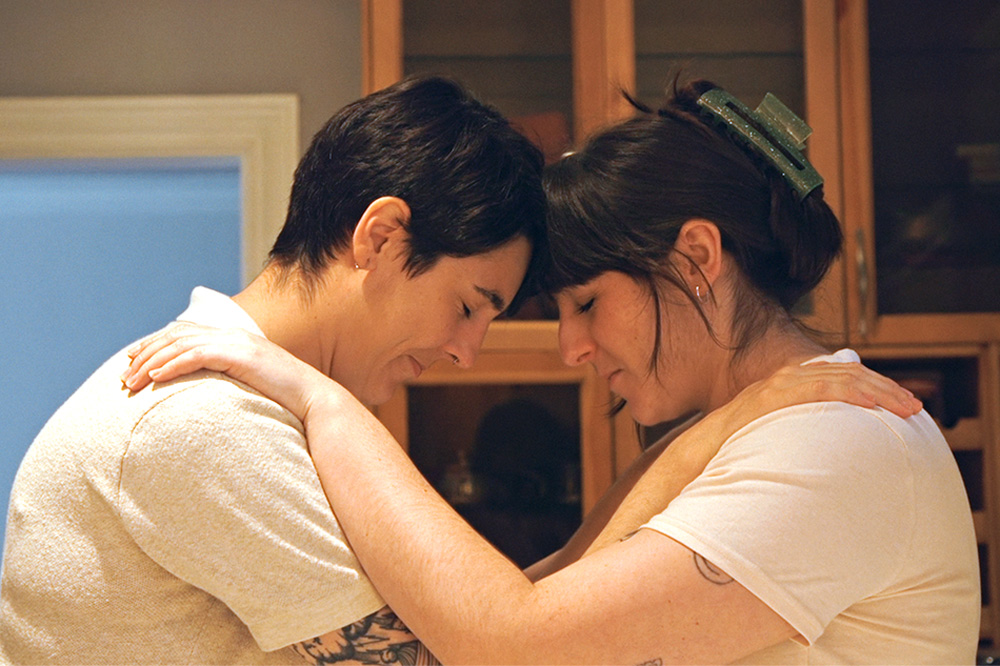

There are different types of long-distance relationships Amber Love tracks in “One Another,” impressively quantifying the abstract work it requires to stay in a friendship over time. Geographically, the most difficult to maintain would be that of Joe and Roni, two pals so close in Boston that the latter has a tattoo of Joe’s writing on her, yet he feels he has to head west to become his own person, moving away from a family that he sees as preventing his growth. Then there’s Giorgia in Chicago who regrets how she ended up parting ways with her friend Alexa over text, having complained about how she may not have been as considerate as she would’ve liked as they dealt with sensitive issues and was met with a block, and Lorri in Lansing, who drifted apart from her friend Lisa after the two became close after a cancer diagnosis and after a clean bill of health led to less time spent together, now finds connections hard to come by in middle age.
Even when the three main subjects of the film feel like there’s no one there for them, Love extends the compassionate feeling that someone is with her camera, observing the trio navigate the thorny personal issues that they may have to resolve within themselves before being in someone else’s corner. It was work that the filmmaker may even have had to take on herself when Lorri is actually her mother and she didn’t need to look far to cast Giorgia and Joe, both longtime acquaintances, but while Love keeps herself off camera, it is clear the personal history allows for incredible intimacy and access to explore a subject that’s difficult to articulate even when people aren’t keeping their guard up. As months go by, “One Another” is able to follow the small, significant steps it takes to mend fences or in some cases, make a reunion that could seem inevitable that much further away, but all the while Love shows how important it is to actively nourish such bonds when the impact they have becomes so evident in front of her lens.
The film surely had people calling someone in their life that they hadn’t reached out to in a minute after its recent premiere at SXSW and Love generously took the time to talk about how she made sure the festival was a bonding experience for both audiences and her cast and crew alike, as well as keeping a personal distance to make the film she wanted to make and finding a way to express the often ineffable nature of friendships.
How did this come about?
Funnily enough, the film actually started with Joe. In 2019, he was planning to move to the Bay Area. We met in college, so naturally we’ve talked about friendship a lot and we’re very cerebral people, as you can tell in Joe’s section of the film, so [the film] seemed like a really great opportunity to talk about the making of friendships. And then the pandemic happens, [which] pushed back filming and a lot shifted for a lot of people being in lockdown, so the film naturally started to become not quite about losing friendships, but working through rough spots and it does end up with the loss of some of them [as well as] the coming together of others. Giorgia was the second to join the film and when people would ask me why am I making this film, I would always go back to [how] friendships were really important to me growing up. I grew up very poor. We would not have survived the way that we did if we didn’t have our friendships to see us through, and every time I told that story, people [would then say], “Why is your mom not in the film? So we started filming together almost two years into already working on the film.
In your mom’s story in particular, the film seems to act as motivation for her to reunite with her friend Lisa from who she’s been estranged for some time. What’s it like negotiating making the film and feeling like you might be meddling in someone’s personal life?
I’m a very relationships-first filmmaker. It really matters to me that people that I’m filming with feel safe and protected and the interesting thing about films where the director is in a very close relationship with the subjects and have known them for years before is there’s a level of trust that allows for the ability to push people a little bit in a more intimate way. My mom and Lisa had more or less stopped talking in 2016, and the first time I filmed with my mom, it was not the plan, but [she and Lisa] had basically started to try hanging out again but only in group settings. They would both do anything for me. Lisa’s basically a second mom, so the film became an opportunity for me to to push them a little bit. The scene where they are playing games together is actually the first time they were alone [together] in five years and that shoot was very awkward, but very interesting to do. I pushed, but I pushed gently and it ended okay, but I think that shoot really broke a dam for them and allowed us to basically continue to filming the rest of the film, but also allowed them to start hanging out without me.
I knew all of them for years before making the film, but they’re very different people and we met in very different ways. Joe and I met in college, so we had like a good eight years under our belt already and Giorgia and I met through work and then we both left that job and continued to be friends. So it was interesting negotiating each of their different communication styles and needs. The difference was how we handled production with each of them. Each of them takes in information in a very different way. Each of them need different types of care to feel comfortable and to feel safe. Giorgia is actually the one that I knew for the least number of years when we started filming and filming together was what has strengthened our friendship. Now we’re very good friends, but what worked for Joe didn’t necessarily work for Giorgia and didn’t necessarily work for Lori, so it was a learning experience for me on my first feature to figure out my own workflow with all of these different people.
When you realized this was a different film than you started out to make, was it difficult to pivot?
I love that actually. I am not a filmmaker that goes into things with like a strong idea of how I hope that they turn out and that’s the fun of documentary — you’re capturing life and life is really wild and unpredictable. It would be a mistake to go into making a documentary with an idealized version of what this will be. I like to go by my gut as a filmmaker and a lot of that also requires me to be in regular communication with the participants about what is the film turning into? How are we changing? How are we pivoting if something’s different? For Joe, at the beginning of the film, he and Roni’s relationship was fine and that was not the focus of the film at all. It wasn’t until almost the last year of the film that they started to pull away from each other a bit. Then there was a time in which Giorgia’s part of the film that was very much about her trying to reconnect and process the childhood relationship. Lori’s part of the film was very much about being in this empty nest stage of life and then Joe was still making friends [in the Bay Area], so [I thought] where does this fit in the film? And how do we handle this if these two [of the three stories] are about losing [friends] and this one is about still making [them]. There was a time in the production where it was unclear how it was all going to come together, but the thing is life be life and it really just started to come together. I think it it’s because we didn’t force anything. We let things run their natural course and they all came to some kind of resolution that felt natural.
Once you got the film back to the edit and it has this abstract idea at the center, was there anything you could hold onto as a central theme?
The main part of the edit started with just watching through all the footage and not imposing a strong structure on it. I realized that all three of these people, even though they are at various stages of life and very different stages in their friendships, were all asking themselves similar questions and hitting similar emotional beats. That really became the spine of the film. I wanted a natural bridge between each story, [which] became someone asking a similar question about class or about how they feel about their mental health, like they’re dealing with uncertainty or in some cases, depression and anxiety, and I wanted the film to have a natural set of peaks and valleys where you can be rooting for them all at the end, you can feel for them in the middle and when you have a unified emotional beat between all three, that’s really what makes them come together, especially as they’re asking themselves similar questions.
The premiere is still to come, but what’s it like getting to this point with it and getting ready to share it with the world?
It’s been really exciting. All of the participants are going to be at the world premiere and we’re all renting a big house together and hanging out. We’re having morning yoga sessions and we’re basically planning it like a retreat because like as much as I’ve worked really hard on this film, so have they. They’ve brought their full selves and have been very vulnerable during this process, so as much as it’s a celebration of the film, it’s a celebration of them. We even had like a film festival orientation last weekend where like we sat them down, me and my producer and we’re like, “Okay, these are the random questions you’re gonna get from reporters and here’s how to handle a crowd” because I want them to have the tools to be able to fully experience and celebrate this opportunity with us. Basically I made a film with my friends and now I get to hang out with my friends at a festival. So it’s great.
“One Another” does not yet have U.S. distribution.