



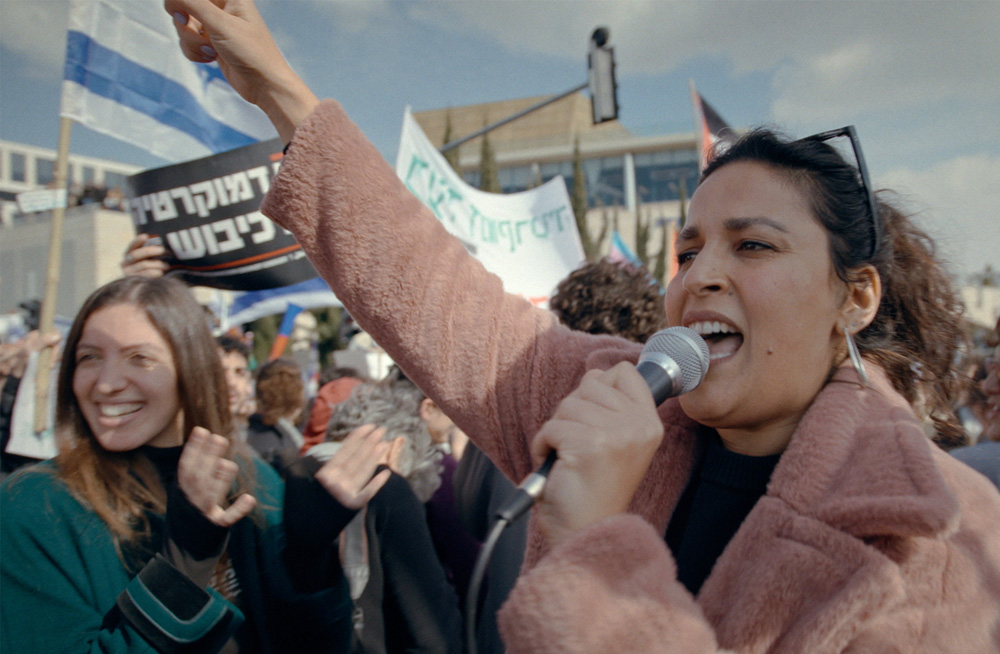

It could be a revelation alone for audiences in the west that there is even a comedy festival in Palestine to play as Noam Shuster Eliassi walks onto the stage of the 1001 Laughs event in “Coexistence, My Ass,” quick to quip as an Israeli by birth, “I’m only staying for seven minutes, not 70 years.”
This was before the events of October 7th, but director Amber Fares has long known when to follow a good story in every sense of the term as both a cinematographer on films such as Erika Cohn’s “The Judge” about a rare female judge in an Islamic court in the Middle East and as a director on “Speed Sisters,” about a Palestinian racing team pushing the limits of the odometer and expectations of what women are capable of, and she had to be intrigued upon learning about Shuster Eliassi’s unconventional peace building plan revolving around stand-up comedy. Shuster Eliassi, who had been inspired by the unexpected rise of Volodymyr Zelensky from a sitcom star in Ukraine playing the president to actually becoming commander-in-chief of the country, had spent time working at the United Nations and found that lightening the mood was a better foundation for serious conversations about peace than confrontation, hitting the road herself one community at a time and grabbing the attention of Harvard, which offered her a residency of their own at their Divinity School’s Religion, Conflict and Peace Initiative to develop the act.
Anyone skeptical of what Shuster Eliassi can achieve only needs to catch a few minutes of her set in “Coexistence, My Ass” to be completely disarmed as she finds light-hearted humor in the difficulties of life in a region constantly under siege, appealing to everyone’s desire for stability, and the comedy act is laced throughout Fares’ moving profile of the comedian who endures unimaginable setbacks over the many years cameras roll, returning to Tel Aviv during COVID and promptly placed into isolation where video diaries reveal she could go stir-crazy and she finds she’s put years into refining a routine that seems like an increasingly inadequate response to the violence in the West Bank. Still, Shuster Eliassi’s own ability to hold it all together against all odds with the belief that she can pull others to the table is inspiring and like its subject, the film creates a warm invitation to grapple with the otherwise unthinkable.
Following its premiere earlier this year at Sundance where it won a Special Jury Prize for Freedom of Expression, the film is beginning its U.S. theatrical run in New York this week and Fares generously took the time to talk about the rollercoaster of tracking Shuster Eliassi over such a pivotal point in her life and for the Middle East as a whole, finding a way to keep getting footage when it was no longer possible to film herself due to various restrictions and the productive conversations that it has already started.
 Did you have any idea of what you were taking on when you started out with this?
Yeah, I don’t think I knew what I was taking on, to be absolutely honest. Noam and I are old friends. We met when I was living in Ramallah, making my first film “Speed Sisters” and at the time, she was working for the U.N. and we had a lot of friends in common. We became friends and then over the years just followed each other on social media, so I saw that she was telling jokes and coming to Harvard. While she was here in the States, we met up in Brooklyn and she was telling me about what she was trying to do with this one-woman show and I thought it was a really interesting way into some of these larger issues, which I’m always looking for [like with “Speed Sisters” where it’s] race car driving and [I was intrigued with] a comedian to talk about the perils of coexistence [in the Gaza Strip]. So the next day, I picked up a camera and went to Boston on the weekend and started filming with Noam.
One of the first things that I shot [became] the very opening of the film and at the time I thought that the film might be about Noam trying to break into comedy in the U.S. and touring university campuses in an election year. But one thing led to another and COVID happened and it was just this wild ride over the next five years. We didn’t really understand at the time what we were documenting and that we would be documenting the lead up to October 7th and what was to come after. It was just [originally a matter of] being a good protagonist and knowing who she is and how likable she is and all of these things that she’s doing and trying to figure out what the story was from there.
Did you know you’d have the one-woman show as the spine for this that you could fall back on or at least engage with throughout?
Noam’s comedy is so personal and political that I thought it would be interesting to replace sit-down interviews with having her comedy show narrate her life. But that comedy show was evolving as we were filming, so it was always a little bit of a dance. We filmed the comedy show that’s in the film in September of 2024 — it was one of the last things that we filmed. And the last two [scenes] of her on stage were around October 7th. Those were things that she had never performed before and were written specifically for the film. But [along the way] we filmed her performing so many different versions of that show or in short comedy sets, so there were different variations and we would take the jokes that we thought could work [structurally] and we would place hold them in the timeline, so it could be a joke about her writing the e-mail to go to Harvard like she said at a festival in Haifa in Hebrew and we would just use that as a placeholder [for what she’d have in her final set] and other ones we’d have from an English show or an Arabic show, like it was this patchwork [for the edit].
Then we use that to [think] “Okay, this joke works” or “This is what we want to focus on” and it was really like a back-and-forth [where] we would see where [a joke] would fit and then we’d refine it and work with [Noam] on how we can adjust it. Then when we filmed [the main comedy set], we did it in Montreal, [a city] known for its comedy with Just for Laughs, so there were a lot of people there that knew how to film live events like this. We had Noam do two shows one in the morning and one in the afternoon where we had a few people in the audience and filmed it quite tight, so we could stop, start, have her say [something] and then say it again, really just to make sure that we had versions of the joke that would work because when she goes to do it, English is her third language, and we were a little bit nervous about [simply shooting the show front-to-back] because [it would be easy to say] one thing wrong, so we just wanted to have insurance that if we needed to cut into something else, we could. Then we sold out that show in Montreal and she performed it from front to back and it ended up being one of the last things that we put into the put into the film.
You also have this celebrated career as a cinematographer and a good deal of the film involves footage you couldn’t have shot yourself, whether it’s Noam’s personal videos or footage from the West Bank when both COVID and the war wouldn’t allow you to travel there yourself. Was it a different way of relating to the material as a storyteller?
It was definitely a different process. When I made “Speed Sisters,” I was living in the West Bank, so I was there on every single shoot and filmed a lot of it and if not, had a cinematographer that I was with. In this case, I was living in the U.S. and we had COVID in the middle, so I wasn’t always physically there as much. But fortunately, I connected with Rachel Leah Jones, an amazing director and producer based out of Tel Aviv, who had a really lovely film called “Advocate,” and her partner Philippe Bellaiche is a really amazing cinematographer, so a lot of this was filmed with me not being there.
And I would make longer trips and go, but then having Noam during the COVID years film herself was also really interesting because the whole world was on shutdown. The first few days of COVID, Noam decided to go home and she was doing [the filming] for herself too, [thinking] “This is wild what I’m having to do,” and then she was in quarantine. When she got got sick, and was filming herself in the ambulance, I didn’t tell her to do that. She just did it, which was amazing. but when she got into the hotel [where she had to isolate], I realized it’s really hard to continue to film yourself and live through something like that. You can’t really do both, so I asked her who her friends were [who could keep tabs] and there were a lot of these young folks in their twenties that were Palestinian and Israeli that were around her, so I got them to film for me. So I’d be up at four o’clock in the morning,instructing them on how I wanted things shot or talking to them about what to say, so I was running like a little production company at my kitchen table in the middle of COVID.
Beyond the world-changing events that end up changing the course of the movie, was there anything that happened on a smaller-scale that changed your ideas of what this could be?
For Noam, the parts that I found that I didn’t expect were how she takes political events and twists it into satire. There were a few skits that she was able to do [on television] — one was a tourism spoof, welcoming people from the Gulf that were now traveling to Israel because of the Abraham Accord — and she was doing it in Arabic and then it would be put on Israeli TV with Hebrew subtitles and then put online and spread all over the Middle East. And I’d have friends in Lebanon or in Qatar and Dubai texting me, saying [her skits like] the Dubai, Dubai, Dubai song, let’s say, was reaching them. They were really excited about it and thought it was really funny in all of these other Arab countries and that was really something that I wasn’t expecting about how she uses her identity and her language to subvert the joke. Like the joke is sort of on Israelis, but they don’t quite get it because it’s in Arabic and it’s a joke that she’s having with the Arab world on the expense of Israelis who can’t speak Arabic, but it’s on Israeli TV. I just thought that was really brilliant and it was really exciting to see where she was taking her comedy in that way.
What’s it been like sharing this with audiences so far?
It’s been an amazing film to screen. Audiences have been really moved by the film and what I’ve been told is it’s the type of film that stays with you long after you leave the theater. The responses that we’ve been getting really around the world have been very heartfelt. As a filmmaker, you want your films to make a lasting impact and I do believe we’ve really achieved that with this film and it a lot of potential to move the needle and [start] these conversations that are relatively tough within our own community. Like I had a mother and daughter that came to one of the screenings at a Jewish film festival and afterwards had said to me that they had been very far apart on this issue and not able to really have a conversation about it, but this film helped them ease into that. As a filmmaker, that’s why we do what we’re doing. So it’s been really a pleasure to see this film out in the world.
“Coexistence, My Ass” opens on October 29th in New York at the IFC Center, Toronto at the Hot Docs Ted Rogers Cinema on November 2nd (with an additional screening on November 14th), Chicago at Alamo Wrigleyville on November 5th, Houston at the River Oaks Theater on November 6th, Los Angeles on November 7th at the NoHo 7 and the Monica Film Center, San Francisco at the Roxie Theater on November 12th with a sneak preview on November 9th, and Detroit at the E-magine Palladium on November 10th and the Michigan Theater on November 11th. A full list of upcoming screenings and dates is here.