



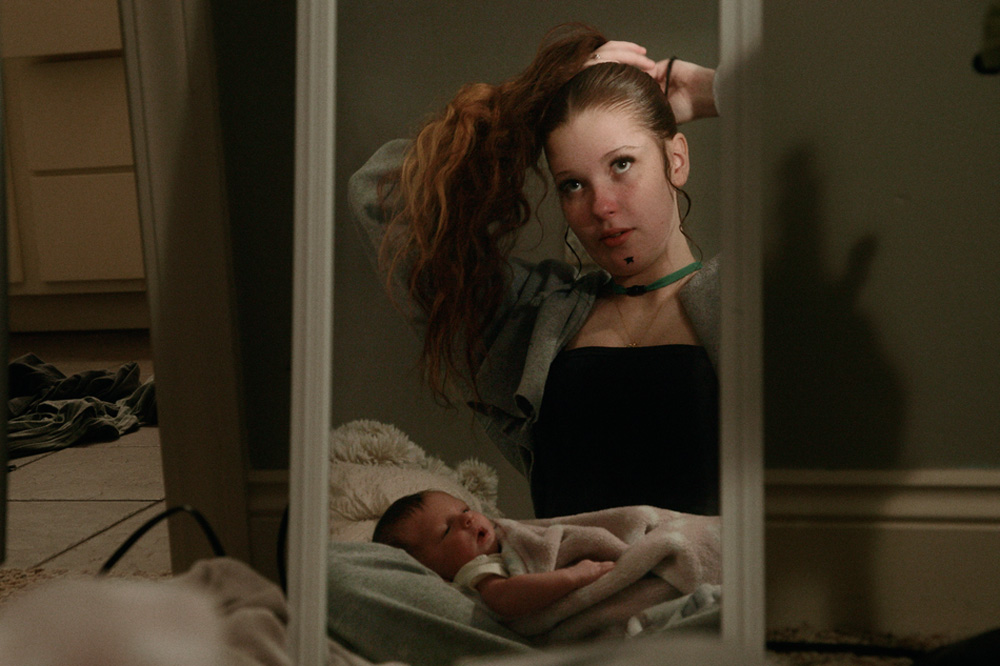

It should be a happy moment for Audra in “Baby/Girls” after she’s learned her daughter Grace has safely delivered a granddaughter, but they aren’t exactly tears of joy rolling down her cheeks as her own mother comes to console her. At 41, she’s probably a little too young to be a grandmother, but at 15, she’s knows Grace definitely isn’t of age to handle all the responsibilities that are coming her way and the unthinkable is at the same time not entirely unexpected when as Audra says later, if you look the lives of herself and her daughter, there is some frightening overlap. It’s a remarkable scene that Jackie Jesko and Alyse Walsh capture when Grace enters the room, with three generations of women in a single family, repeating a cycle that has prevented them from having much of a life beyond the room they find themselves in when they’ve had to raise children during the years they could be expected to spend finding out who they are. As the filmmakers relate quite powerfully, it’s a cycle that’s held back plenty of women across Arkansas, which has the highest teen pregnancy rate in the country, when sex education hasn’t been taught in school and often isn’t passed down from parents to children.
Grace, along with the 17-year-old Ariana and the 16-year-old Olive, aren’t in high school anymore, but the Compassion House in Springdale where Jesko and Walsh set up ahead of the births of their babies. As one of the attendees there explains, the operation there isn’t exactly a halfway house or a group home, yet as a Christian-run prenatal care provider it’s where judges regularly send teenage mothers with the hope they can receive what they need, though by then it seems the future has been written for them and the film doesn’t need to leave its walls to illustrate a broken social safety net, warmly showing the people that still selflessly serve the young women, but painting a vivid picture of how they’ve been failed by everyone else as Grace, Olivia and Ariana share their stories, from boyfriends that leave before the baby is born (with Ariana’s partner a notable exception) to schools they can no longer comfortably attend as their bellies get bigger, all but ending prospects for a livelihood besides being a mother. (Not that they have had much use in the first place when Olivia attests she has only just become aware that she pees out of a different orifice than she has sex and can’t remember any proper sex education course.)
The overall situation is only going to get worse in Arkansas as the filmmakers start rolling their cameras as the Dobbs decision, leaving states to decide their policy on abortion, is handed down, but Jesko and Walsh concentrate on the damage that’s already been done to generations of women, particularly in the South, who are treated as second-class citizens as far as their education is concerned and at the mercy of men who face no consequences for their responsibility in a pregnancy but their own conscience. The filmmakers are careful not to portray their subjects as either hopelessly naive or, equally perilously as the MTV series “Teen Mom” dealt with, lionize them for having to show strength beyond their years, but they are clearly shown as a product of an unhealthy environment where the issues will only become greater as the population expands as a direct result.
With a strong structure that only gradually introduces the sexual abuse and incest that are a large part of the problem as well, the film impressively never overwhelms with just how dire the circumstances are as it conveys the incredible odds that Ariana, Olivia and Grace face as they attempt to raise children that might not have to endure what they have to. While most of the parents stay off screen, speaking volumes about the strained relationships that have likely contributed to the vicious cycle, Jesko and Walsh do well to spend time with Audra, Grace’s mother, who has been through hell and back with four young children besides Grace to raise and having to care for another after her daughter gives birth. As she talks about the community she was raised in with the perspective that age has brought that her daughter can’t yet have – describing how she was brought up to see love as a transaction and sex as love – Audra quantifies a burden far less obvious than all the basic needs of a child that a mother needs to fulfill – to impart hard-won knowledge to the next generation and quite admirably, “Baby/Girls” is here to help with the heavy lifting with a light enough touch to break through.
“Baby/Girls” will screen again at SXSW on March 14th at 2:15 pm at Alamo Lamar 6.