



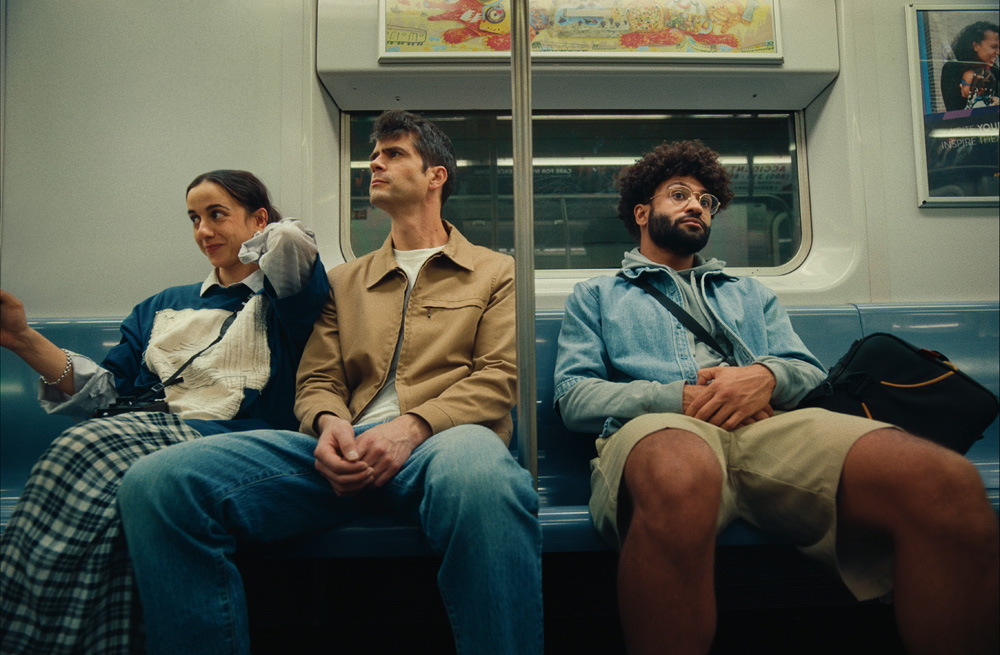

The amount of places Simon (Tristan Turner) can go in “The Travel Companion” can be overwhelming, having his best friend Bruce (Anthony Overbeck), whose job at a airline provides the opportunity to travel anywhere in the world on flights that haven’t been filled to capacity for a designated friend or relative. It’s been a boon to his filmmaking career, being able to travel all over for a documentary bigger than he could ever afford as any scrappy young filmmaker just trying to make rent in New York, yet racking up footage has also paralyzed him to a degree when the only thing he can think of doing is talking up the film at various industry events and keep shooting rather than trying to finish it in any way. Production, however, may be finally be winding down against his will when Bruce can extend his golden ticket to Beatrice (Naomi Asa), a new filmmaker in his life that he’s interested in romantically.
Simon may reek of desperation as he attempts to get back in Bruce’s good graces, but writer/directors Alex Mallis and Travis Wood craft a laid-back comedy that unlike its aimless protagonist has a distinct sense of purpose. Set in a world the two clearly know well as they follow the filmmaker from a festival Q & A where he’s the center of attention to the menial commercial work he takes to actually make a living, filming stock footage of taxicabs, and find that there’s peril in between the two poles when Simon is robbed of his ambition by finding safety in simply staying afloat rather than striving towards his initial goals, but wants to pin the blame on someone else when threatened with the possibility that his golden ticket will be taken away. It may actually add insult to injury that Mallis and Wood make something so breezy and poignant out of Simon’s misery when completing his own film couldn’t look more difficult, but “The Travel Companion” expresses how a picture perfect reality may belie enormous anxieties running underneath for anyone in the arts stymied by fixating on an idealized version of both themselves and their work, even when it can be enjoyed simply as a lighthearted comedy of someone who can’t help but get out of his own way.
After being warmly received at its premiere at Tribeca and enjoying the kind of celebrated run on the festival circuit that Simon lusts after, “The Travel Companion” is now starting to roll out to theaters around the country and Mallis and Wood graciously took the time to talk about how they became a filmmaking team and how Wood’s real time as a travel companion led to this delightful debut feature, as well as making the most of unfussy camerawork and slipping into airports to film.
 How did the two of you first join forces as filmmakers and start to work on a feature?
Travis Wood: Basically we’re in a collective together called Meerkat Media based in New York City. Alex has been a part of the group for a while, and I joined seven years ago and we just clicked right away. He was working on a doc short that he wanted some help editing and I just jumped in and helped with that. We’ve been working on stuff ever since.
Alex Mallis: Travis and I worked on a lot of shorts individually and then we made a bunch together. And there’s always been a bit of a valley between shorts and features in my head. I made so many shorts that it always just felt like the feature needs to be the masterpiece, the big swing that says everything I want it to say. And on a subconscious level, that was actually preventing me from making the feature because I’m not waking up in the middle of the night and saying, “Holy shit, I just got this earth-moving idea and actually when I linked up with Travis, I feel like we had this energy to just make stuff. We both came from skateboarding and the kind of movies that you make when you’re skateboarding are very much shoot first, edit later. We have no plan. That energy really lends itself well to short doc making.
But there was a moment where we realized, “Let’s apply that energy to a feature. So we were hanging out at IFFBoston, screening a short, and we were joking around. Travis was telling me about potentially losing his travel companion status and it felt just kind of funny enough to [say] “Let’s do it. Let’s build something off that.This could be this is something that we can write that we could make into a feature. And let’s not be precious. We don’t have the whole thing mapped out, but we do have this like this feeling. And that was enough to get us moving.
Was the idea always going to be that he was a filmmaker as well?
Travis Wood: Yeah, I think the first idea we had was, “Oh, we should open [the film] at a Q & A” because we were at the festival and that’s how the new person’s introduced. From that Initial scene, we [thought], “Okay, this is based in the world and maybe the travel’s helping his like personal project. That structure came pretty early on, but as we were writing it, I think we ended up going even deeper and maybe more inside than I think we had thought of at the outset.
Alex Mallis: That was super fun. We had probably been on stage in that exact scenario all of 30 minutes prior to talking about it at IFFBoston. And shout out IFFBoston and all film festivals — it’s not easy to facilitate that many filmmakers. And even the best versions [of the Q & As] can be a bit awkward when dealing with like a bunch of short filmmakers, so it’s not a knock on the festivals, but highlighting this awkward experience. But we went into that day shooting that, which was meant to be a oner. It’s close to three minutes, if not a little over. That’s a lot of choreography and we did not have a chance to rehearse with those actors prior. In addition to our DP Jason Chiu’s expert cinematography and camera operating in that moment, a huge hat tip to our actors that day — some of whom are actors, some of whom are non-professional actors — they came and everybody just nailed it. It was the first read-through and everybody feels real and believable. Most of the people on the stage are filmmakers that have been in these exact scenarios, so it wasn’t a huge leap for them to inhabit these characters.
Travis Wood: Yeah, that was a really fun scene to cast. When we were just thinking which local filmmakers do we want in this, it was so fun to picture Brit [Fryer] and Joanna [Arnow] up there and and get to see it come to life.
Something that I was so moved by, because I know so many filmmakers that go through this, is is the idea of having a project that you end up talking to death and it becomes uninteresting in your own head. Was that always a part of this?
Alex Mallis: Yeah, that is a pretty universal feeling for a lot of filmmakers, [having] this idea that you have in your head and trying to move it into reality. It’s something that I definitely go through, and when I have an idea for something, it can feel undefined in my head, but because it’s undefined, it can feel perfect. It feels so exciting because you don’t have to know all the answers when it’s just in your head. But as soon as you start to to make it and produce the thing and shine light on it, you start to see all the flaws and it becomes imperfect and scary. Maybe you stop and get scared into submission. And I feel like Simon is going through some of that. He’s thinking about this project that he has so clearly in his head, but maybe he’s not actually making the damn thing because it it’s so much easier to just hold it inside and word dump on people and feel good about that. The thing he gets from the project is the sense of satisfaction when he can articulate it. But all of the hard work of “I need to go shoot this thing and I need this thing to be imperfect for a long time until it becomes good” — that’s scary. And I feel like Simon for a number of reasons was unable to move past that.
What sold you on Tristan Turner to play Simon?
Travis Wood: Even just visually from his first tape, just looking at him, I [thought], this guy could make an experimental doc. I just felt it looking at him. And then the performance that followed felt like the perfect blend of annoying but believable, but also you want to root for this guy. He really softened it from the page and brought an empathetic performance to it.
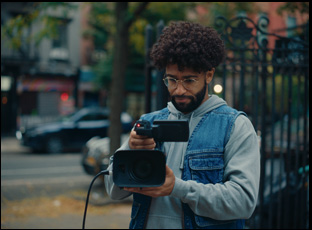 The film has a really crisp but evocative visual style, a lot of stationary shots that still feel very lively. What was it like to find a playful style?
Alex Mallis: That is one of the most fun parts of this process. We thought a lot about the mumblecore approach in the sense that we don’t have a lot of time. We’re going to be scrappy. We looked at filmmakers like Hong Sang Soo and how he approaches scenes with minimal coverage. Things play out in the action. And then we also looked at some of the big dogs like Spielberg and thinking about blocking and like how do we fit action into these shots where we don’t have to have seven angles to tell the story because we admire that type of filmmaking, but also because we just didn’t have time. We would have time for three setups per scene, three takes per setup and if those are your limitations, then you really need to be thoughtful. That meant Travis and myself and Jason [our cinematographer] walking through these spaces and using our phones with a (codridge app), just setting up shots and shot listing, trying to be as economical as possible without losing the whole joy of this thing.
What was it like figuring out how to film inside an airport?
Alex Mallis: Yeah, it’s funny, everybody who read the script is like, “Hey, nice script. But how are you going to shoot the airports?” That was always the number one question. And I feel like Travis and I were just confident. We had this doc filmmaker mentality of “we will get it done. We will ask forgiveness, not permission.” And the way that that ended up playing out is buying a one-way fully refundable ticket to get through security at JFK into the Delta terminal. And [it was just] Tristan and myself with a small camera. [We] got through security, built the camera, and started shooting and it was a bit revelatory how little anybody cared at all. No one even looked at us. No one even was curious. We started shooting just little sneaky shots of him sitting in the corner where there were no people and by the end of the shoot, we were emboldened to the point that I had actually rigged the camera onto a gimbal and we were sprinting full speed through the through the main wing of the Delta terminal. Again, no one was even looking at us. I think the only reaction I had was from some kid who was like, “Oh, nice.” Beyond that, nobody even nobody cared. I think they just assumed we were like making a travel vlog.
Was there anything that happened that you may not have anticipated, but made it into the final film and you now really like about it?
Travis Wood: One of my favorite things is when Simon goes to Beatrice’s set, and the whole time we were like, “We need a big set somewhere, and we hadn’t really thought about what it would be and then lo and behold, down the block of one of our locations was a big commercial production was happening, and we just hustled and got over there. Basically we walked through that set that was live and happening with our equipment and then basically seamlessly cut it and recreate the dialogue portion later.
Incredible. The music also is such a great part of this and quite chameleonic. What was it like to work on the score?
Alex Mallis: That was really fun. All of us are very musically inclined. I’m also a DJ, so I’m always thinking about music and while we were editing and even shooting and writing, we were building playlists of songs that felt cinematic or might be appropriate for different sections. One of the first songs that we latched on to is this Kaleidoscope Orchestra cover of a Todd Terje track called “Inspector Norse.” We loved it. It felt like it had this cheeky energy while also feeling epic. We didn’t have any budget [for music] and I feel post music budgets can be five or six figures, so it was tough to figure out how to do that. In that case, it was just a case of how do we get to this artist? We actually through some friends and with a good bit of luck, we were able to reach Todd Terje himself and pitch him on the film and get him excited. He was gracious enough to let us use it for a really amazing discount. And then we also worked with Elliot Krimsky, a friend and a wonderful musician based here in New York and he was able to fill in all of the gaps that we had with some really amazing original compositions.
What’s it been like to put this out into the world so far?
Travis Wood: It’s been incredibly fun. And what keeps me going at every stage is that we learn a little bit more about how festivals work, how distribution works, how theaters work, and now how PR works. I just keep learning at every stage and it’s been been carrying me.
Is it true you actually call your shot with your next movie in this one?
Alex Mallis: Yes, the marquee that Simon and Bruce walk under near the top of the film is advertising a film called “Watching Fire” and that will be Travis and I’s next feature film that we’ve started developing, which we’re really excited about — as soon as we can take even one breath of fresh air. This has been taking all our time, but we’re going to hit the ground running with that one.
“The Travel Companion” opens on April 10th in New York at the BAMCinematek, April 16 through 22nd in Rogers, Minnesota at the Emagine Rogers and Farmington Hills, Michigan at the Riviera, April 17th through 23rd in Duluth at the Zeitgeist Zinema 2 and Cincinnati at the Esquire and May 1st through May 7th in Hutchinson, Minnesota at the State Theatre and Rochester, Minnesota at Pop’s Art Theatre. A full list of theaters and dates is here.