


Reza Dahya is not an introvert, or at least he couldn’t afford to be as the host of the popular “O.T.A. Live” on FLOW, the home of hip hop on the radio dial in Toronto in the early 2000s. However, as he would interview the artists that would pass through the studio, there was something he was holding back as he harbored dreams of own to express himself as freely as they did, only in a different medium.
“It was always there in the back of my mind, but it didn’t feel like a possible thing to do, just because I was in a totally different world for so long,” Dahya says now of his pursuit of filmmaking. “But it was an itch to create in different, more personal ways, and I’m not a musician — I didn’t have the talent to play and get on stage and sing my heart out, so when I realized that I could speak in a sense through all of these different skills that I have, I realized ‘Oh, that’s what a director does’ that I could I could speak as an artist and say something to the world.”
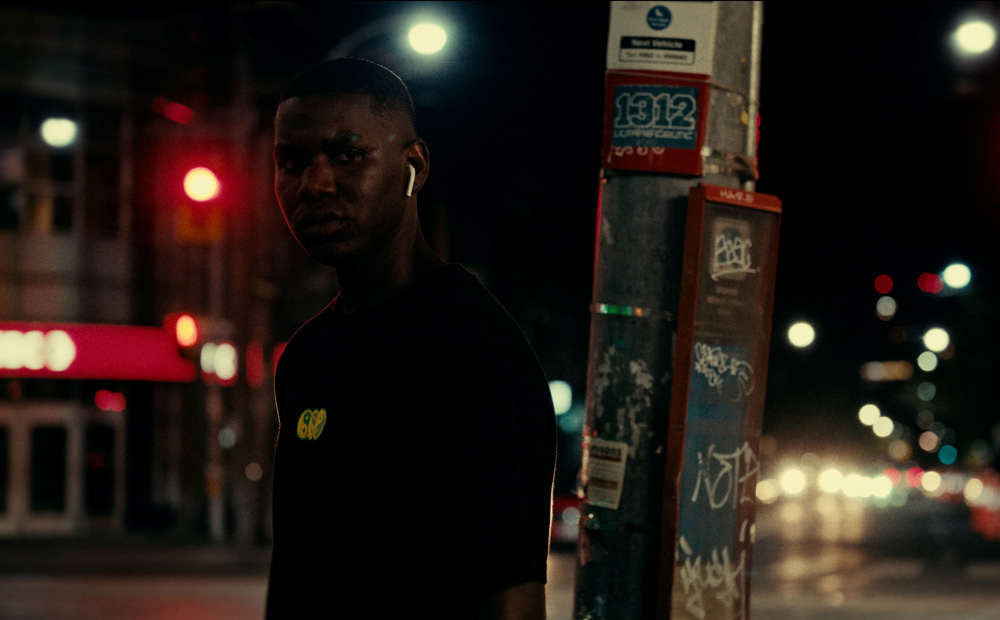
Dahya’s instincts weren’t wrong, which he proves time and again in his engaging debut feature “Boxcutter.” Still, to hear him speak about gingerly dipping his toe into the arena makes it seem as if there were at least some passing similarities between himself and Rome (Ashton James), an aspiring rapper who has the talent to pursue a career in the arts if not necessarily the nerve, seemingly content to quietly work for a package distribution center as he bides his time for his big break. It may appear at first when he’s at home on some headphones working on some tracks that he’s an artist of intense focus, but in fact as the film wears on, it becomes increasingly evident that Rome holds his music close to the vest because of the fear of putting himself out in public in such a vulnerable way. Yet he is pulled outside when the laptop containing all his sound files is stolen and he knows of a producer he worked with who should have a backup, but finding her will require a search through Toronto’s quite-literally underground hip-hop scene as he and a childhood friend Jenaya (Zoe Lewis) find their way into studios in Suburban basements and tucked into downtown buildings to find the tracks with the ultimate hope of getting them to a top artist named Ritchie (Rich Kidd), for whom Rome would be willing to risk everything when it could launch his career.
Not only does “Boxcutter” make for a great travelogue of Toronto as it hits every neighborhood in the GTA over the course of a day, reflecting all the vibrancy of the multicultural city as well as the tensions of ongoing gentrification, but it also charts how difficult it is to establish oneself in an artistic field in a fascinating way when Rome can suffer from a lack of self-confidence that he tries to best to hide, but there is also no shortage of predators in the industry that promise opportunity to those desperate for it that have no intention of coming through, making it even more difficult to have faith in himself when he doesn’t feel he can trust anyone. Well before Rome’s fate is settled, it’s obvious that Dahya has conquered these issues for himself with a drama full of swagger when Rome and Jenaya criss-cross the metropolis with abandon and the filmmaker’s roots in the music industry adds rich detail to the story of someone finding the power in their own voice. With the film now crossing the border into U.S. theaters after first making its premiere at SXSW earlier this year, Dahya graciously took the time to talk about making the transition to filmmaking, finding a great screenwriter in his midst while working in radio to team with on “Boxcutter,” and why scenes set in public spaces without a lot of protection from real life intruding doesn’t faze him.
 From what I understand, Chris Cromie actually worked with you at Flow. How did you two come to collaborate on “Boxcutter”?
Yeah, on our radio show my partner Ty Harper and I used to do this amazing segment called “The Unauthorized Biography” and it was this weekly 30-minute show, like a documentary within our bigger show where we would feature an artist every week and talk about their life, almost like “VH1 Behind the Music” but focused on the music itself, not really the drama or their personal lives. That was a huge endeavor every week to produce and we had writers who would help us research and and in some cases write these these specials. Chris was one of those interns on the show and one day, I think I’ve showed him something I was experimenting with and he [said], “Oh, I didn’t know you were into film,” and he goes, “I write scripts,” because when we were just writing these radio docs, it was more for audio than it is for a visual presentation, and I’m like, “Get out of here! What do you know?” So I gave him an idea for a short film that I was thinking about and he [said], “Give me a couple weeks. I’ll write something.” And I left that meeting and [thought] “I’m not going to hear from this guy,” but lo and behold a couple weeks later, he sends me an e-mail with a draft of a script, fully formatted with a beginning, middle and the story is there. And I [thought] “This is crazy. That turned out to be my first short film and we’ve just been going from there.
From the very first scene of “Boxcutter,” there’s a really clever way into this character who holding onto his music without letting it out into the public when he listens to it on headphones. What was it like to figure out an expression for this guy?
It took a lot of drafts and a lot of trial and error. Rome was just alone trying to figure out how to do this thing, and then obviously working with Chris, we spent a lot of time on the themes and what is Rome’s arc, just trying to keep it simple, like “Okay, he’s going from closed off and in his head and in his room to wherever he’s got to go we really [need to] make sure every scene is in service of that journey because there’s moments where the script goes this way and that way and it’s all about reeling it in. We did two table reads, which actually helped a lot in just keeping focused and in a space that is connecting with an audience. You can tell by doing a talk back with a live audience what is connecting and what’s not and what people are confused about and that really helped us get the script where it needs to be.
What was it like seeing Ashton and Zoe’s dynamic? And what sold you on this in the first place?
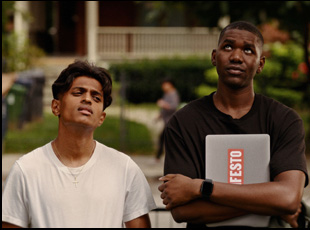
Putting them in the room together where it just was right there in front of you and you see it happening in real time, you’re like “This is it. This is Rome and Jenaya.” It was a traditional casting process, but it was definitely that chemistry read where we had cast Ashton and then [brought in] Zoe, and it was still very tough. The thing about Zoe was at the time, she was quite inexperienced as an actor. She’s an artist first and foremost —a singer-songwriter, and she had acted before, but there were other actors [up for the role] who had more experience, but there was just something about Ashton and Zoe together that felt familial. It felt a little more brother-sister and that’s what we wanted to go for. Then seeing them to get work together in the chemistry read was like magic, and watching their relationship grow during the shooting was so beautiful to watch. As a director, I always wondered how people capture real life moments, because I’d always been so stuck to the script and and on this film, it was really about loosening up and letting go, and just being able to put the camera on them for a couple scenes and there’s ad-lib, it just feels so real and so lived in. That was so rewarding for me as a director to be able to capture moments like that.
 You’re putting their feet to the fire as well, throwing them into public spaces like the subway or the middle of the busy Yonge and Dundas intersection in Toronto. What was it like planning for that?
I felt more bad for the crew. Our sound recordist was sweating a lot because there’s construction everywhere. Yonge and Dundas was crazy loud, but everyone was on the same page of the type of movie we’re trying to make and [thought] it’s okay to be in those spaces. The technology is at a point now where you can do a lot with location sound that even ten years ago might have been way more difficult, so I wasn’t too worried about that. Then as far as the actors, they were a little nervous about some of the public spaces, but once you get there and it’s like, “Okay, we have an hour. Let’s just do it,” you quickly realize that no one [in the public] really cares and we weren’t some big production — it was four or five of us at Yonge and Dundas, so it’s not really a big disturbance. We got lucky. There weren’t people trying to get in the shots, so it was actually pretty smooth.
The funny thing about that shoot, which did halt our shooting, was there was a live protest that came down the street, so we had to pause for 30, 40 minutes and we actually went over and joined the protests and shot some of it. It was part of the thing because you’re live and that just brings life to the film too. The backgrounds are real. The people are real. The spaces are real.
The camerawork gives the film a real energy too — it’s not exactly handheld, but quite fluid where you give the actors a lot of room to maneuver as the camera will swirl around a scene. What was it like to figure out?
Yeah, James Klopko, the [director of photography], and I spoke a lot about visual language and we agreed that we wanted the camera to be alive and floating and moving all the time, reacting to the emotions in the scene and following Rome’s inner journey. But then we also because there’s a lot of walking and running, I didn’t want it to be all fully handheld. I wanted to have a bit of a higher production value to it, so we made some technical choices [about] how to do this [where] it’s organic and alive, but also steady, which I feel gives the film a bit of a dreamy feel, even though it’s grounded and a bit gritty. It was a bit of a balance.
 There’s a really interesting rhythm too as far as the interiors versus the exteriors when there’s this driving idea that Rome is trying to break through, but you see all this business that has to happen behind closed doors that he doesn’t necessarily want to be a part of in order for that to occur. Was it interesting once you got the footage back to the edit to think about that balance of where you’d spend your time or was that all in the script?
I don’t think that was intentional, but more that they we’re on a quest and there’s stops that got to be made and some of those are inside and some are outside. But there were definitely thematic choices for some of the outdoor locations, based on the tone and what’s going on with Rome at the moment. The only interior scene like that that really comes to mind is early on in the film when they go to a condo building, and there’s a sharp contrast between Jenaya’s house at the beginning of the film and this basement studio that’s rich with history and culture, [which is] a real space in Toronto [where] that’s the working studio for DJ Merciless, the producer, and the soulless white wall with glass windows condo. It speaks a lot about the changes going on in the city and the difference in generations. [Those locations are] all there for a reason and they all say something different, like even the home studio at the beginning of the film versus the the high-end professional studio three-quarters in. They all have a different tone and they’re all saying a different thing for sure.
What was it like thinking about the music for this, both incorporating it and thinking about Rome as a musician?
That was one of the most fun parts for me. To answer the last part of that question, you actually don’t ever hear Rome’s music, so that part of it was taken out of the process, and we did that for a couple reasons. One, whatever the audience’s expectations are of the character’s music, you can never meet it. So it’s more interesting to leave it to the imagination of what he sounds like, and then also we tried to avoid as many cliches from hip-hop movies that we could, one of them being that he’s got to touch the mic and rap at some point. [I thought] “We don’t need to do that anymore.” This particular story is not about that. It’s about his internal journey, so I don’t know need to watch him perform.
Then as far as the needle drops That was just organic. I edited the film, so it was really [asking myself], “Hey, what what feels good for this scene and just trying things. I built up a playlist of Toronto artists and a bunch of those songs are in the film. We had a pretty modest budget, so the generosity of the artists to say yes to allowing us to use their songs was quite a miracle. Our music supervisor was amazing and and all the artists were so gracious.
 What’s it been like to get this to the finish line and start sharing it with audiences?
It’s been a trip with a lot of highs and a lot of lows, a real rollercoaster. But the screenings are always such a high. People really seem to connect with the film and I’ve loved speaking with people afterwards and just see people feel happy. There’s there’s just so much going on in the world that’s really heavy and dark and sad and to have a moment where people come together and feel happy is so beautiful.
That part of it has been amazing, but it’s been so much hard work and it’s been relentless. We’re such a small team. Our producer Soko Negash is so amazing and together, she and I have dedicated so much to this whole thing and then [other] people have come on board and it’s been really heartwarming. I really love our team and our actors and that their work is connecting with people, and they are being seen and people are seeing themselves in their work. That’s so powerful, and it would be such a crime to go through all of that work and then not go as hard as you can to share it.
And for me personally, I’m opening myself up just like Rome, having to be vulnerable and having to share [his art] and what that means and how that’s going to affect me moving forward — and I know it’s going to be hard to navigate when this is all over. It’s a lot, creating and sharing and putting out [something] but it’s so valuable and it needs to happen on so many different levels. At the end of the day, I feel really lucky to have been able to make a film. It’s so rare to do that, and I also keep telling myself five years from now, I’m going to look back at this as the time of my life, so any time I feel exhausted or I just want to curl up, I take those moments, but then I’m like, “This is going to be something you look back on forever as like a beautiful time, so try to enjoy each each moment.”
“Boxcutter” will open on October 24th in New York at the Cinema Village and on November 3rd in Los Angeles at the Laemmle NoHo 7.