


History certainly wasn’t lost on Mascha Schilinski when she stood where so many other filmmakers had over the years on the Croisette awaiting the premiere of her second full-length feature “Sound of Falling” at Cannes, and for this particular film, there was some poetry in it. She and her co-writer Louise Peter had wrapped up work on a few episodes of a TV series in 2020 when they were stranded to some degree by the COVID lockdown and took shelter near the location of their last production when they stumbled upon a farmhouse that had been abandoned. Remnants left over by previous inhabitants evoked thoughts of not only the lives they lived, but the impact that they had on each other even if they never shared the space at the same time, and Schilinski and Peter began to discuss a new story to tell together just to entertain themselves, not necessarily thinking it would become anything and perhaps either a novel or a sound installation if it did.
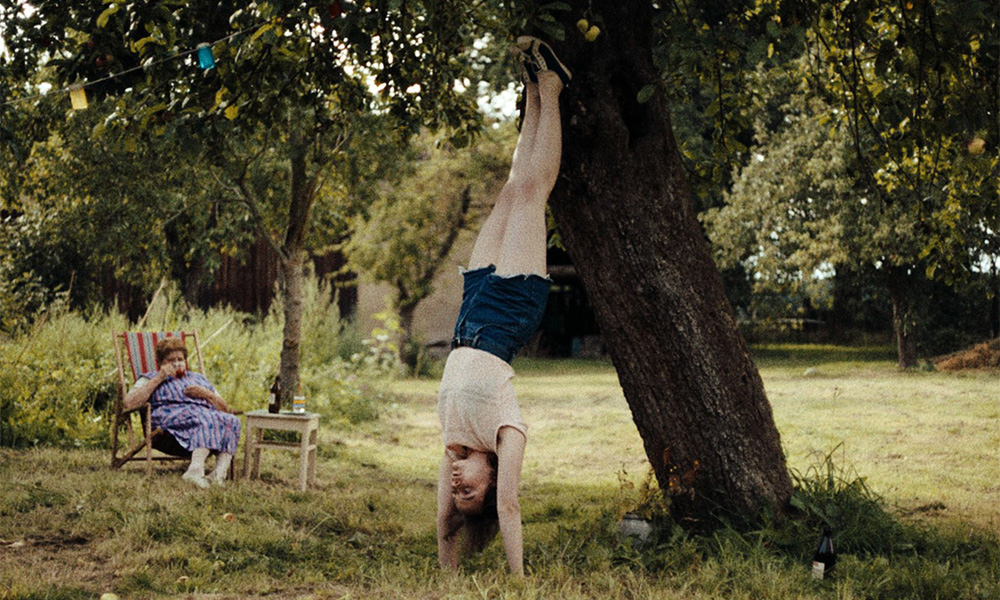
Even if Schilinski hadn’t been preoccupied for years with how people could leave an impression on one another across generations, she’d gain a unique perspective of the impact her own presence could have when “Sound of Falling” was greeted with the kind of rapturous reception reserved for only the most celebrated of auteurs at the Lumière, at once joining a grand tradition and at the same time pushing cinema in a new direction as soon as word began to reverberate in film circles around the world as soon as the end credits started to roll. What makes the film so remarkable is also why it’s so difficult to describe, yet it moves freely between four decades on a farm where young women, varying in age from the prepubescent Alma (Hanna Heckt) to the teenager Angelika (Lena Urzendowsky), gradually find the boundaries that give shape to their lives, both in terms of the limits imposed upon them within their families and communities and events from the past that they may have no knowledge of but have had immeasurable influence.
Words may fail to do justice to the film — or provide any to its characters whose inability to articulate what they’re feeling to others prevents any clear way of contending with their circumstances, but Schilinski prefers another form of expression, masterfully stirring the senses instead with the quotidian sounds of their environment that can send a shiver down the spine when it can anticipate what’s coming to the compositions extended as the characters’ point of view that can show how finite it is, relocating the viewer’s consciousness to what’s outside the frame. It’s there where the weight of previous generations and other forces beyond the control of the young women is felt most strongly while their restlessness is put front and center, creating a whirlwind that one can’t help but surrender to and the vulnerability of having the world speed by can be deeply felt.
After taking home a Jury Prize at Cannes and subsequent awards at the Chicago Film Fest and Cameraimage, among others, “Sound of Falling” was selected by Germany as its official Oscar entry for the Best International Feature and it was a great privilege to catch up with Schilinski recently as she was in New York to attend the Gotham Awards. With the help of a translator, the director spoke about the inspiration behind the film, her singular approach to conveying perspective and the fun ritual that set her actors free from the heavy characters they had to carry.
 How did this take shape?
My co-writer and I were discussing for a long time these subtle questions about what is written into our bodies what determines us through time. We were collecting all these phenomena about intergenerational trauma and we were so interested in invisible things and things that you have no name for and that have more of a literary quality. I was asking myself how can we turn this into a film. Then we um found this location [in Altmark] through COVID by accident. It was not that we were looking for it, but we had this feeling, “Oh, this could be really a vessel for all these questions that we wanted to explore.” I was immediately fascinated by the simultaneity of time there that hit me really deep because it’s an old childhood question that I asked myself a lot, this feeling that someone had been sitting at that same place where I was sitting right now and what was that person thinking? Does it have something to do with me?
At this farmhouse, I found it fascinating to juxtapose these images where someone is standing at one spot and do something profound and someone else has at the same spot has a very [mundane] existential experience to explore [ideas] about time and that we maybe don’t know anything about time.
From what I understand, this wasn’t originally a story primarily about women. How did it evolve in that sense?
Yeah, this was not our first intention at all because it was about intergenerational trauma in general. We had male characters as well, but through research we found out so many secrets about women’s lives — things that we really didn’t know before — and because all these stories are often so much on the sidelines of history itself, I tried to put them at the center and to explore more about these stories that are that are so full of shame that they aren’t told even on your deathbed.
It was so fascinating to hear that you got to write it in the place that it was set, how did being there allow you to think about how you would present it visually?
During the screenplay process of writing, I realized that this is really a film about memory itself and how memory and imagination flow into each other and how unreliable memory can be. You have pictures in your mind that maybe never happened, but you build your identity on these images. Fabian Gamper, my [director of photography] and I talked a lot about how can we capture this feeling of how memory feels and also when you can’t reach a memory anymore — how it feels when someone beloved passed away and you forgot part of this phase and you want to remember so hard but you can’t. These were questions that we asked a lot. I also wanted to do a film from a radical, subjective point of view where you’re really in this heads of these different [women] and you can capture these rituals and different times through their eyes.
 I found it so fascinating at what moments you decided to be directly in their perspective or outside of it, either using the sense of sound or the way that the camera moves. What guided you as far as when you would enter someone’s point of view or stay away from it?
That’s for me the key of this film. This situation that we’re in now for this [interview where] we were sitting here, speaking to each other, and we see each other but when I remember it later, maybe I suddenly see myself from an outside perspective and then I have an image in my mind that actually never happened. Maybe I forgot what was my clothes were, but I can see myself sitting in this room [remembering what I said]. I wanted to bring these images in this stream of memory from all the people who lived on this place to create this feeling of unreliable memories [where] you can’t be sure, is this a real memory or not?
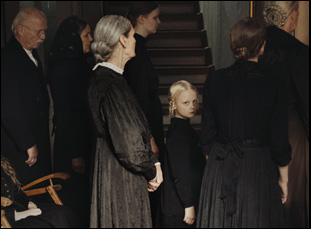
It was not a concept [where I would think] now we have to take this view or this gaze from this perspective. It was really an instinct. Writing the screenplay, I could feel now someone has to look back. The inspiration for the film was finding this photograph at the farm of these three women and they were looking directly into the camera and to break through this fourth wall became a motive for this film as well.
Indeed, you’re able to let them transcend the screen. One of the other things you do brilliantly is to orient the audience even though you don’t distinguish the time periods. What was it like you’re echoing scenes without replicating shots necessarily to convey a chronological cycle?
Yeah, it was really to stick by this idea that we are completely in this subjective state of mind from these characters, and that we don’t do images that are just for the audience, explaining things. We really believed in this idea that, so for example, when we go for a walk and then other people are passing by, we hear snapshots from sentences and we can feel immediately a whole life behind it. So it doesn’t need so much to get the feeling about the people or to understand something. I was interested in exploring this idea and also to challenge the audience in this way that they don’t know [and want to lean in].
 From what I understand, you were able to keep the mood light on set, even with the heavy subject matter. What was it like to create the right environment?
Yeah, the good thing is that all the kids in this film already had their own thoughts about death, violence and all this heavy stuff in this film, so they have this same instinct that we are exploring in the film itself. They are little detectives, finding things out that should be hidden by adults, so it was really easy to speak with them about this. I actually learned a lot from them and from their perspectives about these topics.
On the other hand, I wanted to make sure that the kids feel safe and sometimes it’s easy to go into a character, but it’s hard to find a way, even for adult actors. So we had this ritual of making this imagination shower. I was doing this with [Hanna Heckt, the young actress who plays] Alma every day [where] after shooting all day, [we would pretend to take a shower and] I returned her into Hanna. And she would leave [the set] for the weekend with her mother.
But one time, we forgot to do this and they were far away from the location where we shoot, so they had to make a U-turn. Hanna was sitting in the car and she was realizing, “Oh my goodness, I’m still Alma. I can’t go in the weekend like this.” [laughs] So then they came back and I did [the shower]. And then she said, “I’m Hannah! That’s so good. Thank you so much. I’m not Alma anymore.” The adults found this so funny at the beginning, but after a while they asked me as well for a magic shower because it was so helpful.
That sensitivity is evident from the final product. What’s it been like to see so many people touched by the film?
It’s so exciting. It’s such a journey for me. It’s like an adventure because I never expected this journey. I was never asking myself who is the audience for it. It was really this longing for a film that I had in mind that I missed for myself that I wanted to see. For me, it’s a miracle that it touches so many people and I’m incredibly thankful for for this awareness and for this visibility.
“Sound of Falling” opens in theaters on January 16th.