



In one of the many grace notes that sneaks up on you in “Blue-Eyed Girl,” it is undeniably poignant to have Marisa Coughlan’s writing credit for the film come up just as she comes into focus in character as Jane, a mother of two who has to take time away from a busy life to head back to where she grew up to tend to her ailing father Jack (Beau Bridges). Driving through a car wash where the suds are wiped away to reveal the mom suddenly seeing what she has to do next, the actress gets the appropriate movie star entrance, but after making a name for herself delivering the whipsmart dialogue of Kevin Williamson (“Teaching Mrs. Tingle”) and Broken Lizard (“Super Troopers”) like no one else, the well-placed opening title for her first produced script is just as deserved, something that Coughlan wasn’t even conscious of until she saw the final product.
“That [moment] came from a moment of me sitting in a car wash thinking it’s so weird how you’re moving [along] and it was just one of those rumination moments about life,” says Coughlan, who could be pleasantly surprised by what life had in store once more upon seeing the name drop, likely instigated by the film’s director J. Mills Goodloe.
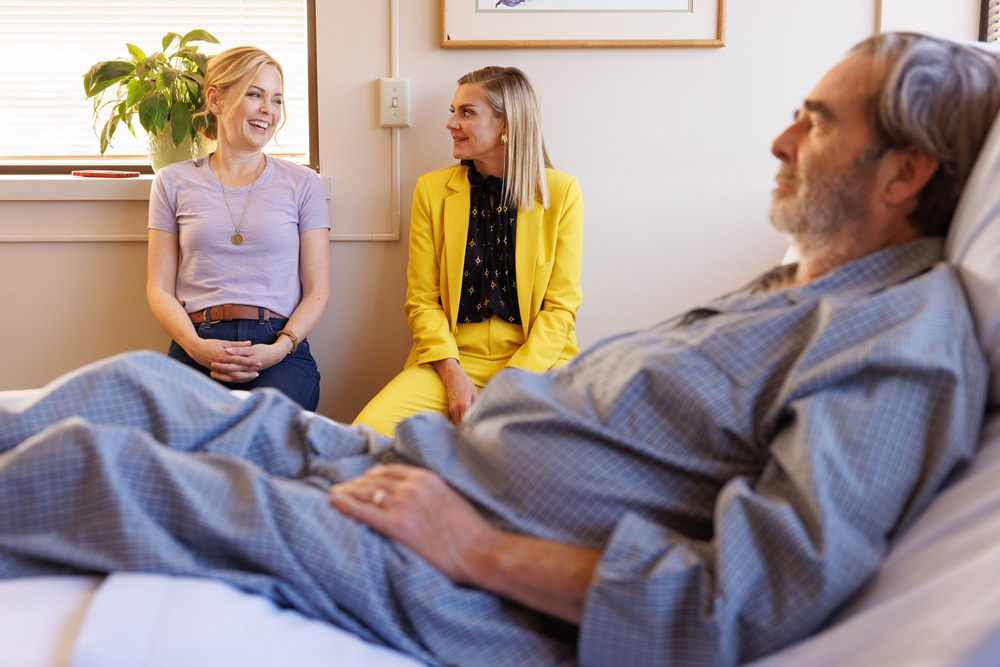
It is satisfying enough to see Coughlan in a leading role, having long played supporting parts where she could reliably steal scenes with her quick wit, but there’s an extra poignance to learn how she found herself reenergized by taking her life in a new direction in telling the story of someone else gaining the courage to do so. “Blue-Eyed Girl” is an impressive showcase for all her talents as it follows Jane back home to Minnesota where Jack recovers from a recent suicide attempt, a byproduct of a longtime struggle with bipolar disorder, and reunites with her sisters Alex (Eliza Coupe) and Cici (Bridey Elliott), the latter of whom is pulled away from her immersive work at a touring Renaissance Faire and always dressed accordingly.
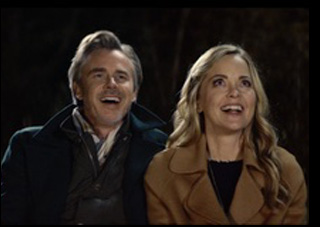
Even as Cal tries to calm their nerves by saying “I’m sick in the head, not in the body” — and clearly has great care in a compassionate nurse named Kathryn (Lisa Gay Hamilton) — anxieties run high and Jane has plenty else on her mind as this unexpected trip may have offered an escape from a marriage she worries has stalled with her husband Cal (Freddy Rodriguez), but only adds to her stress when she finds that her high school boyfriend Harrison (Sam Trammell) has also returned to town for a wedding, leading to wonder what might’ve been when they reconnect. Although Jane may be tortured by such thoughts, one doesn’t have to wonder the same about Coughlan career-wise as she imbues all the relationships in the film with the same humor and heart she could be counted on to bring to one of her own performances and while film benefits from the relaxed attitude of a seasoned pro in not tugging the heartstrings too hard, the deft balance of comedy and drama marks marvelous screenwriting debut.
After first premiering locally at the Twin Cities Film Festival under the title “Days When the Rains Came,” “Blue-Eyed Girl” is now available everywhere on VOD and Coughlan generously spoke about putting all of herself into the film when she turned her own home into a set and touched on real life events in her own life for inspiration.
 It’s no surprise to me that you’re a great writer. Was it something you always wanted to pursue or was it this film that brought it out?
Considering I wrote a movie about sliding doors and regrets and hopes, I do regret not becoming a writer earlier because I had ideas and yearnings and I’d always be like, “I’ve got to find a writer for this.” Then finally when I was 29 years old, maybe on “Boston Legal,” I decided to sit down and write and I wrote two or three TV shows in a row. One of them was a “Boston Legal spec and I realized, “Oh, wait, I don’t need to go find a writer. Maybe I can just do this.” It was a great learning process, but I do wish I had figured it out earlier.
How did you end up putting pen to paper for “Blue-Eyed Girl”?
I’m from Minnesota originally, and I moved to LA and went to college out there and then stayed [to work] as an actress, but I had three small kids and we moved back here [to Minnesota] and came back. My husband’s dad wasn’t well and my dad had passed in the interim, so coming home and walking the streets I walked when I was 16 and 17 brought this flood of memories of my dad and also just being young and idealistic, picturing what my life was going to be. I just wrote it almost stream of consciously. I didn’t outline it. I just got up early in the morning and started writing, just to purge missing my dad and wrote out some conversations and a lot of words of wisdom from my dad that are in a weird way, just me playing out conversations I wish I could have with him now, so it came organically.
When it comes from a personal place as this does, is that something you want to share with the other actors? Or do you want them to develop their own characters?
It’s funny because I don’t have sisters in real life, so it wasn’t like, “Oh, come and meet my sister. You should be just like her.” It was this amalgamation of all my best friends and my husband has four sisters, so they were born of my mind more than anything else. But all [the actors] made it their own. They didn’t they as much as they knew it was drawn from a personal place. It was really more like the themes and the ideas than the actual people.
 The relationship between Jack and his nurse Ryn is a particularly beautiful part of this as they find this deep connection later in life. How did that come into play as a storyline?
It’s funny because as a writer, I just will take little fragments of things I’ve heard and stories people have told me and metabolize them into something, so Ryn’s story was a little bit drawn from some personal stuff, but also I just thought the notion of two people who are a little bit older and a bit lonely who find each other and share their pain and let that forge a friendship, there’s something so hopeful about people at that stage in life when you’ve seen a lot of life and finding someone that you really can connect with.
On the opposite end, you’ve got this great Renaissance Faire element with Cici, the sister played by Bridey Elliott, who is always in full regalia, bringing a little fantasy into the mix. How did that become a part of this?
When we first moved back, there’s this thing called the St. Paul Winter Carnival and there’s a very very earnest court that presides over the carnival. They do a royal court tour all over the land for the entire year until the next person is crowned the following year —it’s women in their thirties — and I just read a bunch of interviews of them one day, not connected to the movie. I thought this is just such an interesting peek into a very niche world, and when all three sisters are searching for where do I belong in the world, especially for our younger sister in the movie who never quite fit into our dynamic — I feel like the two older sisters really have a little synergy that’s happening — there was something kind of beautiful about [Cici] finding her place in this super weird, quirky world. The fact that this world actually exists is also just odd enough to put put it in there and maybe it’s a little bit of a break from when things are feeling heavy.
You make Minnesota look so beautiful. What was it like figuring out how to present this area you knew well?
Once we decided to make it, we were raising money and my partner in crime Mills Goodloe, who directed the movie [said] “We’re going to shoot this October 10th. That’s what’s happening,” because he said we need a goal [to work towards]. But what he didn’t understand because he’s grew up in California was there are leaves on the trees [in the fall], but when they go, they go so all of a sudden, it turned into this mad race to capture the fall foliage. We did it, so we did make our state look pretty beautiful, but it was this ticking clock to make sure we got all the exterior shots when fall was at peak glory.
 When you’re acting in something you’ve written, does that make it easier on set or do you have to get rid of having a certain idea of it in your head versus what’s happening in the moment?
What was tricky about this was that it wasn’t isolated to being the writer and the actress. It was also my kids are the kids in the movie. The house in the movie is my house. My mom is in the background of almost every scene in the movie and my best friends are extras, so it was just the merging of two worlds, which was wonderful, but also intense. I’m also parenting my four kids, so I’d think, “I’ve got to make lunches.” Then you have to be on set and you don’t know your lines and you’ve got a science test. There was a lot going on.
It’s got to be special then to have this on your hands now, not only the achievement of pulling it off, but just capturing this moment in your life.
It’s pretty amazing. Also because we had really just come out of COVID and almost everyone I know creatively was just feeling isolated and stuck, [wondering] what is it going to look like now? There was a lot of fear and I wrote [this film] about a phase in this character’s life where she felt stuck and she needed to have a new chapter. And then in a weird way, that’s exactly what it ended up doing for me. It gave me this second wind and this next chapter. Being able to wear all the hats at once and make this baby really has done for me exactly what I wanted my character to have, so it’s been great and it couldn’t make me happier that people relate to it.
“Blue-Eyed Girl” is now available to stream on Prime Video and AppleTV.