




There is a lot going on in “La Gradiva” as Ms. Mercier (Antonia Buresi) tries to explain a Plinian eruption to her class of high school seniors at the site where the granddaddy of them all occurred centuries earlier at Mount Vesuvius, and cinematographer-turned-director Marine Atlan (collaborating with another DP Pierre Mazoyer behind the camera) is careful to gather everything, not ideally described as reaction shots when half the class is concerned with other things — putting on sunscreen or checking their phone — but instead to reflect the considerable dynamics at play as certain students gravitate towards one another or distance themselves from others or how they engage with their studies in such a way that the panorama of the natural wonder proves secondary to the intrigue of the social landscape she envisions. And in spite of never working the obvious metaphor to death when she often finds a location that has a way of speaking to what’s going on in any given scene emotionally, in setting this particular early scene at a volcano, Atlan clearly nods to the precarious sensation of living in such a state that puts everyone on edge that gives a crackling energy to the rest of her monumental directorial debut.
Atlan burns through a lot of film on “La Gradiva” when no scene has only one perspective, providing a fascinating view into a field trip with a bus full of French students across Italy. Free of adult supervision with the exception of Ms. Mercier and a single colleague, the teens can feel like adults when they can easily sneak off to drink or have sex and the teachers themselves can’t keep up the act of being a model for them all day, let alone a week. (One of the finest scenes in the film involves Ms. Mercier smoking cigarettes right along with her pupils after a long day, quietly entertained by their fierce intellectual debate about the value of education.) Ms. Mercier remains passionate about the job, but as she confides in a bus driver, she’s exhausted and you can understand why when each student is something of an enigma and she is expected to cater to them all.
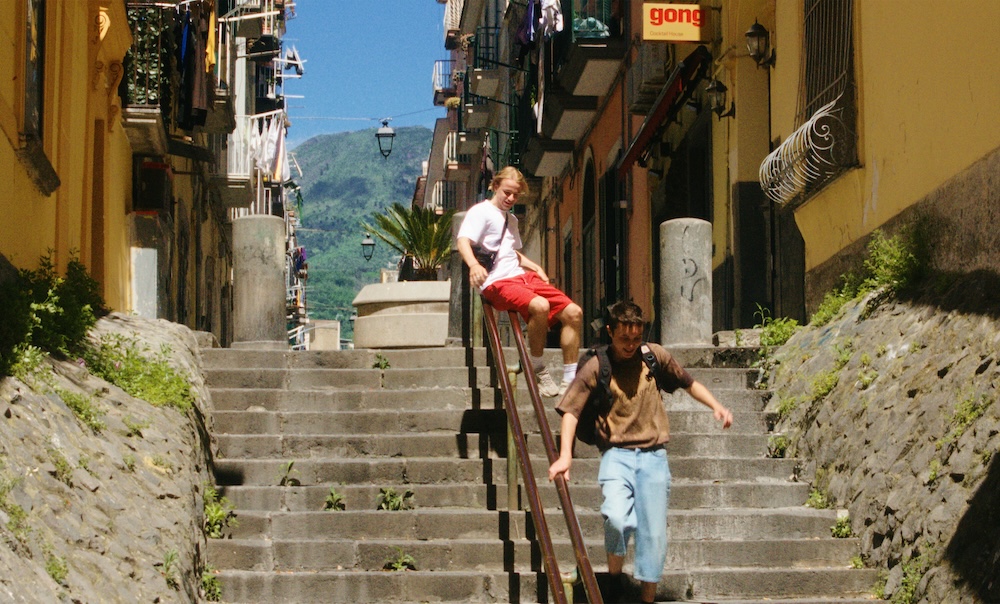
Although Atlan and co-writer Anne Brouillet afford nearly everyone on the trip at least a moment to show the different personalities at play, “La Gradiva” comes to focus on Toni (Colas Quignard) and Suzanne (Suzanne Gerin), who get a most fitting introduction in the hallway of a train where they both are on the outside looking in as the former has seen his best friend (Mitia Capellier) duck into a compartment for sex with a classmate, sneaking a glimpse himself through the drawn curtain, and the latter is keeping an eye on him. Both are deprived of such physical affection in their own lives when Toni, while being widely accepted as gay remains an anomaly amongst his class, and Suzanne has a dour view of herself, preferring to draw or read and though they are eventually paired off for an activity, they instantly reject spending any time together though if they did, they might realize they have plenty in common. While Suzanne has become content staying on the periphery until she can move onto college where hopefully she’ll find her people, Toni feels more and more detached from others when he not only fears a fraying connection with James, but he has been led to believe he has ancestors in Italy and a fruitless search for other members of the Montresi family leaves him concerned he has no roots or that what he’s been told is a lie.
Both are old enough to decide on the kind of person they want to be and well-observed taking active steps in that direction, but are not fully formed and although ideally Ms. Mercier can inspire with her passionate lectures, covering both science and art when they also take tours of museums in Naples, there’s only so much wisdom any adult can impart and instead the teens are left to look to one another when they surely haven’t figured it all out. The uncertainty leads to a number of riveting scenes of the entire class taking away something different from various interactions, with Atlan and Mazoyer’s coverage as well as deft editing by Guillaume Lillo dazzling as it balances out where everyone is at, and with both hormones and emotions running high, the director is able to relay the same intensity of experience. Ultimately, it is bound to overwhelm Toni and Suzanne, who increasingly have trouble containing what they’re feeling and brought to wrenching life by Quignard and Capellier. As they try their hardest to be honest with themselves as they put on a brave face for everyone else, “La Gradiva” comes across as one of the truest depictions of such a restless age put on screen in recent memory.
“La Gradiva” will screen once more at Cannes as part of Critics Week on May 22nd at Le Raimu at 7 pm.