




The most obvious way to approach “The Yogurt Shop Murders” would’ve involved dimly lit rooms and interviews in isolation to convey the devastation caused by the horrific deaths of four teenage girls at an I Can’t Believe It’s Yogurt in Austin in 1991 and the dark nature of those that perpetrated the crime. However, Margaret Brown knew that was no way to get at a real story.
“We had a rule where if anyone had a dog they had to be in the shot,” said Brown of the many pets that make unexpected cameos in the series that may be rarely the focus, but give rise to revelations when conjuring an airiness to speak about grim subjects rather than claustrophobia of tucking them away. “I wanted people to feel relaxed and interviews to feel lived in, so anytime there was a dog, we pretty much gravitated toward the dog.”
In situations for which there are no words, Brown has long had the ability to elicit them, excavating histories that can be difficult to talk about for reasons of memory or trauma, whether it was the fresh round of recriminations to surface along with the newly discovered remains of the slave ship Clotilda in “Descendent” or returning to her hometown in Alabama in “The Order of Myths” to find the roots of its segregated Mardi Gras celebrations as a holdover from antebellum times. Ironically, her latest might defy description as well when it’s bound to be a high watermark of the popular true crime genre – and in fact, makes a fine pairing with the first season of “True Detective” on HBO with its Texas setting and colorful characters – yet eludes such easy categorization when the director elegantly quantifies the psychic toll the unsolved murders had on the city of Austin since they were committed 30 years ago.
Although locals can cite specifics of the case and lament the 1991 murders of Jennifer Harbison and Eliza Thomas, who worked at the yogurt shop, and Harbison’s younger sister Sarah and her friend Amy Ayers as the moment the capitol city lost its innocence as a hippie enclave in a state known for its cowboys, it is as if time stopped for those directly involved in the aftermath. (The parents of the teenagers such as Ayers’ father who introduced himself to Brown by saying the exact number of years and days since he last saw his daughter alive, to the police as John Jones, one of the two initial lead investigators on the case, can be seen pulling out the suit from his closet that he wore to the press conference announcing the murders, never to put it on again.) While it’s unlikely anyone will ever find peace, the director puts everyone at ease enough to process the emotions guiding them through a most frustrating search for justice where the initial urgency to get a quick arrest led to disagreements in the police department that stymied progress on the case and many suspects were brought in for exhibiting the sketchy behavior that’s long been a byproduct of Austin’s independent streak that didn’t necessarily extend to criminal activity.
Having made Austin her home in the early 2000s, Brown organically taps into the idiosyncratic currents that have always run through town with the same frequency as the Guadalupe River where the chief targets of the investigation in the case lurk, presenting a crime that touches all different corners of the city. But it’s her extraordinary empathy that leads to expressing how uncertainty about what happened can be even more punishing to those who have lived on than the graphic details that are known, including Claire Huie, a fellow Austinite who set about making her own documentary 15 years ago amidst the various episodes of “48 Hours” devoted to the crime, and reached her own dead end. Making great use of that footage now as well as conducting her own investigation, Brown replicates the emotional rollercoaster that all those touched by the murders have had to endure, forced to rationalize the unfathomable and find the strength to carry on as they all feel in debt to the deceased. With the four-part series recently premiering on HBO with new episodes every Sunday throughout August, Brown graciously spoke about her first episodic work, capturing a time and place in her own life with the project and the very different version she originally had in mind.
What got you interested in this?
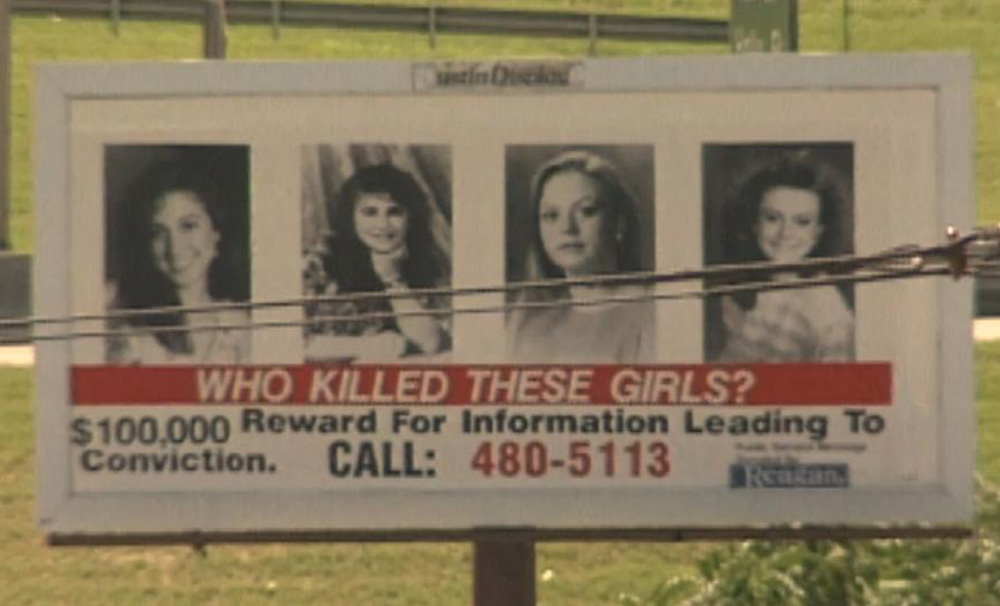
It’s one of the main Austin stories and I’ve lived in Austin on and off since the late ‘90s and it was just something that was always in the air. I just remember being at like parties late at night where people just start talking about the rumors around it and everyone’s theory about what happened, so I knew already it was a good story without even it was something I knew that could be really interesting. I’ve always been attracted to stories where I feel like I know this story already [to some degree] and I remember those billboards [of the young women] and a lot of my friends who work in film and friends who don’t knew the girls. They had siblings that went to school with them or were cheerleaders with them, so it felt close to me and a lot of my friends are reporters in Austin.
But I’m not a true crime filmmaker. I’ve listened to a few [podcasts] and I’ve watched some [series], but it wasn’t what I’d normally be doing. I actually came on when I saw the archival footage via Emma Stone and Dave McCary’s company Fruit Tree and they brought it to a24, so there was already a package put together and they had a package [of archival footage] ready to send me and it was amazing to see. They had really painted a picture, so I started to feel what I could do with it was very Lynchian in terms of a piece of a time when I wasn’t in Austin, but I could imagine it from when I was. I could still feel the edges of what that must have been like [where] the cowboy thing but also the punk thing [met]. Now Austin’s different with the tech boom, but all that is still there, so I felt like, “This is a time capsule of where I live, not just a story of this crime,” so that was like very seductive.
This is built in part on top of work that had been done around 2009 by Claire Huie, who I had known from making a doc “The King of Texas” about Eagle Pennell with his son Rene. As is made clear in the series, she couldn’t bring herself to finish when the experience of making it was too overwhelming, but I wonder what it was like to encounter all this footage she had compiled and also be able to tell a story that so many filmmakers experience, but rarely want to put on screen when a project doesn’t work out?
I identified with it so much. There were so many times when I would think, “Well, I have to go back and interview Claire again because she can articulate this even better than I can” [as far as] this meta narrative about making movies. She lives really near me and she just gave the production 250 hours of footage. She never finished the film and the making of it made her stop making movies. Now she’s a meditation teacher, but I think she was a really ambitious filmmaker and the yogurt shop destroyed a lot of people’s lives – obviously, the families the most, but there were other people left in its wake and I think Claire for a long time was one of them.
What was it like to meet the families for the first time?
I met the families right when I started – not everybody. Barbara didn’t want to do it for a really long time, so that was difficult, but the Ayers family I met right away and it really impacted me on how I wanted to make the movie because it went from me seeing the footage and [thinking], “Oh, this is Austin in the 90s, it feels Lynchian or like “Slacker,’” to meeting the families and feeling the weight of their pain. I [thought] it can’t be as stylized as it is in my head. I have to figure out a different way to tell the story. Not that I wanted to tell it without stylizing it because that footage also exists – that’s the fabric of it – we used to color colored neon backlights for all the interviews because we wanted it to feel connected to the archival footage in a certain way, but I didn’t go as stylized as I was [initially] thinking because you would be thinking about the lighting and not about what they were saying and what they were saying was so powerful. I wanted people to really be interested.
I never cease to be amazed at how natural those interviews still come off in your films when it’s usually quite a heavy subject and the person in front of you looks relaxed enough to actively process their experience in front of you. It may come naturally, but what’s it like to create the space to do that?
I don’t know. Part of it is that the people in the film are pretty gifted storytellers and like Huck, who’s the white cop who was first on the beat, he’s such a phenomenal storyteller. I’m just curious about people and what makes people tick and I love everybody, so that’s how I approach things. I try to be as open as I can and turn off my judgy brain, which I’m sure is very judgy while I’m talking to someone, just to really deeply listen. It’s kind of a trance sometimes when you interview someone. You’re so in the moment, paying attention.
Was there anything that happened that changed your ideas about this as you were working towards on it?
I was promised by all my reporter friends there was twists and turns all the time and there’s all these group chats I have with the editors and the producers, all talking about theories and it was always a very alive project with lots of different opinions. I really tried to go in thinking I don’t know what happened, so I’m just going to be open-minded and I was getting surprised all the time. I remember when we found out that the Cold Case unit had a life-size replica of the yogurt shop they had made right when you walk into the Cold Case unit, so every day everyone who works there has to walk by that as a reminder of something that’s unresolved. I just thought “Holy shit! That’s insane.” Then when I learned about some of the DNA stuff, that was really interesting.
Was it interesting to figure how to engage with the crime as far as the narrative was concerned while leaving the room for everything else that makes this so fascinating?
I felt I had to tell the story of the crime because there will be no story without it, so it’s not that I wanted to take the crime out of it because it’s inextricable. But it was so dark and so hard to witness pain with all these people – and I’m obviously not a therapist – and we thought a lot all the way through about how we all go through this. Life is, in a lot of ways, suffering and trying to find joy and seeing how these people in very different ways continue to live alongside this trauma that’s never going to go away is a real human question and I was interested in that. The crime is the vehicle to get there, but I was really inspired by these families relationship to that and curious about what works for different people.
Was it different to work on a four-part series?
It was hard. In a really crass way, one thing I was interested in was that I’ve never gotten to do a cliffhanger, so [I wondered] how do you do that? That was fun to figure out with my team because it was very much a team effort. I work a lot of the times with the same people over and over and we all went in together. Like I was saying there’s so many group texts going, which makes it really feel collaborative and like we’re in the darkness together. But sometimes it was just really hard to wake up in the morning, imagining we’re excavating something that these poor families have had to go through for so long and we’re just part of it. I know what I’m going through is such a small fraction of what people in this case have gone through, so it was just very humbling. I really was worried that I wouldn’t do a good job and it was so important to me to do justice.
“The Yogurt Shop Murders” premieres on HBO on August 3rd at 10 pm and airs new episodes each Sunday through August, available to also stream on HBO Max.