



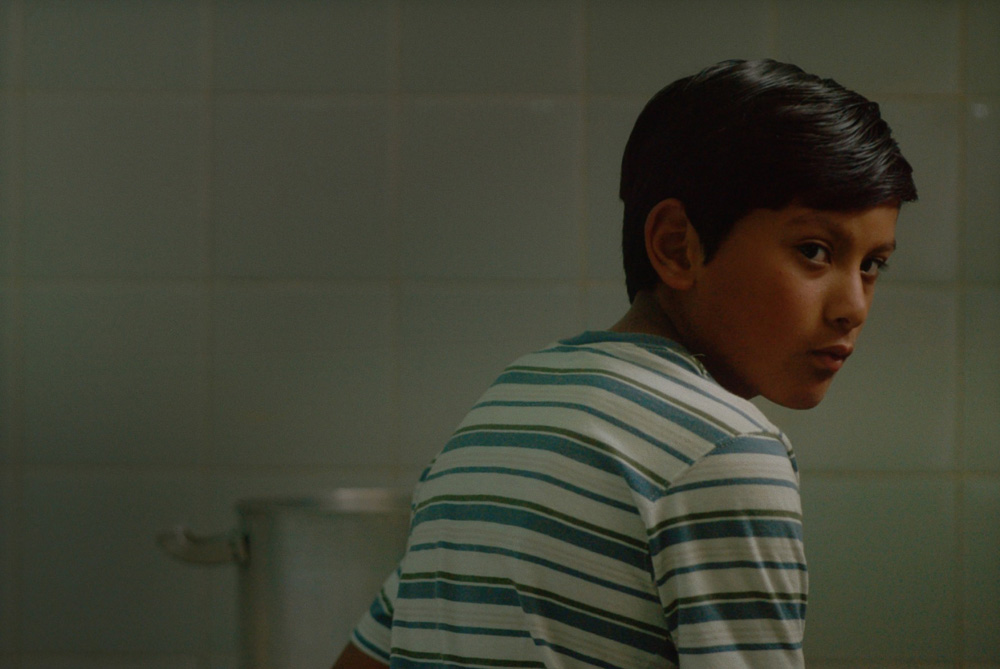

“Mischievous and confident – you have that look,” a man who goes by the name of the Terrible Black (Fabian Casas) tells the 10-year-old Milo (Milo Barria) in “The River Train,” alerting him to an audition for a play going on in town. The two barely know each other, but it’s the natural thing to tell such a precocious boy who has found himself in the big city of Buenos Aires sans any adult supervision, with co-writers/directors Lorenzo Ferro and Lucas A. Vignale having come to the same conclusion themselves long before that the child should be on a stage or a screen. It’s a bet that everyone wins in the filmmakers’ playful feature debut in which there may never be any great sense of danger for the unaccompanied minor who takes the train from the countryside despite the sketchy characters he runs into, but the danger lies in not knowing what the world outside his small town actually looks like.
Touched with just the right amount of organic whimsy, Milo’s journey isn’t much more than spending a little over 72 hours in his company, but it’s a quietly formative period as he ventures away from his family, presumably for the first time, and begins combining the reason he’d run away with a reason to keep watching when he dazzles, dancing up a storm at a Malambo competition where he impresses much of the crowd except his father Mariano (Mariano Barria). After seeing his dad prepare him to take the stage not by practicing his footwork, but to ask for instinctual one-word responses to a word game, constantly commanding “Don’t think, speak,” it’s hard to imagine any outcome being satisfactory and there are no words at all on the way home even in success, leaving Milo to consider greener pastures than the ones they drive past. After dinner, he decides to hop on the one train that passes through town, a trip where a monochrome opening title sequence turns to technicolor when he ends up in a metropolis, unsure of what to do, but finding the world is ready to take care of him when a pair of headphones he randomly finds instructs him as to where he can find a place to stay, though he’ll still have to pilfer an empanada or two from a local market if he wants anything to eat.
“The River Train” has the obvious charm of its adorable star who hasn’t yet made up his mind about the world as he’s thrust into it, but less pronounced yet equally endearing is how ingrained that childlike wonder is ingrained into the fabric of the film when there are gently absurdist touches that invite curiosity such as the train conductor who brings Milo to the city is prone to poetic monologues and spare locations and modest costumes come to life with daps of lively colors and intriguing compositions. Ferro and Vignale walk a fine line between offering the same space to viewers as to Milo to process what’s happening and threatening to become tedious when the ambiguity of drawing conclusions as the child’s consciousness takes shape can feel as the filmmakers didn’t want to make any choices themselves, but they foster a way of seeing the world with innocence that feels unforced and true, yielding a film that’s appropriately strange and surreal at times in approaching the unknown but warmly imaginative when it comes to recasting the sights and sounds people take for granted as they age to once again feeling full of possibility and promise.
“The River Train” will screen again at the Berlinale on February 17th at 4 pm at Cubix 9, February 18th at 10:15 pm at Cubix 8, February 20th at 1 pm at Colosseum 1, February 22nd at 2:30 pm at Cubix 9.