



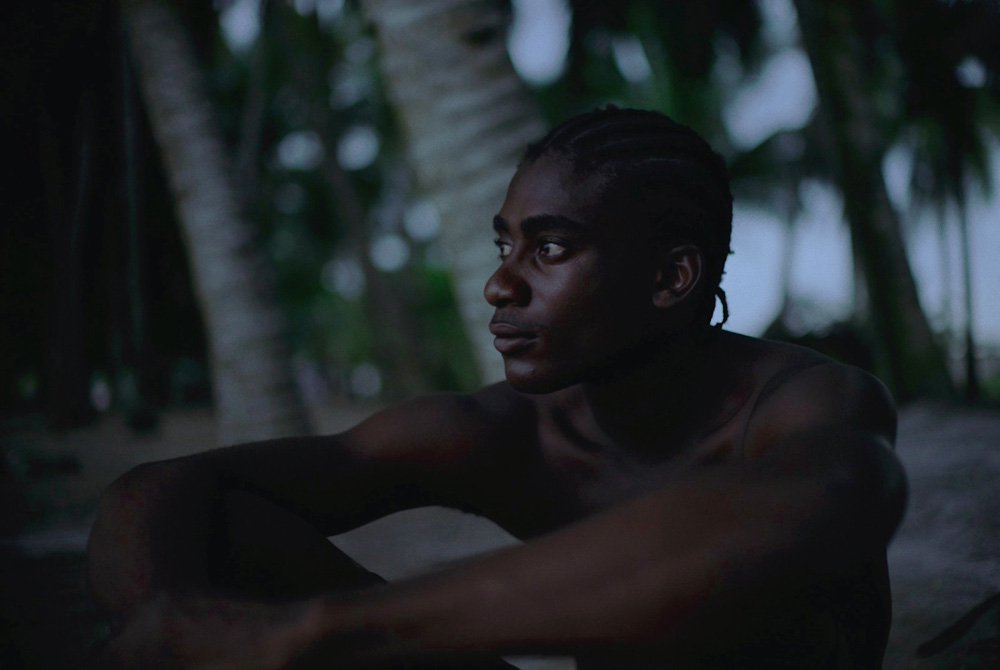

Kojo (Daniel Atsu Haukporti) and Tony (Joey Boivin Desmeules) have more in common than they could know in “Paradise,” connected by director Jérémy Comte at first with a cut between them sharing a joint with friends on opposite sides of the world. Although Tony smokes his in the company of friends he goes skateboarding with during a lazy afternoon in Canada, Kojo has to sneak off after church to light up with a pal in Ghana, leaving his father to wonder where he is the next morning when he doesn’t immediately return. Both teens don’t seem much of their single parents anyway when they have to work, but while Tony hasn’t ever seen his father, raised by his mother Chantal (Evelyne de la Cheneliere) who now is preoccupied with teaching Tai Chi while running a household that’s hardly zen with its pressures, Kojo only now is about to miss his when he learns that in searching for his son, his dad has gone missing.
Comte, who turned heads with his 2018 Oscar-nominated short “Fauve” about a a pair of boys who fell into quicksand, is bound to turn a few more as he fearlessly dives into a whole other morass in his fascinating feature debut that reminds a bit of another Quebecois filmmaker’s international breakthrough, Denis Villeneuve’s “Incendies,” in taking a story of intimate scale and broadening it to a global scope. Kojo and Tony may have thousands of miles between them, but they share a gaping hole in another way when they could use some parental guidance and find they have nowhere to turn. Working with co-writer Will Niava, the director finds a novel way to bring the two together when their lack of good judgment leads to them closer to each other physically as much as psychologically, seeing each other as adversaries when they share the exact same issues.
The film surprises from the start when Kojo appears as if he’s found his way into a music video with an SUV speeding down the street with a man tossing out fistfuls of cash as he’s buffered by motorcyclists as a grand show of his wealth, but Kojo is one of many who runs to collect as many bills as he can to take back to his father who spends his days stitching together fishing nets for a living. It turns out that Kojo could make more than his father does with a different kind of phishing, ultimately tracing back the charity to a scam run over computers where voice manipulation and a few choice text messages can pull in lonely adults looking for love and wring them dry. “With women, you’ve got to play the long game,” Kojo tells a new batch of recruits after successfully luring several to open their Venmos to him, one of which turns out to be Tony’s mother, who believes she’s engaged in a long-distance relationship with a sailor. He isn’t slick enough to avoid raising suspicions, but he has incentive to stay in the relationship after Tony’s mother realizes she’s been had when after losing his father, a deep sense of loneliness sets in and could use a compassionate ear, not matter where it comes from.
The reveals baked into moving back and forth between Ghana and Canada risk becoming rote as a form of suspense, but what does end up surprising about “Paradise” is how Comte is able to express the need for connection by his two adrift leads who make reckless decisions that reflect what is missing from their lives. Cinematographer Olivier Gossot, who brought such striking visuals to “Fauve,” brings a crisp, cool distance to a drama where the characters at the center are often smoldering as they search for answers that may never come. Of course, Tony feels he has to do something upon learning of his mother’s potential financial ruin, but rather than looking as if he’s grown a sense of responsibility, a quest to make things right only reduces himself and Kojo to appearing as the misguided youth that they are, an observation handled so well that it appears that Compte is working with both skill and wisdom beyond his years.
“Paradise” will screen again at Berlinale on February 19th at 10:45 am at the Colosseum 1 and February 21st at 10:30 pm at the Zoo Palast 2.