




When Madeleine Sims-Fewer and Dusty Mancinelli approached Grace Glowicki and Ben Petrie, a real-life couple, to play one that had lost their spark in their second feature “Honey Bunch,” they planned to woo them the old-fashioned way.
“We made dumplings,” says Sims-Fewer of the dinner in which they convinced the couple to come onboard, cooking up a full meal for Glowicki and Petrie to feast on while laying one out narratively by performing their script in full. “We really went all out to try and and bribe them to be in the film. Like old storytellers of yore.”
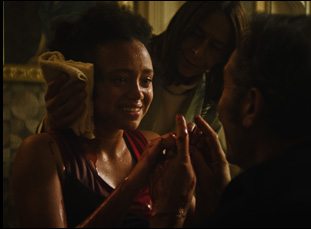
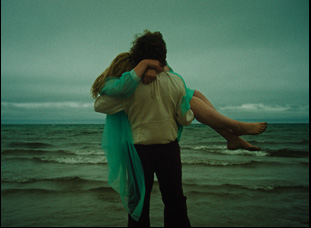
While seeing the final product would make one desperate to see what this dinner table version of “Honey Bunch” would look like given all the special effects to be compensated for with performance, not to mention the convivial company that was there in general when the quartet are fast becoming some of the most fascinating raconteurs around, the persuasive elements of the gambit come through undiluted in Sims-Fewer and Mancinelli’s seductive gothic horror film which sees longtime lovers Homer (Petrie) and Diana (Glowicki) retreat to the countryside where the latter is set to recover from the effects of a recent car accident. Her hip may have been shattered in the incident, but more concerning is what the crash did to her confidence as Diana’s memory comes and goes, relying on Homer to help her get through the days and making a hand-off to a hospice staff, led by Kate Dickie’s caretaker Farah, unnerving, even before learning more of their experimental “sensory stimulation therapy.”
However, Diana can’t know who to trust when she starts to question the motives for Homer bringing her to the clinic in the first place as she becomes bothered by all the strange goings on, particularly that there are corners of the institution that are curiously off-limits, though she has freedom to roam all across its lush gardens where stepping outside can seem like she’s exploring the recesses of her mind. After setting up a similar mystery box in their shocking debut “Violation,” Sims-Fewer and Mancinelli pull off surprises even when there’s some expectation of them as the film follows Diana reevaluating everything she believed to be true before, most thoroughly her connection with Homer where she can start seeing neglect where she once saw love and even vice versa, and has to wonder if she’s being gaslit now when she’s been made to feel she can’t trust her own instincts either. A thoughtful rumination on a couple that has to evolve as personal evolution takes place, the film nonetheless finds suspense in how dangerous it can feel being inside a committed relationship when that bond was forged years earlier the people involved aren’t even entirely aware of who they’ll be on any given day when faced with what life throws at them.
After the film became a conversation starter out of Berlinale around this time last year, “Honey Bunch” is set to be an ideal way for many to spend this Valentine’s Day weekend cuddling up on the couch with its premiere on Shudder, when it is bound to nudge a couple closer together in its darker moments and prompt passionate conversation after. Recently, Sims-Fewer and Mancinelli spoke about how they sought to make something they could watch on repeat, landing the perfect pair of actors to lead it in their filmmaker peers Glowicki and Petrie of “Dead Lover” fame, and creating something that could be chameleonic in tone.
 How did this come about?
Madeleine Sims-Fewer: It was after we made our first feature “Violation,” which was a micro-budget horror dealing with our own trauma and we had a very harrowing experience making the film, although it was cathartic in a lot of ways when we were shooting it. When we were in post, we had to watch these horrors over and over and over again and after that, we [thought\, “Okay, what are we going to write next? We wanted to make something that we can watch again and again and not feel totally wrecked and traumatized, so we decided to make a our version of a twisted love story, looking at a gothic mystery framework and then trying to upend expectations or deepen people’s understandings of the characters that we had within that.
Dusty Mancinelli: What was really interesting is trying to develop this idea of how far are you willing to go for the person that you love and do it within a genre landscape, so we were keen to utilize tropes to build your expectations up in a particular way so that we can then pull the rug out from underneath you. When we think about their relationship, Homer and Diana, it’s really through that perspective and the film we’re seeing from her point of view, so as the film evolves, there’s something that happens right at the midpoint that really transforms the film and challenges you as an audience to think more deeply about what you have already seen. For us, what was really exciting is that it’s a film that when you watch it a second time, you see a completely different movie.
Madeleine Sims-Fewer: We were trying to peel back the layers like that with a lot of movies where there’s a twist, when you watch it a second time, you’re just waiting for the twist. And although there is something of a twist in our film, we wanted you to be able to then go back and watch it and actually be watching it from another perspective rather than just waiting for the twist.
 It totally works — I’ve seen it a two times myself and it’s fascinating how it plays completely differently and tonally, there’s enough in there with various touchpoint it can play as a bit of a screwball comedy or a gothic horror. What was it like giving yourself that kind of narrative leeway?
Dusty Mancinelli: We were really reacting to the footage that we have and trying to service the best version of the material. We learned really quickly Grace and Ben are really unique performers and that the film was just much stranger than we had really anticipated. That was an amazing thing that we had to lean into with the sound design and the music in the film and what’s really interesting is that I think how you watch the movie shapes how you see it. When we premiered at TIFF, the first screening felt like it was a nice combination where the audience were scared, but also lots of laughter. The second screening, for whatever reason, I do not know why, it was just scarier. Someone passed out and and had to leave the theater and it was just so interesting how your experience of a film is really shaped by the environment in which you watch it and by your own own attitudes and the headspace of where you are when you watch it.
Madeleine Sims-Fewer: But the comedy was always there on the page because we wrote the the characters of Homer and Diana really with Grace and Ben in mind and drawing things from our own experiences and our own daft conversations in our relationship, so it definitely had some of that “Girlfriends” meets Nic Roeg element too.
When Ben and Grace are a real-life couple, was that actually what attracted you to them at first as potential leads?
Dusty Mancinelli: We have been fans of their work for years and we wrote it for Grace and Ben to star in and luckily, they really connected with the characters and we had this unique opportunity to really develop the characters with them and find the voices with them. But what’s so great about them is that they’re incredibly professional in separating like their personal life from the characters that they play. They have their own clear boundaries and that allowed us to think deeply about what characters do we connect to and why? That brought out a lot of our ow personal relationship explorations through the characters.
Madeleine Sims-Fewer: We don’t have any boundaries when it comes to art. [laughs]
Dusty Mancinelli: Yeah, Madeleine is more Homer, I’m more Diana.
 At what point did you have the central location in mind for this institute? It has so much personality in and of itself.
Dusty Mancinelli: Yeah, this is shot all across Ontario in Canada. It’s really challenging to find the type of architecture that we were going for. We spent eight months really scouring the place and we found this gorgeous little manor in Owen Sound and this man Barry, who was in his eighties, has lived there his entire life. He was so thrilled for us to be there. He was the groundskeeper and he had these gorgeous gardens. Otherwise, we filmed all over and we stitched together the waterfall, the caves and the bluffs and all the other locations in the film, so that it feels like a cohesive world.
Madeleine Sims-Fewer: Yeah, with “Violation,” it was also one central story location, but at least 20 locations made up that one cottage. And we just built on that [idea] because we really want to create unique worlds as as filmmakers and “Honey Bunch” was this unique world that we had a very specific idea in our head of, so we just basically drew a map of what the location was for us and then we found all of these places and built on what we’d done in “Violation” of just stitching it together but on a much larger scale.
Sonically, you also create quite a world and you’re working once again with composer Andrea Boccadoro as well as time surf for some great needle drops. What was it like putting together the music?
Dusty Mancinelli: Yeah, Andrea, our composer, is incredible and we’ve worked with him on all of our films. We knew early on that the film was set in the ’70s, so we really wanted to adopt similar approaches to to filmmaking. For example, we used old lenses from that era and we knew the scores back then were far more melodic and theme-driven, so early on, a big part of how we conceived of developing the score with Andrea was trying to find the individual themes for the characters. That really transformed the tone of the movie — the emotionality of how you connect to the story was through those particular themes.
Madeleine Sims-Fewer: Yeah, and some of the songs were baked into the script and some songs that were in the script we couldn’t afford, so we had to then go on a hunt for music that gave the same the same feel. Everything that we found ended up being more appropriate than what we had initially had in our minds and we like to make playlists for our actors of songs that they would listen to or songs that spark a certain emotion that comes with a scene and we found a lot of the music that way.
Dusty Mancinelli: For example, the opening song in the film is this amazing Ivor Cutler track and he’s this Scottish Folk musician that not a lot of people are aware of, but he’s got just such a unique voice that’s tragic and beautiful and humorous. It was just so specific and we knew instantly we needed to open the movie with some something that was quite provocative and strange as a sound because the movie is very, very weird and we want you to know it’s weird from the very first frame until the last frame.
 Aside from people passing out in Toronto, what’s it been like seeing audiences respond so warmly to the film?
Dusty Mancinelli: It’s been so exciting.
Madeleine Sims-Fewer: When we released “Violation,” it was during COVID, so it was quite sad because everything was really distanced and we do all all our audience engagement was online, so this has been really lovely.
Dusty Mancinelli: Also, we finished this movie a year ago with the world premiere at Berlin, so we’ve been waiting to release this movie to the world for a really long time and it’s just really exciting to get it out there and for people to see it and to hear the conversations of how people connect with it and the things it evokes and what draws out of them is really interesting.
“Honey Bunch” is now streaming on Shudder.