

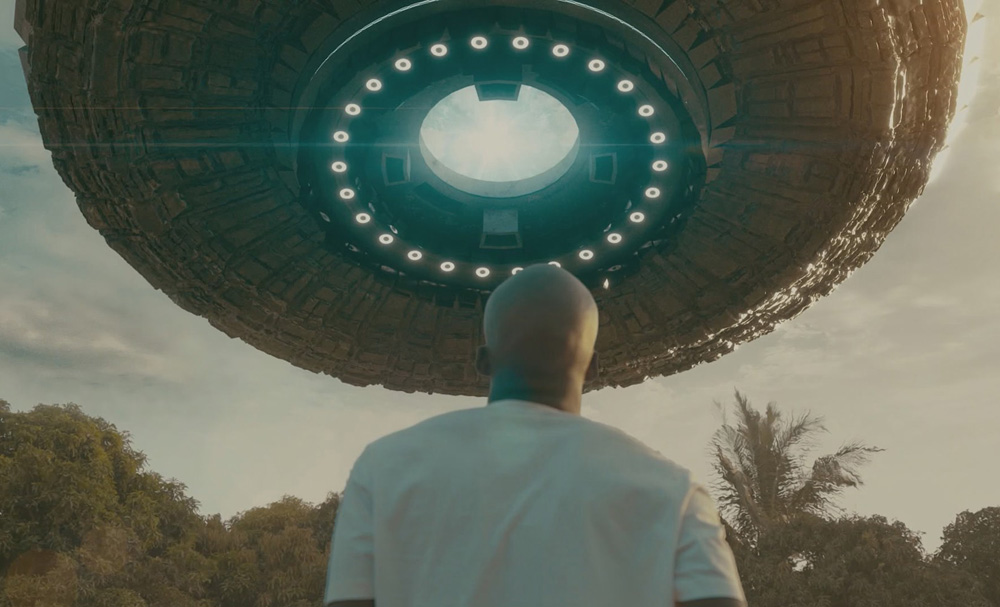

“Sci-fi is not Nollywood,” Raymond clarifies in “Crocodile,” differentiating what he’s been up to with the Nigerian film collective known as The Critics and what the rest of the scrappy film industry there has been doing for some time. The country has been known for their prolific output, releasing over 2500 films a year yet as Raymond sees it, too few have been devoted to thinking outside of it whether in terms of the future or simply geographically. A teenager in 2019, it’s safe to say he is of the first YouTube generation, having learned to make films from tutorials, having access to examples from website and ultimately making them to upload, having a group of friends always at the ready to put together a production that he can come back to his house and edit together. Even before imagining other stories unfolding in other galaxies, it seems as if he’s fashioned a universe of his own on earth when working away on his computer.
This isn’t the first time that New Zealand-born director Pietra Brettkelly has tracked someone who sees cinema as a lifeline, once heading to Kabul to follow Ibrahim Arif’s passionate push for preservation of Afghanistan’s National Film Archive as it was threatened to be lost under Taliban rule in the 2015 doc “A Flickering Truth,” and those of a similar belief will surely be quite taken with her latest, which doesn’t concern itself with history at all, but rather how one can maintain hope for the future when the Critics grow up amidst the ever-present uncertainty in a country deprived of resources and subject to ongoing violent conflict. Hardship isn’t dwelled upon in “Crocodile” when Raymond and his crew themselves put their heads down to create escapism, a pursuit that Raymond doesn’t even feel he can share with his own father who is a conservative pastor, but finds great success sharing with the world as the Critics’ lo-fi productions packed with savvy editing and special effects have UPS making visits to their door in Kaduna with commemorative plaques from YouTube about their ever-growing number of subscribers.
They get even more impressive packages from Hollywood addresses that can help give a professional polish to their work, which should be spoiled here, but when “Crocodile” was filmed over 13 years, it’s bound to include as many lows as highs and the time Brettkelly spends with the group during their formative years ends up as a story that could happen anywhere when Godwin, another key member of the group starts to have a greater interest in music as an artistic pursuit, and other serious issues crop up that prevent remaining as tight as they once were. The documentary is presented as “A Film by Pietra Brettkelly and the Critics” and it sports the latter’s energetic editing style, even playfully bending reality at times as their genre films do, and seems to mirror their maturation as it starts to calm down as they age, though as they wonder themselves, that might not always be for the best as they fondly recollect running around with camera phones and feel increasingly locked into certain way of doing things more professionally. Another one of the film’s early strengths becomes a liability later on when presenting the Critics as a collective, avoiding sit-down interviews and resisting singling anyone out, tangling up their increasingly individually specific storylines a bit when it isn’t always easy to keep track.
However, “Crocodile” inspires the same visceral reaction as the Critics’ work does in general with as much immediacy when they are shown succeeding against all odds, having to pour gas into a power generator to keep the batteries for their cameras charged and gaining more personal fuel for the fire from seeing the available technology democratize whose stories get told. (Even within the group, it’s nice to see Raymond’s much younger sister Rachel get a shot at the director’s chair and making a far different film than her brother would.) At a time when it seems like technology and global connectivity have only created greater insularity, “Crocodile” demonstrates impressive reach, both in conveying how far stories can travel and how potent creative expression remains in creating community.
“Crocodile” will screen again at Berlinale on February 14th at 9 pm at the Cinema Betonhalle at Silent Green, February 20th at 7 pm at Zoo Palast 2 and February 22nd at 10 pm at the Cinema Betonhalle at Silent Green.