


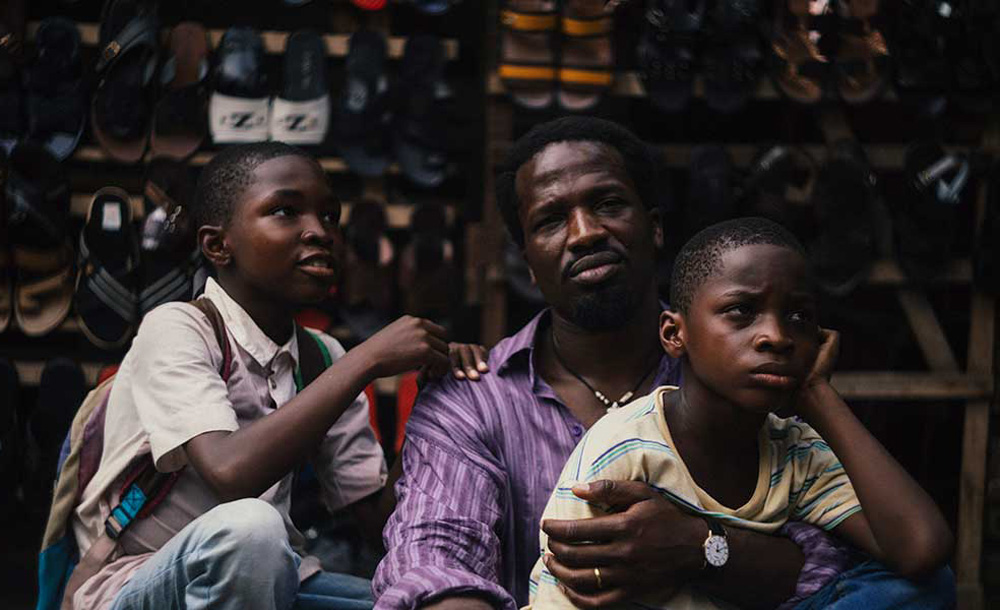

If a sense of revelation is felt throughout “My Father’s Shadow,” it might be because it was such a big part of the process for Akinola Davies Jr. The director hadn’t even known his brother Wale wrote screenplays when he asked him to read a first draft of what would become a short, then ultimately Davies’ first feature that was loosely autobiographical in recalling a rare day they could spend with their dad in Lagos, a major adventure for two boys from a village in Nigeria, but one of hidden purpose for their father as he tried to collect what was owed to him for the work that puled him away from them for so long. In casting the feature, Davies then would not know until late in the process that the reason that his lead actors Marvelous Egbo and Godwin Egbo had such a natural fraternal chemistry after a long, long search for the right boys was because in fact they were real-life brothers, making their way through to the end from different avenues. Obviously, these could be taken as signs of fate that the film was meant to be, but additionally it was a sign to Davies how one can be so close to something and yet still not know all there is to understand about it.
“My Father’s Shadow” retains an endearing sense of curiosity about it even though Davies Jr., a celebrated director who rose through the ranks of music videos and luxury brand commercials, shows a masterful handle over the proceedings, returning to the country of his birth and reviving a day as consequential in Nigerian history as it was for himself and his brother personally when setting the film on June 12, 1993, the first presidential election day in the country since the military took control over the government a decade earlier. Moshood Abiola of the Social Democratic Party was poised to defeat the incumbent General Ibrahim Babngida in the popular vote, giving hope to those who had hoped for some stability and the need for it can be seen in the increasingly desperate search for Folarin (Sope Dirisu) to find someone who will sign off on his paycheck, told by a supervisor that his patience will be rewarded, though increasingly it looks like anyone with a modicum of power acts with impunity with the example from the top.
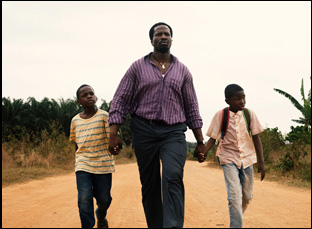
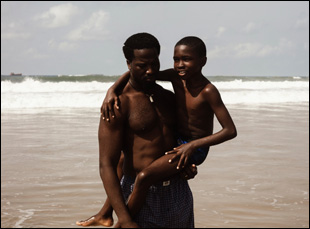
Folarin attempts to set a far better one for his kids, putting a good face on the wait by looking for ways to keep the young Akin (Godwin Egbo) and his slightly younger brother Remi (Marvellous Egbo) entertained with a trip to the beach and ultimately the ice cream that only Akin has saved up enough money for – displeased when Folarin makes them share — but the two get to see a different side of their father when it can’t all be fun and games, with the pressure of how he will continue to put a roof over their heads as well as feeling the tensions of the political unrest that he’s tried to protect the kids from eventually creeping in. Filmed on beautifully fickle 16 mm, the film has a real electricity to it, especially when Davies Jr. foists his cast into the middle of busy streets in Lagos where it’s easy to be swept up in the spirit of the city and with the old celluloid stock, there’s an acknowledgement of looking back on an opportunity to spend quality time with someone that in retrospect proved even more precious than it was in the moment, knowing the strain he was under.
The extraordinary film was seen as such from its premiere at Cannes where Davies Jr. received a special mention for the Camera d’Or Prize and subsequently was selected as a Breakthrough Director at the Gothams and the film itself was selected as Nigeria’s official entry to the Oscars and nominated at the BAFTAs for an Outstanding Debut Feature. Now arriving on U.S. shores this week, the director was kind enough to take the time to talk about how he was able to create such a lively drama, having experiences of all types come back to help him tell such an exquisite story and why seeing the film on the big screen now with audiences is particularly special for him.
 You worked with your brother Wale on the screenplay for this. That must be so interesting to crack this particular story when you must have different perspectives on a story like this.
It’s been great. Wale and I have always been fairly close in age and have a very similar emotional and world view and love for Nigeria, having grown up between Nigeria and the UK. We’ve always been close and this film has been an opportunity for us to be even closer because I think the death of our father was something that we never really spoke about until we started making this film. Equally, I think my brother is an incredible, incredible writer. He loves the world of written words. I love pictures, so working together, we have a separation of labor and then we edit and work together. We really enjoy each other’s company. We’re best friends as well, so ultimately any opportunity to just spend more time together has just been a really generous gift and this film has certainly been that.
You had filmed in Nigeria before, but did you know the infrastructure was there to pull off a production as ambitious as this?
I did, but this film is incredibly ambitious no matter what the infrastructure is like. Thankfully we’d been working together for almost 11 years. We started a service company which takes care of international productions coming into Nigeria as well, so we’ve been working with loads of communities in Lagos and working with [local] crew and talent for years and years. On that side, we knew we could pull it off, but logistically shooting on 16mm is never an easy choice [because then you have to factor in] how we’re going to get the rushes and dailies and not strike sets until until we know that things look good? What happens if a camera breaks? All these type of things. So it’s a really ambitious film, but fortune favors the brave and I think we were extremely brave in in what we try to do in terms of in terms of the creation of this film. Every day was like moving a mountain and I’m just really glad that people are familiar with me now for the first time, but the 16 years in which I’ve been engaged in film and the 10 years of our company have all paid off in the end in a way.
You’ve said that during the first days of filming, there actually was a malfunctioning camera – it was producing a double exposure. I would’ve completely melted down in that situation, but from what I understand it was a blessing in disguise. How did you survive it?
I started off in every role apart from director. I was a production runner, basically making teas. I worked in production design, I worked in costume, I would try to be moonlight as a producer, and I worked as a second AD, so I know that things go wrong on set and having come with a lot of those experiences, I think it’s really important for people on set to be able to tell you if a mistake has happened and to claim responsibility and not to feel like if you know if they make a mistake it’s going to be the end of their world. So after we saw the first set of rushes and there was that double exposure, it was a gift because it allowed us to reshoot those early opening scenes. They ultimately didn’t make it in the film, anyway, but it allowed us to work with the boys and warm them up a little bit more and it allowed the whole crew to be a little bit more more of like a well-oiled machine by the time we had to reshoot.
We had to shoot them really quickly because we we we didn’t have extra days to be able to make it up and when it comes to mistakes, sometimes they are the more interesting spontaneous things in a film. We actually use some of those double exposures in the opening sequence and there’s a lot of Easter eggs in the film, especially in the beginning where camera lenses are being changed. We use a lot of that because we really wanted to lean into the analog feel of of the story.
Once you bring Marvelous and Godwin on board, do they change your ideas of what these characters are or was it pretty fixed in your head?
It changed a little bit because I think they became more and more expressive. They shared more and more of themselves with us and in the interim, I did have this fixed idea of “No, you need to perform it as it is on the page, but as we spent time with them, the more we got to know them and the more they trusted us, the more we came back every day, the more we engaged with them and allowed them to play and they just felt freer, especially Godwin. I don’t think he really knew what he signed up for and he learned it by by trial, whereas I think Marvelous really was locked in. He wanted this opportunity and he really wanted to make this happen. He really wants to be an actor and to learn his craft, so getting to know them more allowed us to humanize their characters a little bit more and allow us to learn who they are and put that into the film.
You’ve got a bunch of great locations in this. Did that give shape to the story at all?
Yeah, if you’ve ever been to Lagos, a lot of the places we wrote in were quite ambitious to film in. The first two weeks we shot outside Lagos in a place called Ibado, which is a historical Yoruba town and we shot in a in a complex which was for agriculture, which meant all the crew were together for the first two weeks and then because when we went into Lagos we needed to be very established in the way we were working because shooting in a big metropolis, you need to know what you’re doing. And the Lagos we grew up in is the one we wanted to try and get on camera as much as possible. When I was growing up, there was a beach available to the public in Lagos, but those beaches don’t exist anymore due to climate change. They got eroded and they’ve since been claimed back, so it’s now like a luxury neighborhood. But a lot of the geography really affected the way we picture Nigeria.
 You’re recreating this time in Nigerian history so vividly and the parallel is so striking of these boys trying to make a connection with their father as the country as a whole is seeking out a new leader. Was that a foundational idea or evolve over time?
Yeah, they they feel quite seamless now, but when we wrote the short film, there was only really the relationship with the boys and their father and that is on a micro level — the hope and the promise of fatherhood and where you believe the virtues will be instilled by a father and the promise of that seeing you through your life, but we needed a counterbalance [in the feature] which added a little bit of tension. Because we were the same age as the boys in ’93 during the election crisis and we lived through this, we realized this is something we can pull from and what that represented was this statesmanship and this [idea of a] young nation being raised and this maverick politician instilling virtues and an understanding of what we wanted the country to become. Those two things counterbalance each other. One’s micro and one’s the macro and when we came to developing the script, those two things felt very in tandem.
From what I understand, you were very happy with the first assembly of this movie, but I know the tone is so delicate. What it was like to feel it out and get it to what it needed to be?
I was happy with the assembly of the movie because I knew we didn’t need to have any reshoots. We had what I thought could become a movie. I worked with an incredible editor from Mexico City, Omar Guzmán Castro, who was very experienced and really managed to chisel out what the film then became, but editing was really tough for me. It was the most emotional aspect of making the film, oher than maybe shooting the funeral sequence. In the editing, you can make multiple versions of the same film and it was really important for us to figure out how to just trust to lean into the themes of the film to get it.
You make the film three times — one in the script, one in the production and one in the edit, and we really had to develop a language. I’m from a commercial background and music videos and fashion, so we got loads of coverage in terms of characters and in terms of place and textures, but really how do you put all those textures together? How do you create a language? A lot of the film is really composed and we chose moments where we move from that composition either to spinning shots or even handheld moments and even then you have to utilize that as best as possible with the sound design and the score and really weaving it together. It was like a weaving of all the tapestries of film together to to make it solid.
It seems to have come together just right. What’s it been like sharing it with audiences now?
It’s been very surreal and very humbling. You always just want to make a good film and you hope people like it, so the fact that it’s traveled so well and people have really warm to it, it’s been really heartfelt. The most important thing now is the theatrical and that people go to the cinemas and experience the film that they’ve been hearing about because that’s what it’s designed for. I think really independent films need to be consumed in the cinema in order for more stories like this to get precedence.The best films I’ve seen this year are “foreign” or independent films and I think there’s really so much of our experiences that are very similar, even though they they differ in nuance and context, and some people will have you believe the cinema is in a very unhealthy place. But I think the opposite. There’s incredible filmmakers and storytellers making films in in very difficult circumstances and most of us just need an outlet to be able to get those films out and [theatrical is] also our biggest marketing devices to talk about the film, so it’s really humbling to be in such an incredible ecosystem, making art and I just hope I can keep keep doing that and all this has been really beautiful.
“My Father’s Shadow” opens on February 13th in New York at the Angelika Film Center, Chicago at the Gene Siskel Film Center, Los Angeles at the Laemmle Royal, Omaha at FilmStreams and Santa Fe at the Center for Contemporary Arts before expanding on February 20th. A full list of theaters and dates is here.