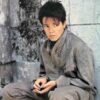
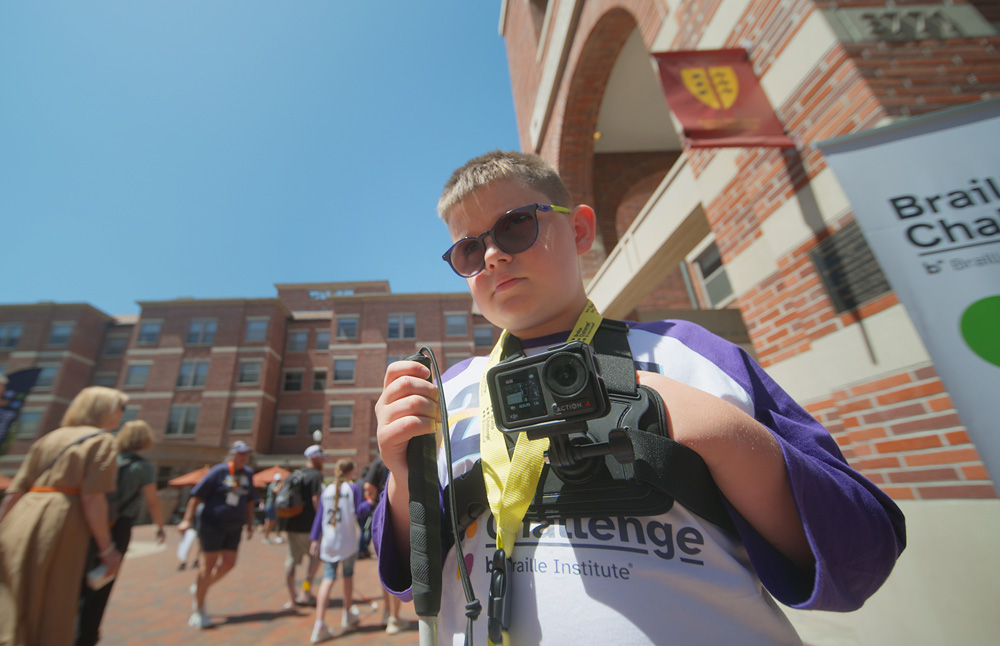

“I think Atlanta’s more beautiful,” Chris says of being in Los Angeles, in town for the Braille Challenge in “Brailled It” and perhaps a bit swayed by the fact that the Chick-Fil-A near the USC campus where the annual competition takes place is closed for the summer. He has been blind since birth, but has very strong opinions about the world as he observes it and while he’s disappointed that there are no waffle fries in his immediate future, he can’t help but be pleased to be among his peers when he says “in most classrooms, I’m the only blind kid.”
In “Brailled It,” audiences with sight are allowed to experience the world as Chris does when he’s outfitted with a camera, as are two other competitors at the Braille Challenge – the prepubscent Isaiah and Chris’ fellow teen Salome – to show the hotel where the competition takes place as an endless labyrinth of hallways that could confuse just about anyone but are gracefully traversed by those who use their other senses. While they are all in Los Angeles to take on one another for the title of who can read the fastest in their age group, there is far more camaraderie than rivalry even amongst those who have just met after traveling in from all different parts of the country. Welcomed by the USC Marching Band, the young students are treated to a weekend in which even when the chaos of a crowded convention floor can be a bit overwhelming, the visually impaired kids can feel safe in one another’s company and move ahead together, just being able to enjoy their youth.
The film was the brainchild of David Grabias, who is quick to suggest he had little to do with it beyond coming up with its initial conceit of allowing the trio of kids to document their own experience to understand the world as they do, yet the approach is inspired as “Brailled It” takes full advantage of a cinematic form capable of creating all types of sensation and elicits a great deal of understanding for what the blind endure as well as offer a film that doesn’t need to be seen to be felt. After premiering at Slamdance earlier this year, “Brailled It” is now finding its way into theaters and Grabias took the time to talk about how the unique project came together, how he let his cast lead the way and how the film changed his own perspective.
 How’d you get interested in this?
I used to have an office that was around the corner from the Braille Institute [in Los Angeles], and I was always curious what they were up to. I went in one day and talked to the receptionist who was telling me about all the stuff that they do, and she said, “Oh, by the way, we’re having this thing called the Braille Challenge. You really ought to check it out.” So I reached out and managed to get permission just to go hang out and observe, and I was just blown away by how smart, articulate, charismatic and talented the kids were. I knew that there was something that needed to be shared there, and I got permission from the Braille Institute to to make a film.
From the beginning, it was clear that we needed to have the participants, the kids that were in the competition, to be the ones that were doing the filming, so through the Braille Challenge staff, we got connected to a whole bunch of the kids who were coming to compete. Nine of them agreed to be filmmakers, to document their experiences, and to wear to carry cameras for the weekend and that really is the what the film is made of. Those kids did all the filming — they chose what to film, when to turn the camera on, all that kind of stuff, and each of them brought their own personal point of view to their footage. It’s a unique experience being with them, so it was really incredible what they were able to capture.
Where you in all of this when you empowered the kids in this way to cover the Braille Challenge as it’s actually unfolding?
We’re observing. Every morning we would meet the kids and get them set up with their cameras, make sure that the batteries were charged and their memory cards were ready to go and then just let them loose. We just hung out on the sidelines, watching all the events and if someone needed help with technical issue with their camera or for whatever reason they wanted to take the camera off, we were there to support them and then at the end of the day we’d collect all the cameras, collect all the footage and copy it to drives. It was three days of that.
 Because you’re carrying their vision all the way through, how engaged were they throughout the post-production process?
For the editorial process, we have a fantastic editor here in Los Angeles, Edgar Sardarian, and he went through and created an assembly of each of the nine filmmakers and it was pretty clear [we should focus on] three of them. First, they had done the most filming. They really had recorded everything. They also had really been intentional and had been filmmakers. They’ve gone out and curated scenes and moments and conversations. And they also had been the most vulnerable or open. Then we did a very early rough cut where we just intercut their all of their scenes with each other and we added audio description and then shared that with the kids and their families to make sure that they were comfortable with all the material and also just to give them a chance to give us feedback on the scenes and what scenes they liked or didn’t like. Then with their feedback, we really honed that edit down and once again redid the audio description. They were really able to help guide us and to provide some creative feedback.
It sounds like you really did pick the strongest footage, but was it intentional that the three characters come from such diverse perspectives as well in terms of age and experience?
A little bit. I think we got lucky, quite frankly, that the three participants who had done the most filming and had the best conversations were were a diverse set of kids. An older boy [Chris], a girl kind of in the middle [Salome], and then a younger boy [Chris]. They also came from different places and were of different ethnicities, and that’s a testament to the Braille Challenge, the diversity of the kids who are participating in that. But they really had done the best job of curating and directing and capturing the best material.
The competition element isn’t really emphasized as part of the storytelling structure, which was refreshing. How much did you want it to be a part of the film?
Yeah, it was clear that we knew that no matter what the kids filmed, we had the ticking clock of the competition to push the narrative forward, so the audience had something to follow. But the goal was always not to tell a story about this competition, but to tell a story about the kids and to use this competition as a way into their world and to get a glimpse of what it’s like for them not just to be there, but to be in community and to interact with their peers and to really get a glimpse into what their lives are like. All the credit goes to Salome, Isaiah, and Chris. They just captured such great moments that we were able to really lean into that approach and focus on the intimacy, the emotion, and the interactions.
When you get all this footage back after the weekend, was there anything that really came as a surprise to you?
It sounds simplistic, but what really struck us is we needed to listen to the footage rather than watch it. All these kids are blind, so they’re not paying attention so much to the visuals. They know the camera’s filming, they know where it’s pointed generally, but it’s an audio-first experience and for us as filmmakers [with sight], we really had to flip our expectations. Normally visuals are primary, and you’re tracking who’s in a scene and who you care for and what’s happening based on visual cues — someone’s face, what they look like, and so on. Are they smiling or crying? In this case, it’s really the opposite. It’s through the dialogue and the net environmental audio that you learn what’s happening, who these kids are, who they’re talking to, what they’re interested in, and what their cares and concerns are. That I found was a really revolutionary realization. In editorial, periodically, we would literally turn off the picture and review scenes just through listening to it to make sure that it worked and that the film truly was accessible to across the sight spectrum.
 Did that make sound design an interesting part of the process?
Yeah, 100%. We decided early on not to add much music. There’s a little bit in the [opening] credits and then at the very end, but we stayed away because we felt it was not necessary to be there as as an emotional crutch. Then we were sensitive to the fact that music sometimes can obfuscate or muddy the audio and we wanted to make sure that audiences that were watching and experiencing the film audio-first were not distracted or confused that way. We worked with a fantastic sound designer in the Bay Area, Immersive Sound, who did a really beautiful job with sound design and in every environment where the kids were filming, we had simultaneously recorded 3D spatial audio, so we laid that in during the sound design phase, so when you experience the film either on headphones or in a movie theater, you get a surround sound experience, which I think helps to make it even more immersive and helps to give a better sense of how the kids are navigating that space.
What’s it been like sharing with audiences of all types?
It’s been super exciting. So far, the feedback has been fantastic and for me, what’s been most interesting are the conversations afterwards, walking out of a screening and how many people start talking about this notion of what does it mean for a blind person to make a film? Fundamentally, there’s something super powerful and exciting and creative about that idea, so I’m so excited to see other film blind filmmakers come out and make work to further that conversation. For myself as a creative to see that happen has just been so interesting, rewarding and powerful.
“Brailled It” opens on September 4th in New York at the Quad Cinema, September 11th in Atlanta at the Tara Theatre and September 18th in Los Angeles at the Laemmle Glendale. A full list of theaters and dates is here.