



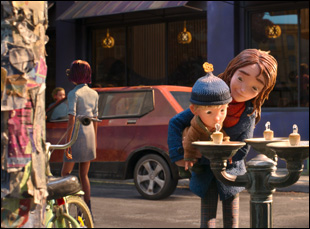
For as big a production as “Wildwood” became — the largest undertaking in the history of the Portland-based animation studio Laika, which optioned the novel on which it was based in 2009 and used the intervening time to develop technology that could actually pull off the ambition of it — there was always going to be a little bit of its authors Colin Meloy and Carson Ellis in it – in a literal sense, as much as a creative one when animators made sure to throw in flyers for Meloy’s band The Decemberists in the background and tucked in other Easter eggs throughout.
“The Legionaries Lament bookstore, I didn’t catch that until the second time around,” says Meloy, who with Ellis could be delighted with the same sense of discovery as audiences have when they gave the studio their space in adapting their novel to the screen, where titles of Decemberists songs as well as nods to his and the studio’s shared home of the Pacific Northwest will surely only emerge after repeat viewings. “It was very sweet. We’re obviously very flattered to be involved, and that they included ourselves.”
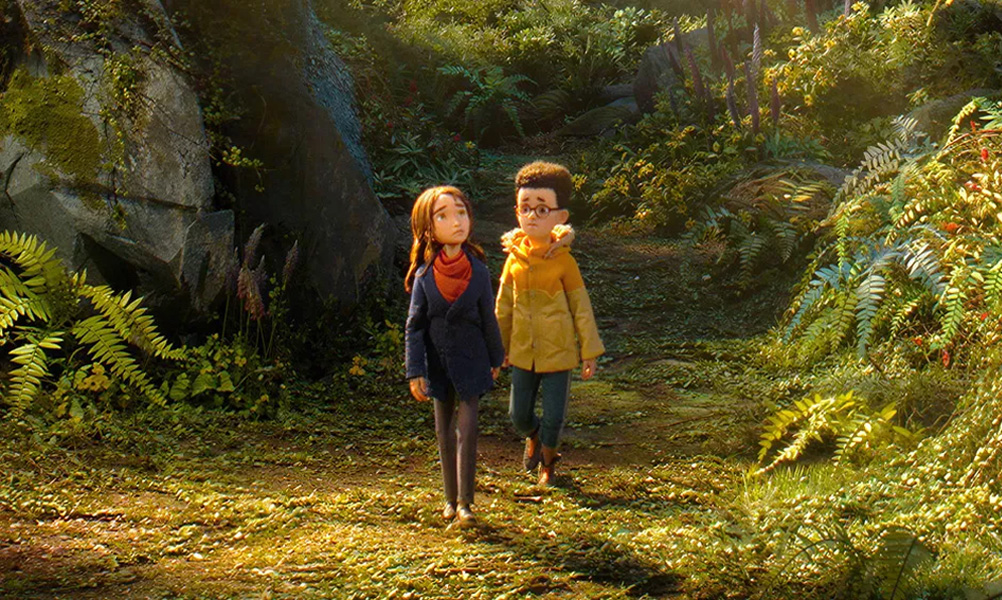
Meloy and Ellis had already created something bigger than themselves with “Wildwood” when they first put pen to paper, embarking on a fantastical tale that took place in their own backyard when it imagined that the verdant Forest Park as a place full of mystery and magic that a teenager named Prue (Peyton Elizabeth Lee) must enter, followed by her classmate Curtis (Jacob Tremblay), to rescue her baby brother Mac when he is kidnapped by a witch (Carey Mulligan) that hopes to replace her own child who died too early. But as imagined by the hundreds of stop-motion specialists at Laika, somehow the magisterial world that had only been in Meloy and Ellis’ mind and subsequently passed onto readers of their 2011 novel feels even grander when brought to the screen, full of bold colors and vibrant realizations of the authors’ clever turns of phrase — a murder of crows takes on a truly terrifying dimension in hounding Prue and Curtis when fulfilling the definition of the term.
While Meloy and Ellis were content to entrust director Travis Knight and crew with their own baby, having busy careers of their own as The Decemberists took off and Ellis became renowned as an illustrator, they still were given the final word on the project when Knight asked if Meloy might want to contribute a song for the end credits. Not only did this require Meloy to revisit a story that he conceived of at a far different point in his career, but to provide a summation of sorts for this enormous playground he and Ellis had conceived of and while this became a surprise for himself alongside the many in-jokes planted in the film, he naturally rose to the occasion with “The Better Part of Bravery,” an irresistible ode to youth from the seasoned perspective of someone older, celebrating the wisdom to be found at both ends of the spectrum.
With the propulsive dueling guitars and the insistent, aching vocals that have become a hallmark of The Decemberists, the song sends audiences out on a high as the film itself does as an end-of-the-year release and recently, Meloy generously took the time to talk about the challenge of creating a punctuation point for nearly two decades of “Wildwood” in his life, how he used songs to build the world of “Wildwood” while writing the novel, only to have songs complete it as a film and seeing the story he created with Ellis reiterated so many times over the years.
 What’s it like to see this world you had in your head realized on screen?
It’s really bizarre and surreal. It’s super exciting. There are lots of points in the last 16 years that I thought it wouldn’t happen, but here we are and to see it happen is a really extraordinary thing.
From what I understand, the book itself came out of a different idea for how this story would ultimately take shape during your formative creative years. What’s it been like to have an idea and see it evolve over different mediums?
Yeah, it started out as a project that Carson and I took on when we were broke artists living in a warehouse in Portland, Oregon in 2001, [in our] mid-20s, trying to figure out what we’re going to do with our lives, working service industry jobs. One thing that we liked, because we have this sort of shared brain with a lot of shared sensibilities and fascinations [was that] a great way would be for me to write a story that she would illustrate. We both had a love for folktale, fairy tale tropes, and archetypes and we figured it would be some kind of strange children’s book. We started writing it. I wrote about 80 pages and Carson drew a handful of illustrations and I actually serialized it on my Substack, if you want to read the thing, but it was about this girl named Ruthie who lives in a winter chateau in this vaguely Russian area and somebody arrives in the middle of the night, a sailor who’s escaped [from] a ship that’s been locked in ice at sea, and he comes with mysterious box. Ruthie wakes the next morning and everybody’s disappeared in the house, and the only thing that’s left is this box and inside the box is a very strange cog, so she goes on an adventure to try to find out what this cog is all about, [which involves] reviving a mechanical boy prince who has pulled this cog from his chest in order to commit suicide.
It was wildly inappropriate for kids — Ruthie, who was like 12 or 13, gets pregnant in the middle of it and then gives birth to a rabbit, so [there were] a lot of really strange [elements], and it was definitely going to be a kid’s book for adults [if we published it], but we had no publishers in mind. Then our lives took over — the band became really busy, and Carson started doing a lot more illustration work. And we put it away until right around 2009, when we were like, “Why don’t we go back to that and just see what’s going on?” We showed that manuscript to Carson’s agent, and he was like, “Uh no, this is not publishable. But have you got any other ideas?” And we did. We had this idea of turning Forest Park, this 5,000-acre park that’s in the middle of Portland, into its own magical world snd it incorporated some of the better parts of the story about Ruthie into it. Our agent was supportive and we started working on it then.
In the book, there were songs, but did you actually have the music in mind for them at the time – or was it interesting to return and have to come up with it?
There’s a song that the bandits sing, and a song that the coyotes sing, and I liked doing that just from a world building perspective, [similar to] Tolkien and and how he fleshed out the world of Middle Earth by including songs. It was nice to be able to write those songs without having to write chords or melodies for them. They could just be songs and the reader could imagine what those melodies were. And when Travis [Knight] asked me to write songs for the film, it was nice to just start from whole cloth and be like, “Okay, I’m just going to write a folk song that the bandits would sing and then write a lullaby that Alexandra would sing [that] maybe she had been sung to herself as a as a child. In that sense, it was fun to kind of go back into that world and and flesh it out even more.
I know you have creative writing in your academic background, but did writing music with narrative intention always come naturally?
I think when I got into writing music, so much of the music that I love, there’s this assumption that if you’re writing music, it should be oblique and poetic, like the Michael Stipe school of songwriting, which I totally love. But I only found my voice as a songwriter once I freed myself of the idea of writing narratively, writing characters and stories with the beginning, a middle and and end, which I think feeds my original love of writing short stories. Once I found a way that songwriting and story writing could meet is where I think I found my voice.
Were you actually in touch with the composer Dario Marinelli at all about the score so there could be a cohesive sound to this?
No, I hadn’t been. I only met him when I was in London for the premiere. He’s a super sweet, super smart guy and did such a great job. A few questions [did come up], particularly with Alexandra’s lullaby because it’s a little complicated and not really in a in a woman’s range. So there was some movement that had to be done and I don’t envy him having to to do that because it was easy for me to write it and record it for my own voice but sometimes translating that for people who have different ranges can be really challenging. But he did a really fantastic job.
How did you end up writing the original song “The Better Part of Bravery” for the film?
Travis had asked me to write the end credit song for the movie, and having never written an end credit song, it was a little daunting. We’ve had songs licensed for movies, but I’ve never wrote a bespoke song, and it was a bit of a high bar because you think of what an end credit song should do. It should be some summation of some theme of the film, but either overtly or covertly be something audiences can carry with them as they leave the theater. You imagine it should be a song that’s good enough that the director would have sought out and licensed it as the perfect song. I hadn’t seen the film [in full when I was asked]. This was in 2023. The film was not close to being finished. It was just snippets and I’d read a draft of a screenplay, but that had been ten years prior, so I sat down and wrote a song that I felt like was the end credit song to my book [since] that was the best thing I could do.
It was called “I Want to Be Lost,” and it was about the journey we all take going beyond our comfort zone into places that feel scary or dangerous, but that’s where real growth happens. That’s founded in a lot of fairy tales, this idea of crossing over into the dark woods being a metaphor for the journey from childhood to adulthood, which is a big part of the book — the journey that crew and Curtis both take. So I wrote that song and [thought], “That was a banger. I nailed it.” Then I sent it in and Travis wrote back a couple weeks later, “I love the song, but it doesn’t work. And this is why…” And initially I was a little taken aback because being the singer/songwriter of your own band, I’m not really accustomed to taking notes from people. I usually just write the song and the song is the song. But I understood the assignment. So I sat with it. He wrote me a very considered e-mail about what were the themes that were in the film that he thought should be in the end credits song and at first I knew that the song that I’d written couldn’t just be changed into that song. It was just too much. It was its own song, so I really struggled with it for a very, very long time.
It was getting nowhere until I was watching the movie “Highlander” with my son, who’s 13. I was introducing him to the classics of American cinema, as is my responsibility as a dad. [laughs] And listening to that soundtrack, which was done by Queen, there’s that great middle part of the movie [with the ballad], “Who Wants to Live Forever” that really poses this question that floats over the entire movie, but is never really ever said. It does such a fantastic job and I read afterwards that Brian May, who had written it, was only able to write that song until after he had seen the whole film. That was like this light bulb, so I asked Travis if I could see a finished cut of the film. And this was in April of this year, so it was really cutting it close. But I sat down and watched the film and suddenly it all made sense, everything that he had written out that he was asking for, I was like, “Oh, absolutely, I can find my way in.” And I wrote “Better Part of Bravery” within a couple days of that.
I’m sorry you had to go through that, but it’s great we ended up getting two songs out of you.
No, it was great. I felt like I learned so much about songwriting in that process.
Maybe I’m reading a little too much into the lyrics, but when you’ve had this whole experience over 16 years and you’re talking in the song about letting go, what’s it like to come to the end of this chapter, if you even see it that way, with this work?
I think we all go through that throughout our lives, you come to this place where you have to let go of something, be it seeing children grow or a partner leaving or a death. There’s just so many big and small things that we have to get our heads around and it really does take bravery to let those things go because your intuition is just to hold on to them as closely as you can, so I do think that that’s a really powerful message. It’s a big part of the power of the message that’s inside of the movie “Wildwood” too.