

In retrospect, it’s slightly amusing that there were so many future filmmakers wandering around the set of Mia Hansen-Løve’s “Eden,” her 2014 masterpiece about unfulfilled potential as it told the story of a DJ surrounded by budding talents and woefully unsure whether he could keep up. Featuring Brady Corbet a year before he would make his directorial debut “Childhood of a Leader” and Greta Gerwig who made “Lady Bird” a few years later, the film also brought together Felix de Givry, the star of the film who was enlisted in part for his background in music, and Ugo Bienvenu, a graphic artist who was among the director’s circle of friends. Neither had any experience making feature films beforehand, but they would be inspired to collaborate on them after.
“Mia Hansen-Løve asked me to draw a lot of things in her movie, and at the same time, she wanted me to have a part and I’m not an actor,” Bienvenu recalls now. “But I met Felix, [in what] was his first role, and Felix and I would never have expected that this movie would [lead to starting] a production company together, because he had a music label and I had another studio in France, but after then we [thought], ‘It was so fun working together on ‘Eden,’ and one year after we had done like so many projects together, we said, okay, let’s partner on a new company made for us and have fun.’ So Mia was our Cupid in France.”
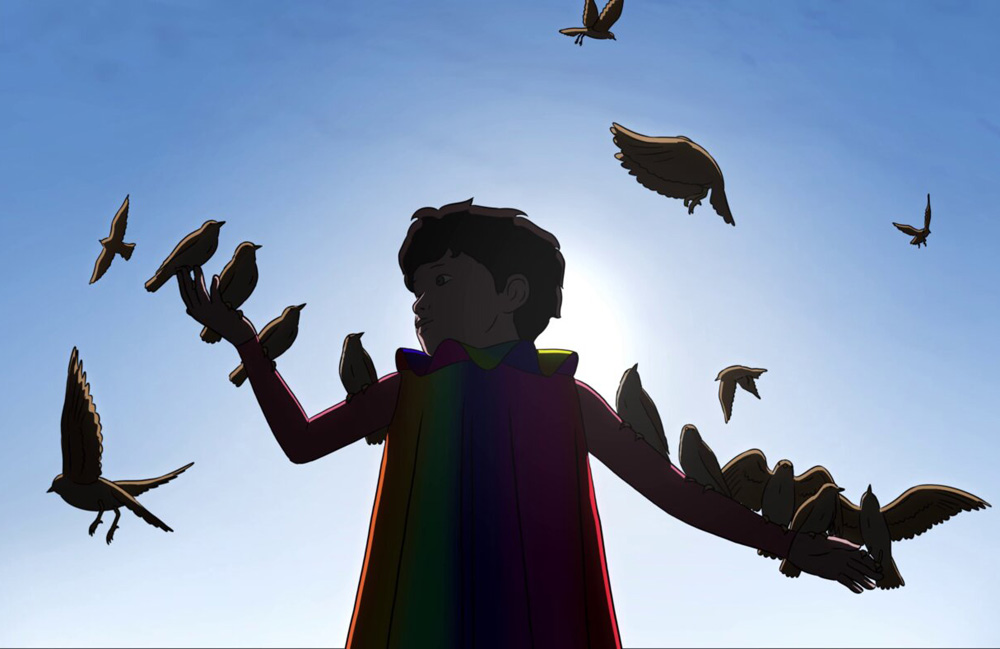
It was purely coincidental that their first feature together, the animated wonder “Arco,” is built around such a meeting of the minds between people of different worlds – quite literally in the case of Iris, a young girl living in the not-too-distant future of 2075, and Arco, a boy around her age who is dropped onto earth from eons later when his parents leave him to his own devices and he finds a time travel suit that he finds he can slip into easily, but attempting a return home is far more difficult. As it happens, Iris has plenty of time on her hands when her own parents are always busy with work and her main company is a robot named Mikki that has a job to do itself, but a friendship between herself and Arco leads her to realize that the future could be bleak as troubling signs in the environment around her in the present created the world in which Arco resides where people have to live vertically to contend with rising sea levels and fresh air is at a premium. Although it’s a dire prediction of the future, the rip-roaring adventure that commences as the two try to get Arco back to his parents suggests that there remains the potential to change destiny should there be the will.
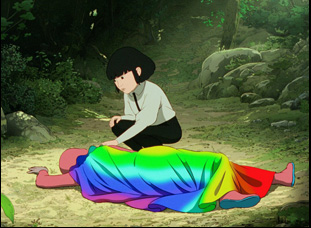
De Givry and Bienvenu have been making their own fate since first co-writing and producing the 2019 short “L’entretien” together, contemplating even then what the world might look like with a lot less people in it as a robot wanders around France, and a single image from Bienvenu’s notebook of a boy flying through the sky, full of hope as he wore every color of the rainbow, led De Givry to believe there was far more to that story. The result earned an Oscar nomination this past week for Best Animated Film following its premiere at Cannes and as the film now soars into theaters in the U.S., Bienvenu spoke about the partnership that he felt gave him wings of his own, truly putting his own future on the line with the film and what gives him hope when his vision of the future can be discouraging.
 How did “Arco” come about?
I had created this [robot] character Mickey for a music video [“Sphere of Existence”] I did for Antoine Kogut and I did a comic book called “System Preference,” and the French Opera called us and said, “Can you do something?” We wanted to do something together, so we did “L’Entretien” in the opera following my music video and my comic book, and also including the vocabulary of Felix. That helped us start working together as writers, and when I got the idea of “Arco,” I [thought], it’s my first feature film and I’ve never written a feature film and the only person that was giving me ideas that were fitting in my vocabulary was Felix. So I was doing the storyboard and he was giving me ideas, so he was writing, I was drawing and it was fluid.
We showed the script to people in France and [they would say] the movie was expensive for the French system and it’s going to be impossible. We were so, so sad and we had our company, and we said that we never paid ourselves, so we [said], “Okay, let’s put all our money into doing an animatic.” We hired three of my best people and we did the animatic and financed [development on the feature] based on the animatic. And everybody that said it’s impossible [before] fell in love with the movie watching the animatic, and everybody wanted it at the time. Also, it happened that we met Natalie [Portman] and Sophie [Mas] and having the animatic and Natalie and Sophie [as producers] made it super clear for everybody, so we were confident. We went to the bank together and we took out millions. We were financing while doing the movie, so every week we had good news and bad news until Cannes — the budget wasn’t cleared before we finished it.
 I’m so glad you bet on yourself!
Yeah, honestly we really put it everything we had [into it]. If the movie had gone wrong, I would have lost my house and Felix too. It was a really huge bet. [It all started when] in 2020, during COVID, I [thought], “Okay, we’re living in super bad science fiction movie right now and maybe science fiction writers are responsible for the world we live in because they just spread bad ideas in the future. They always say that “It’s over, we’re dead.” And I [thought] if we want better things to happen, we have to imagine them first. But I’m cynical too and [I thought], “No, it’s too easy being cynical. It’s too easy to criticize and to bring shadows into the world. But doing light is hard. And I want to be part of the people that bring light to the world now, so this is where I’m going to put my energy — to say things are possible if you try hard enough. This is what happened with “Arco.”
Everybody was saying no and we tried hard enough and we changed our destiny and our own future. But also, I hope this movie will change in a way the mentality and feeling we have now that everything is done. No, everything is not done. It’s our choices that will make the world that we’re going to live in tomorrow. Since the very beginning of my career, I’ve been talking about transmission. To me, transmission is the core of humanity and I’ve always thought that I wanted to leave the world better than when I arrived. That’s why I’m a teacher too and now I’m going to fight for things that are not just important for me, but important for other people. And I think “Arco” is the very first stone in that work.
From what I understand, it was during this time you became a father. Did that change your perspective?
Yeah, I had two kids during the production — one after one year of production and the second one six months before the end, so I did imagine my children and I often hear our kids are going to fix it, you know? Kids are going to create a better world, we trust them. But that’s too easy. It’s too easy because it puts us in a position where we don’t have to act and I didn’t want to do that [in the story]. I wanted my kids to arrive in a world that was prepared for them and to do the best I could with what I have. “Arco” was the result of this feeling.
 One of the things that’s beautifully conveyed, however painful it is, is how often parents have to be in two places at once – both of the main kids are left alone because the adults are working. Was that something in your mind from the start?
I think it’s because we live in a world of indifference now. Iris never sees [her parents] because they work in the city and they do their best to give her the best life they can, living in a good neighborhood with trees. On the other side, Arco has a family, but he wants to go to adventure. He wants to be free and leave home like every kid, and the truth is always in the middle of this. I’m always trying to find the middle in things and because parents will often say, “Oh, it goes by so fast,” I wanted to say to kids, “It goes fast and you have to enjoy the moments we have together. You have to enjoy being here and share feelings and time. Presence is important.”
One of the main questions of our era I think is that images are replacing reality and we are like concepts. We’re living with the shadow of things. I know the trees in Japan better than the trees that are in my garden. This is crazy. We have to go back to things around us and to take care of them. It seems easy because we fight for things that we never experience, but we don’t fight for our neighbor. We don’t fight for the people that are around us that are in difficulty. And if we begin working on reality and engage more with what is around us, and if everybody is doing this, we’d have a better world in our neighborhood, in our country, and then we can do more. It’s too easy to conceptually to say we’re engaged, but we don’t do anything, we just do a message. We have to go back to acting — quotidian, daily acts. It’s not just words. It’s being here and doing things.
Also [staying in the fight] was really important for Iris. In the movie, I didn’t get that. When Arco takes her from the bubble at the school [towards the end], I asked the musician to [score it as if it were] a victory movie, like, “Yeah, they did it!” And it wasn’t working. We did a lot of tests and tons of happy compositions, victorious ones, and it wasn’t working. And one week before finishing the score of this scene, [the composer] called me and said, “Don’t scream. I’m going to show you something.” And he showed me this dramatic score. He rewrote this sequence, and in fact understood the sequence better than me. The sequence was saying, “If Iris runs away [from her family] and goes to Arco’s era, we’re done. If we run away, we’re finished, because Arco’s era won’t exist. But if we want a better future, we have to stay here, we have to fight for what we want and not run away. And this scene [now] is saying that.
 From what I understand, you’ve built up a real community at the studio where you made this. How much does that end up influencing the film?
In fact, I always had my studios. I’m a teacher, I was a teacher myself in Gobelins [in Paris] and everybody I work with were my students or trained with and I’ve known that most of them since they’re 18. Just as I was working with people I love, I was important in their life and I think everybody followed me because I never [considered myself an auteur] because to me, as I said, transmission is so important that I built a family — “Arco” was the opportunity to have this adventure all together and to share the things we like the most and [the film] is a way for me to build relationships and a community. when I had a project for all of us, they followed me because there’s so much love between us.
I’m so happy this movie popped [now] between these productions with tons of money and tons of people working on them and the world recognizes when there’s something genuine. In animation, people working in the industry will often spend a year working on things they don’t like and that’s also why everybody came [to “Arco”] was to do something they liked. That’s why also why we were doing it by hand and not industrial because we’re dealing with a lot of industrial products now. I’m not saying there shouldn’t be, but most of the things we see are made as products and what we were doing was more couture and handcrafted, all about emotions and done with a really small team. I’m happy that the world can still recognize when it’s honest and made with love.
“Arco” opens in theaters on January 23rd.