



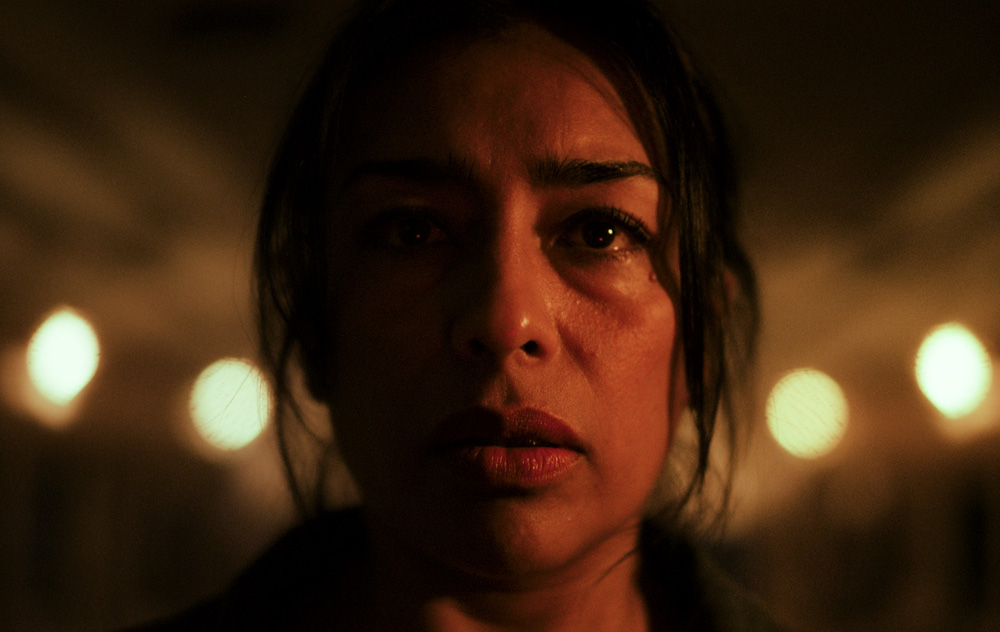

It doesn’t ultimately work, but it’s wise of Detective Rosales (Guillermo Alonso) to appeal to a need to survive for the whole community rather than her own personal fate when trying to get answers from Luz (Adriana Paz) about what happened on her way to work in “ La Cazadora (The Huntress),” having to wake up in the dead of night to take two buses to her job at a factory in Juarez. The driver of the second leg of her travels was shot and killed, making her late to the job and for a variety of reasons, silence would serve her well when discussing anything she witnessed, but Rosales makes a compelling case by not going over the details of what he knows at all, but instead the factory where she works, a foreign conglomerate that would rather shut down one of its outposts that it could easily set up elsewhere than have to deal with any bad headlines for one of its employees. While her own livelihood is at risk, he knows it’s all the others she’s putting on the line by refusing to testify that creates the most weight for her decision.
The “why” always — and unusually — supersedes the “how” as a driving force in Suzanne Andrews Correa’s fascinating and highly original feature debut where peril constantly lies in the broader picture in more ways than one. Concerning the epidemic of missing and murdered women in Latin American countries, the film illuminates a vicious cycle in which mothers connected to such cases or caught up in a general atmosphere of fear are threatened to get lost themselves as they attempt to seek justice, whether consumed with anger or uncertainty in the face of unfathomable cruelty. Minor spoilers ahead, so be warned, but Correa reframes such a story from the start, both aesthetically and narratively when Luz isn’t introduced as a victim, but followed stride-for-stride onto the bus she normally takes to the factory in a bleached blond wig and kills the driver without hesitation. Her immediate instinct to run to a restroom to throw up suggests this was not something she ever thought she was capable of, but even though the reasons behind this specific murder remain vague for much of “The Huntress,” the justification for it becomes clearer as she tries to go about the rest of her day as if nothing happened.
It can be darkly amusing at times how easy this can be for Luz when she is considered so negligible — her kindly boyfriend of three years who unwittingly picks her up from the crime scene can’t be bothered to take notice of how distressed she is as he uses the car ride to ask why she doesn’t eat to spend more time with him and Detective Rosales, for all his intimidation, probably doesn’t see her as a suspect until she slips up by describing the culprit as a woman rather than the man he surely assumed. But Correa sees the disregard for women in general as ugly as it is without ever being overbearing, turning it into suspense when Luz has to define morality for herself in a culture where there is none, at least when it comes to the fairer sex. The film provocatively raises the question of how much a pursuit of justice is worth putting the future at risk or on hold, particularly when Luz’s primary concern isn’t for herself, but rather her 14-year-old daughter Alejandra (Jennifer Trejo), who skips school around the same time as Luz is breaking the law and the mother’s mind inevitably goes to the darkest places imaginable when she can’t immediately be reached.
Paz gives a powerful lead turn projecting strength amidst deep uncertainty about everything Luz is doing and cinematographer Maria Sarasvati Herrera shrewdly operates in tandem expressing both the character’s drive as well as imbalance when the camera may gravitate towards where the action is in any given moment, but in frequently snapping back to Luz, where in fact much is going on as she’s trying to process everything that’s happening, it also infers the amount of pressure she feels to make difficult choices that have implications well beyond herself. It speaks to Correa’s command over presenting such a precarious situation that the narrative’s abrupt shifts from one character to another feel organic, breaking away naturally to Alejandra who left school with a classmate to go dress shopping for her impending birthday or Ximena, the lead of a local Madres Buscadoras group who comes to cross paths with Luz, and the sum of their experiences reflect what’s collectively at stake without resorting to the hackneyed fragmented ensemble approach of so many social issue-driven dramas. When built upon the idea that it takes a bold act to break through indifference, “The Huntress” actively exemplifies it beyond its inciting incident.
“The Huntress” will screen again at the Sundance Film Festival in Park City on January 29th at 8:50 pm at the Megaplex Redstone and January 31st at 9 am. It will also be available virtually on the Sundance online platform from January 29th through February 1st.