


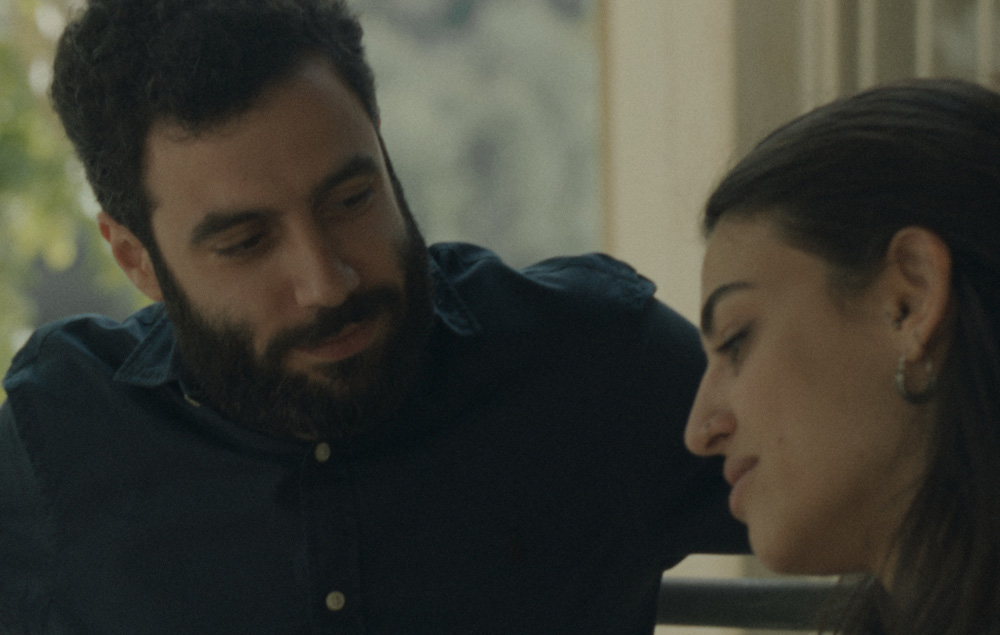

When Scandar Copti moved away from Jerusalem to take a job as a professor at the Abu Dhabi outpost for NYU, he learned quickly that as much as he would miss home, it would have its benefits for him creatively.
“Being away from home connects me even more in terms of stories because when I go back, I almost come like a visitor,” Copti says. “People are eager to tell me stories. I’ll go to a bar or a coffee shop and I shut my mouth and just listen to stories. [I’ll be asked] how is it in Abu Dhabi, I’ll say in two minutes, “It’s beautiful, the food is great…” and then it’s like “So what’s happening with you?” For me, that’s gold. People feel the urge to tell me what has happened in the last six months or a year.”
Although Copti would be nominated for an Oscar for his 2009 drama “Ajami” (co-directed with Yaron Shani), he never bought into the auteur theory, instead developing a filmmaking practice built around the idea that people could bring their own lives to the screen to create something generally more complex than what could be achieved with actors and a script. Even though he’s spent more than a decade teaching students the technique — and delighted by the fact that NYU Abu Dhabi caters to students from 106 different countries who have countless cultures to draw on, his second feature “Happy Holidays” puts the approach to the test with him at the helm, yielding a fascinating ensemble drama built around a family keeping secrets from one another. If the inevitable revelations seem to produce genuine shock, it’s because the cast on occasion wouldn’t actually know what was coming when there was no script to work from and Copti trusted his cast, most of whom had a professional or personal connection to the type of character they played, to act instinctively as they would when faced with a similar situation.
By the time “Happy Holidays” ends, the car accident that opens the film seems like the least of the problems for its central family where a wedding approaches that the bride’s parents Hanan (Walaa Aoun) and Fouad (Imad Hourani) don’t necessarily have the money to pay for, despite their flush lifestyle. Glossing over their finances while pushing ahead is indicative of attitudes that run throughout the family where Fife (Manar Shehab), the victim of the accident fears a far deeper wound opening up should her parents find out about her medical records, as they could be entitled to, and her brother Rami (Toufic Danial) has concerns of his own when his girlfriend Shirley (Shani Dahari) wants to carry out a pregnancy that she told him she had planned to abort, obliging him to eventually tell his conservative Palestinian parents that he’s dating a Jewish girl.
With puckish titles to introduce vignettes for each of the characters who have something to hide from one another (such as “The Not-So-Peculiar Story of Shirley and Her Baby”), devoting chapters not only to Fifi and Rami, but also Hanan and their sister Miri (Merav Mamorsky), the film has fun with a “Rashomon”-esque structure where everyone has their own perspective on what’s happening and don’t necessarily know what someone else in their family does. But Copti also brings to light how much people living in Jaffa, which has one of the greatest mixes of Jews and Arabs in Israel, withhold from one another to avoid confrontation at great expense to their own well-being, becoming potentially toxic to all parties when a more direct conversation might be difficult but instill more trust. Because of the director’s freeform approach, the film is frisky when it could be a drama too heavy for its own good and after a festival run that began last year at Venice and Toronto, “Happy Holidays” is ready to charm and provoke audiences Stateside as it begins its theatrical run. Recently, Copti generously shared how the unique film came together, a production thought to be particularly improbable when filming started just before the pandemic, and pulling off a compelling story where no character is a villain.
 From what I understand, this actually started with a real-life incident close to Shirley’s narrative in the film. How did it take shape?
It’s a non-linear process, so it’s not like here’s a crazy dramatic story and how do I build around it? It starts with, “Okay, what are the themes that are really interesting to me?” so [“Happy Holidays”] started with this big idea of what are values and how do we choose them or how we develop our morality and how do we live by it as social creatures within a group. And then [it became about] how we are blinded by this morality. [So I never say] “Let me develop a character.” It’s all at once, and I wanted to show that good people are trapped in corrupt systems just because there are forces that do not allow them to question their own morality. This is how ideologies are [formed]. This is how 400 years of slavery was done [because] nobody questioned it. This is part of reality. The Israeli occupation of Palestine is part of reality. This is what Zionism does. They occupy people. They segregate people [with] apartheid, wars, and so on.
And I wanted to do this in a way that does not create resistance from the audience, which is crucial for me. I don’t make films to be provocative. I don’t make films for the sake of aesthetics. I make films because I have something to say. There’s a clear intention behind it. And I want to say something to the people I’m criticizing, but I don’t want them to push the film away, so then I started developing this idea [where] I do that through not creating villains. But in every film, there’s a protagonist and an antagonist. But all the characters that you have [in “Happy Holidays”] are protagonists and to do it, you need a special structure for it — of telling one story from one perspective, then letting go of it, and then telling another story from another perspective, and then everybody’s a protagonist. Then towards the end, the audience will develop this cognitive dissonance. It’s like, “Wait a second, do I hate Fifi for what she did? I like her. Do I hate Hanan? But wait a second…” Once I figured out this structure, I started trying to build the stories and the characters within it in a really chaotic way in the beginning and somehow it just gets organized by itself.
When you have such a bifurcated structure, was it interesting to figure out what kind of information you could withhold from one part of the story to put in another or vice versa?
Yes, I also want the audience to be engaged and if you give everything [away early], then the audience will not be engaged. But also it relates to what I just spoke about because I wanted to replicate the way we operate in this world. We know only what we know, we don’t know what others know and we operate based on what we know and what we feel and our expectations from the reality that we perceive, so it’s not the reality itself. It’s what we anticipate and how we interpret it, and this has to do with our ideologies and faith. I was thinking about if there are no intersections within those lives or those intersections are avoided, so it was easy to [decide] what to reveal to the characters and what not to. Let’s say Rami avoids this intersection with his parents who he will never tell that he impregnated a Jewish girl, so we discover it only later. Then it became easier what to withhold and what to release in that sense.
 What was it like to find your cast?
All the actors in the film are not actors, other than three characters where it wasn’t ethical to get people from the same background because they do an illegal thing. But [most] are cast based on the real-life profession. So [Merav Mamorsky, who plays] Miri is a real nurse. [Raed Burbara, who plays] Waleed is a real doctor. The real estate agent [in the film] is a real estate agent [in real life]. And then I start building relationships between people with role plays and improvisations, building their shared histories together and introducing conflict. At the end of the day, I never give them a screenplay. They don’t know what the story is about. And I shoot the film chronologically from beginning to end, so they discover and live the lives of their characters as we go. Their real life has nothing to do with the character. The only resemblance is their personality, so [I look for] someone that is charismatic like Waleed or if I want someone with an authority, I got [Wafaa Aoun to play] Hanan because that’s her personality but in life her ideology is completely different [from the character]. I cast based on personality and what you do in life because I feel nowadays our identity almost is our profession. You’re a reporter or you’re an engineer or a filmmaker and the language and the way you do things [on the job] is something that was very dear to me, so I wanted to capture it and everything they bring it. It’s all improvised.
When that’s the case, was there anything you were particularly excited about that you may not have anticipated as this started to take shape?
That’s the magic of this method because you roll with two cameras and a scene could go on for three hours because it’s real time. Then you get amazed by understanding and realizing again and again how narrow-minded I am as a writer because I’ve written things that are that were obvious to me, but [the story is] going this direction where it’s obvious there is no other way and they bring something fascinating and much richer than what I thought about. So I’m very, very flexible with them if it doesn’t affect the plot that much because the plot itself is very structured in [terms of] how this needs to happen in order for that to happen, but most of the discoveries I have in the editing because I edit my own films and I ended up with 180 hours of footage. It took me 15 months to finish the film.
 I also heard this was delayed because of the pandemic because three days into filming, lockdown happened. What was that like to overcome?
Yeah, now if you tell people, listen they locked us down at home for a year, it seems like a joke, but we shot for three-and-a-half days [before] lockdown and I got really depressed, like “What’s going to happen? What is this thing, COVID? How long is it going to take?” For the first month, I [thought], we’re going to get back in a month. And the producer said, “Yeah, everything is ready. We’re not losing anything. People are waiting because everybody stopped working. It’ll be the same crew.” But then we were able to go back only two years later and I started getting really depressed. What saved me was starting to work on another project and I started working on a documentary with found footage so I didn’t need to go and shoot or anything, which is now in production. And [I told myself] “I’m going to just accept universe gives us. If this project is not going to happen now, it’s going to happen in four years. So let it be. I’ll find new actors, I’ll recast everything and I’ll do it again. But I need to keep my sanity.” Still, it wasn’t easy.
You’ve called some of the scenes in this film documentary as well when you were filming inside of real events. What were those moments like?
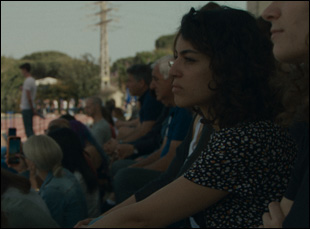
The scenes in the schools were scenes that were taking place by themselves and I just asked the permission to shoot while those events were happening. I planted my actress [Manar Shehab, who plays] Fifi there in the nursery that you see in the film. She came every Friday for six weeks, and she worked as an assistant teacher there so that the kids could get used to her and to the character’s name — we never introduced her with her real name. And we always came with cameras and documented everything. I asked the permission of the school to shoot in Israeli holidays and this is what you see [in the film]. It’s just something that they do every year, [with] the big parade with the soldiers and everything. It’s the Memorial Day ceremony in the school. And we never see faces of soldiers because they told us you cannot show that, but with the long lens, you just blur them out.
 Is it true you name the characters after people you know? If so, do they get a kick out of that?
Yeah, a lot of friends told me, “Hey, thanks” or “Why did you do it?” And I said I do it because I want to love each and every character I’m writing even if they do horrible things. When I name them based on my friends’ names or family, like an aunt that I like or my grandmother, it’s a reminder for me to love my characters. And it makes it easier. It’s like, wait a second, I named this character after a person I love. I cannot now hate them. I need to write from their perspective, understanding their suffering and why they’re behaving in such a way. In the film, people behave in an awful way but they believe that they’re doing the right thing. And historically, most of the awful things that happen happen because people felt that they’re doing the right thing. They were never convinced that they’re doing awful things.
What’s it been like sharing this with audiences?
It was amazing. In Italy, we had the premiere and Nanni Moretti introduced the film and did a Q & A with me. He’s just the funniest, most creative person and director. And then France was incredible and [the film] was a big success. I went to maybe 11 or 12 screenings to do Q & A and people really are into cinema and to have conversations with this level of real cinephiles, people that care about cinema, has been super rewarding. It was an incredible journey.
“Happy Holidays” opens on December 5th in New York at Film Forum and December 12th in Los Angeles at the Laemmle Glendale.