



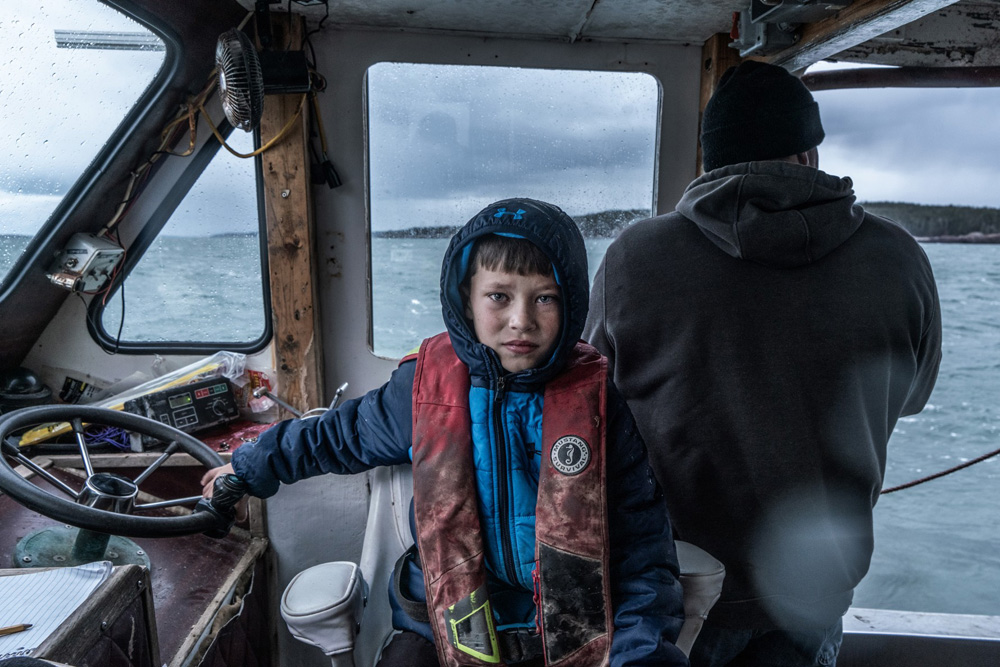

“If Bangor, Maine is the asshole of the world, we’re 200 miles up it,” Mike says of the remote marina on the Northeast Seaboard that gives “Bucks Harbor” its title, describing the brief window ahead of the fall in which he gathers supplies that will last him and his family for much of a year. Thought to be first settled by pilgrims in 1763, not a whole lot seems to have changed in the area in the centuries that have followed where trawling the sea for lobsters and oysters has provided sustenance as far as food on the table and a living wage, but leaves little room for much else, leading one generation after another to know there could be a life outside the family trade, making Mike an admirable role model for his two sons Carter and Ryan when he’s taken pride in being a pillar of the community and a solid provider to his family but also doesn’t have much interest in looking beyond the horizon.
At first, it may seem that director Pete Muller is dropping audiences into the deep end in a variety of ways in his captivating debut feature, asking them to hang on as he visits another fisherman David as he prepares a pelt to make a jacket out of amidst a jumble of introductory scenes that provide a sense of place, but the idea of recycling and resourcefulness at play becomes the heart of the film when it concerns people doing the best with what they have and seem stuck living out the loop when it’s the only life they know. Besides Dave and Mike, the film follows Mark, who doesn’t appear as if has much to talk about from behind the counter of a tackle shop where he’s probably worked since being a teen, and Wayne, a grizzled clammer who likely has tried everything in his life once and recalls his “four ex-wives and 1600 ex-girlfriends” with the passive energy of saying “been there, done that.”
For audiences that feel like they have seen it all as well when it’s obvious all four men are carrying the burden of forging ahead in literally inhospitable conditions when they brave the brutal cold whether they’re on land or sea, “Bucks Harbor” starts to surprise almost immediately after it begins when Mark proves to be anything but the quiet clerk he initially appears (though to spoil the reveal would be criminal) and the time Muller puts in with all of them pays off in reflecting a capacity to change in a situation that doesn’t seem to let them. As deep sea footage of lobsters are sprinkled in sporadically appearing without a care in the world, the men stand in stark contrast when beholden to the obligation of unearthing them for a living with Dave, in particular, noting without anger he owes his former drug addiction to the job with its unforgiving working hours that prevented him from engaging any serious relationship when his life revolved around the tide and he’d use narcotics to stay awake. This didn’t need to be his life, his mother Vicki remembers, when he was once promising enough art student to be accepted at the University of San Francisco but beyond her being unable to foot the bill, the thought of moving across the country was unfathomable when all that was ever expected of him was to work on the water as his father did.
A legacy of toxic masculinity is part of the proceedings when not only Dave felt he had no choice to continue the family business, but Wayne recalls the abuse he suffered at the hands of his father until his death at the age of 13 that led him towards living so recklessly, but in Mike, who cautiously teaches his sons to get their feet wet and is somewhat concerned about when they’ll become professionals after entering the industry so young himself, the film offers a fascinating counterpoint where the limits on imagining any different future seem just as damaging, especially how it appears to have been unconsciously passed down to the kids who seem more eager than their father to start working without knowing how hard it’s been. The film doesn’t make the life look glamorous by any stretch, but Muller, Mark Unger and Nathan Golon’s lucid cinematography does pull the tranquility out from the natural habitat that can make it seem like there isn’t anywhere else you’d rather be, even when such awe extends to threats of trees being ripped from the ground by a torrential storm or waves that could easily capsize a boat. Human nature is shown to be potentially just as treacherous when people refuse to stray far from what they know, but “Bucks Harbor” also demonstrates how rewarding it can be to take a chance on what they don’t when it transports most to a place that’s likely to be overlooked and finds depth in every direction.
“Bucks Harbor” will screen again at Berlinale on February 20th at 10 am at Cubix 9 and February 22nd at 6:15 pm at Cubix 7. It will next play at True/False in Columbia, Missouri on March 5th at 4:30 pm at the Big Ragtag, March 7th at 9:15 pm at Windsor Auditorium and March 8th at 9:30 am at the Big Ragtag.