


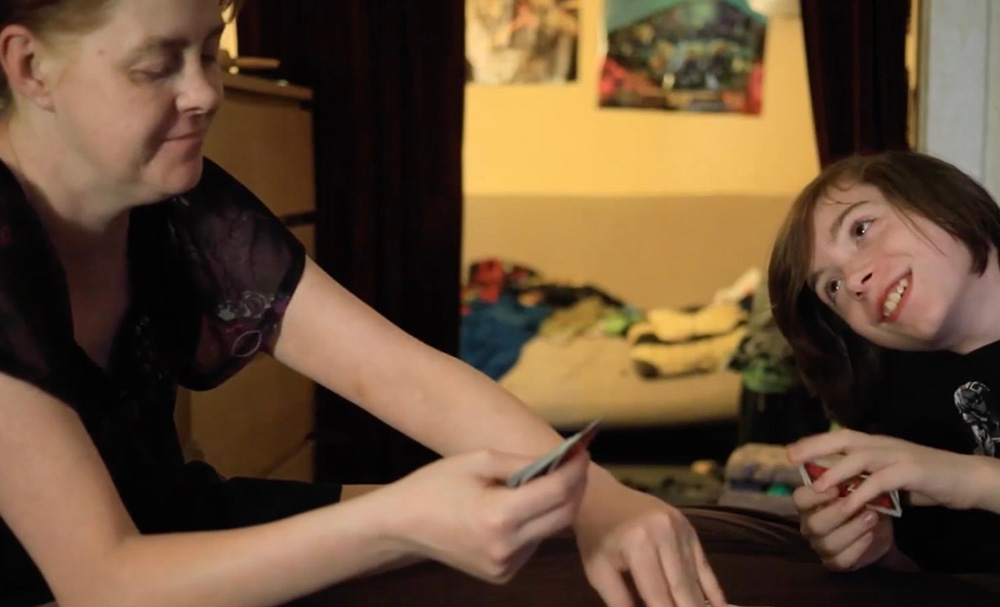

“Video games don’t require half the effort of everything else,” Mikal tells his mother Tonya in “Flophouse America,” chastised for the time he spends playing them, but at the same time clearly needing the escape. The two share a small apartment in a tenement house above a bar where the alcohol all too often makes its way upstairs to Tonya and her husband Jason and while Mikal may not look much different than most other boys his age when glued to his devices, the necessity of disengaging from what’s going on elsewhere looks less like a needless distraction than a survival tactic.
In a sense, the main subject of Monica Strømdahl’s uncompromising chronicle of the family living in poverty becomes disassociation when it isn’t only Mikal that wants to check out, but only one small step removed from homelessness, Jason and Tonya seem as if they can barely summon the effort to engage with greater society as a whole and with no one else to converse with, tensions rise inside the house. Economics aren’t often directly addressed, but the waterlogged walls of their apartment and the need to wash dishes in the bathtub give all the context needed for their precarious circumstances and Mikal, Tonya and Jason will discuss loans and transfers for modest transactions. That Mikal only refers to his parents by their first names also seems indicative of a crushing financial burden when the idea of love comes across as a luxury and the three profess it to one another less as a sign of affection than a plea to stick around despite behaving unforgivably to each other.
From an opening disclaimer warning of a depiction childhood trauma, “Flophouse America” is as difficult to watch as promised when it isn’t only painful to see Mikal trapped inside such a dire situation but attempts for the family to connect in any way are so strained. Yet the observations are unusually worthwhile when Jason and Tonya have little authority over Mikal, much as the 12-year-old would actually appreciate a bit more guidance in his life, and have given into a sense of defeat themselves that they show signs of hoping their son will overcome on his own. Strømdahl tucks into a corner to capture circular arguments over Mikal’s poor grades at school where it’s clear all the boy will take away is the feeling of belittlement as Jason and Tonya intend it to be encouraging. The steady stream of admonishment is even harder to take when the adults have lost the ability to be self-critical, appearing as if life has beaten them down so much that their default response to anything that Mikal rightfully points out as a retort is to simply take them as they are, providing no inspiration for their son to grow himself when they appear incapable of it themselves.
Although the film primarily spends its curt 74-minute runtime inside the apartment, sparing a few scenes outside of it when Mikal roams the hallways for refuge and even visits the manager of the building whom he helps on occasion collect the things of other distressed residents on the property that owe money, “Flophouse America” often inspires thoughts of what’s beyond it, both in terms of the actual world around Mikal and what the future could look like. Glimpses of a generally fraying social safety net emerge in conversations with Jason and Tonya that reflect a despair there may be no coming back from when any happy moment seems as if it can’t come without some kind of cost. (Beyond no obvious social mobility, a mention of Mikal seeing a llama on his way back from school is accompanied by the bleak knowledge that he was dismissed early for the day because of the threat of a school shooting.) The film is actually introduced by a slightly older Mikal, which at first is to present him as a product of poverty but gradually assures that he survived such a fraught environment and Strømdahl impressively threads a needle in acknowledging that not everyone does without painting an entirely bleak picture.
“Flophouse America” is available to see virtually on the DOC NYC online platform from November 17th through November 30th.