


Inside the diaries that Libuše Jarcovjáková kept as she grew up amidst the political turbulence of living in the Czech Republic during the late 1960s when there were regularly protests in the streets against the encroaching authoritarianism of a communist regime, she noted that her mother told her “Now is not the right time for art. You’re not assertive enough for that.” The discouragement wasn’t intended to be dispiriting when Jarcovjáková’s mother was an artist herself, as was her father, but to survive in the profession was difficult enough without the second-guessing that comes with self-expression in such an environment of fear as well as the suspicion that any work may never see the light of day due to government suppression.
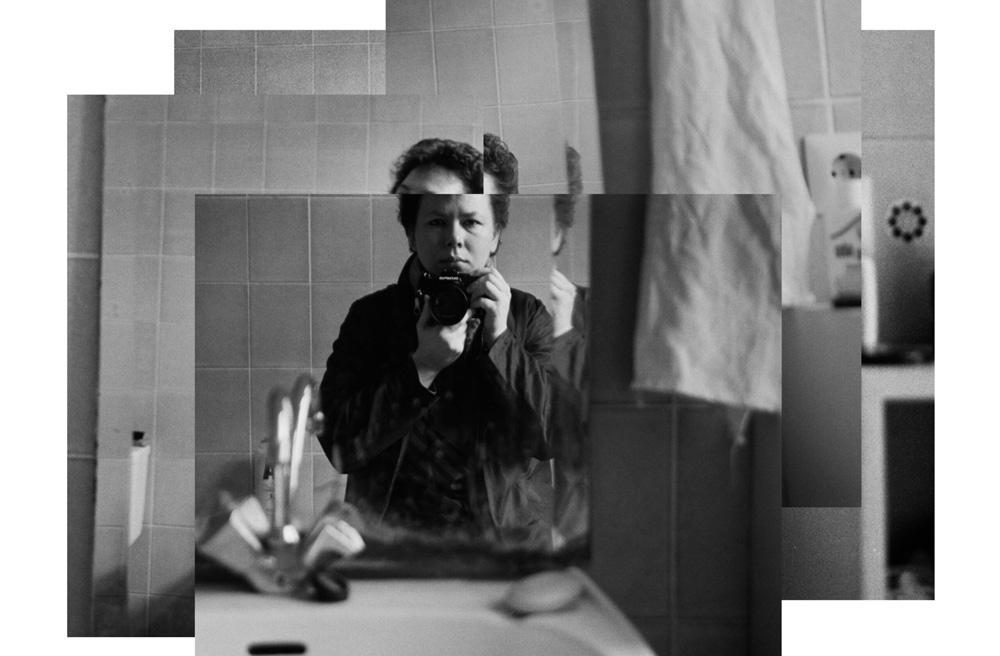
It becomes quite moving then to see Jarcovjáková’s work as a photographer come across with such force in “I’m Not Everything I Want to Be,” which is visually comprised entirely of the pictures she took from her teenage years on, chronicling the vibrant underground scenes of her native Prague, Tokyo and Berlin where those pushed to the margins come to find their own strength. In the stark black-and-white photographs, she exposes an alternative history of a generation including herself who had to build lives atop a crumbling national foundation in the Cold War era and although the many self-portraits of Jarcovjáková throughout reflect a toughness that suggest nothing would ever get in the way of capturing the truth of a moment, including her own vanity when she would often snap pictures at her lowest moments, personal journals speak to her great doubts about finding acceptance while she was at the mercy of the state for services such as her medical care, but contemptuous of the restrictions they were putting on everyday life.
If the reality sounds eerily familiar to the times we’re in now, director Klára Tasovská’s bold biography of Jarcovjáková is appropriately modern to meet the moment even if it limits itself strictly to material that the photographer produced between 1968 and 1989. When Jarcovjáková had the wisdom even then to remark, “Life passes too quickly to understand anything. The only way to survive is to take photos,” she captures the small but accumulating compromises people generally make as part of a larger society as she illustrates entering into her own marriage of convenience and only by sleeping on other people’s couches and spending nights out at the clubs where inhibitions are shed does she get a better sense of herself. Her own liberation occurs in parallel to borders being brought down for others when it concludes with the fall of the Berlin Wall and freed up from typical formal confines of most cinematic profiles, “I’m Not Everything I Want to Be” exudes an infectious air of possibility with both its accompanying anxieties and exhilaration.
After premiering last year at the Berlin Film Festival, the film has only grown stronger and stronger following the arc of its star and was recently selected to represent the Czech Republic at the Oscars. While Jarcovjáková, Tasovská and producer Lukáš Kokeš have been on a barnstorming tour of the States where the trio was heading east from Los Angeles to a stop in New York where the film will play the Metrograph this weekend, they graciously took some time away from their travels to talk about sorting through a trove of 70,000 pictures to speak to the photographer’s remarkable life and making history come alive as much as her pictures long have.
 Klára, what initially got you interested in Libuše’s story?
Klára Tasovská: Her personality and her huge archive — not only photos, but also diary entries. She kept the whole life [there], so for me, it was perfect material for film.
Lukáš Kokeš: I also remember that Klára wanted to do a female gaze story [in general], about self-acceptance and about the struggle of a woman in a society. Then she met Libuše and spoke with her face-to-face and it was a perfect match.
Klára Tasovská: Yeah, her point of view was exciting.
Libuše Jarcovjáková: For me, it was also important when I met Klára, I felt, not immediately, but a little bit later, she’s the right person, partly because of [her] sensibility and strong personality.
Libuše, from what I understand, this was not the first time that you had been approached for a film. What made this interesting for you?
Libuše Jarcovjáková: The other offers I got were boring because everybody wanted to do classical film about a photographer. I hated that idea. So my decision was to make no documentary because I didn’t expect a good result. With Klára, I needed a little bit of time before I made the decision, and it was really out of the blue, but step by step, I felt she understood me perfectly.
Klára Tasovská: Yeah. We talked a lot what the movie should look like.
Lukáš Kokeš: And Klára, when she was studying at Film Academy, she already experimented with a short film where she worked only with still images, sound, and voice of the narrator. [That short] was like a proof of concept [for this film] that you can actually shape a whole narrative using only those three main elements.
The approach doesn’t only feel fresh, but right for the story. There’s a sequence in the film about the T-Club where the images are enlivened by flashes, which apparently was connected to how they were taken in the first place. What was it like to figure out how the circumstances the pictures were captured could inform their ultimate presentation in the film?
Lukáš Kokeš: Yeah, you are talking about a series of pictures where people can see an old LGBTQ club in Prague during the ’80s and back at that time in the 80s in Czechoslovakia, during the communist regime, it was not completely safe to come out as a gay person, so there was this club where queer people met and felt more or less safe.
Libuše Jarcovjáková: It was not prohibited, yes, but not accepted. [You] could be blackmailed.
Lukáš Kokeš: So there was this tricky question. How can you take photos in such an environment, in this subculture, without putting those people in danger? And I remember [Libuše] explained that [she] decided to use flash, so every time people knew that they were being photographed. [Libuše] also love flashlights, so this was also part of artistic decision. And because this was also a disco sequence with music and people dancing, Klára together with the editor Alexander Kashcheev just experimented and came up with this idea to simulate these flashing lights because you are at the disco, so flashing light is something natural. Thanks to this effect, they discovered this strange motion that suddenly appears in still images.
It was a really exciting part of the film. Klára, you really bring the photos to life. What was it like to find a rhythm in general of how to present these photos?
Klára Tasovská: Yeah, it was also our decision with Lukáš and [Alexander] the editor to use contemporary music and sound design to bring the photos alive and make the film more dynamic because we didn’t want to [create a] slideshow with photo after photo. My editor worked before with animation, so I think he had this sense of feeling how the things could be and also he was main sound designer, so we could work with sounds and photos in editing room, only two of us. And I have to say [Alexander] the editor, his greatest asset is his patience.
Lukáš Kokeš: Klára and Alexander spent two years in the editing room making this film, putting one still image after another and then when you add music and sound effects, it suddenly changes — the perception of the pace of the images — so they had to re-cut whole sequences based on sound. And then Klára recorded her voice, testing the voiceover. That had a huge impact again on the tempo of the whole movie, so they had to cut it again.
Klára Tasovská: It was a very intuitive process, so it’s hard to say.
Lukáš Kokeš: You just have to try. There were also some situations where Klára tried to use actual film footage, but suddenly it was clear that it doesn’t match together with this dynamic editing style, so when you put a moving image in there, it was boring. So [in the end] there is no actual film footage. It was trial and error.
Klára Tasovská: For two years.
Libuše Jarcovjáková: Like in the factory. [laughs]
 Libuše, you had previously compiled your work for a book, but was it a different experience to reflect on your life like this?
Libuše Jarcovjáková: It was a completely new experience. I had no imagination [for what this could be] at the beginning because I didn’t know how it works. But I saw how methodical Klára is, and I had full trust in her work. That gave me a lot of security. Somehow at the end, it was a really natural process and I didn’t think too much about it.
Klára Tasovská: Yeah, Libuše totally forgot that a film was in process because we were in editing room and she stayed at home, thinking about other things. After one year, we presented our first cut to her and I think it was a big surprise.
Libuše Jarcovjáková: It was!
Klára, when you’ve got these diaries and then there’s these 70,000 photos, did you look to one first in order to find the story or did they interact?
Klára Tasovská: First, I read all diaries. It took me one year, and I made some structure of the diaries, like a script, and I decided to tell Libuse’ story chronologically. Then divided it into chapters and it helped a lot.
Lukáš Kokeš: It’s from small pieces. I think the starting point was how it was connected you know the starting point of the film was also the first self-portrait that Libuše took like a reflection in a window. That was one of the earliest images.
Klára Tasovská: Yeah, because I wanted to have her like main protagonist, not only with voiceover, but also with her presence on photographs. And point of view. Yeah, and you know put to the film her point of view. So I wanted to really start with the first self portrait she took in her 16 years old and it was in same period when also the Russian occupation started so it connect things connected somehow suddenly.
Libuše Jarcovjáková: Also, I was present all the time. Not in the process, but Klára asked me very often about some details for my life or we looked together at some sequences which were connected with the special period of my life.
Klára Tasovská: Yeah, we discussed it a lot about what was crucial for Libuše in her story and which people she wanted to have in the film.
Lukáš Kokeš: And pretty quickly we found out that the main [theme of the film] would be finding your own place in the world where you feel home. The whole story starts in Prague after the Soviet invasion in Czechoslovakia, and Libuše [says] in the film that she’s scared, she doesn’t know what will happen next and she lost this safe home in Prague. That’s when she starts looking for the feeling of being home and being accepted somewhere else, may it be Berlin or Tokyo.
Klára, when you’ve got these diaries and then there’s these 70,000 photos, did you look to one first in order to find the story or did they interact?
Klára Tasovská: First, I read all diaries. It took me one year, and I [created] some structure from them like a script, and I decided to tell Libuse’ story chronologically, then divided it into chapters and it helped a lot. I wanted to have her as the main protagonist, not only with voiceover, but also with her presence in photographs and put the film in her point of view and I really started with the first self-portrait she took when she was 16 years old and it was in same period when the Russian occupation started, so suddenly it connected things.
Libuše Jarcovjáková: I was also present all the time, not in the [filmmaking] process, but Klára asked me very often about some details for my life or we looked together at some sequences which were connected with special periods of my life.
Klára Tasovská: Yeah, we discussed a lot about what was crucial for Libuše in her story and which people she wanted to have in the film.
Lukáš Kokeš: And pretty quickly, we found that the main [theme of the film] would be finding your own place in the world where you feel home. The whole story starts in Prague after the Soviet invasion in Czechoslovakia and Libuše [says] in the film that she’s scared, she doesn’t know what will happen next. She’s lost this safe home in Prague and that’s when she starts looking for the feeling of home and being accepted somewhere else, may it it be in Berlin or Tokyo.
 What’s this all been like for all of you to travel the world with the film and start sharing it with audiences?
Libuše Jarcovjáková: What’s important for me is the impact that this film has for young people because I’ve heard very often [as we’ve screened it] that for them it’s a huge inspiration. And this [idea of being educational] I feel really gave me the sense of the whole film.
Klára Tasovská: We are happy that our film has worked internationally and universally, across generations.
Lukáš Kokeš: What I liked the most about the process is that it started as a small personal film project and it kept growing and growing. Every time we were surprised with how big it became. Then we had the world premiere at Berlinale, one of the biggest festivals in Europe, and we were absolutely over the moon to present the film there. After Berlinale, hundreds of other festivals selected this film, so it had a huge impact, and we never thought about competing for Oscars. Suddenly, it happened somehow, so the film just keeps surprising us. It’s a living thing. It lives its own life.
“I’m Not Everything I Want to Be” opens on November 7th in New York at the Metrograph.