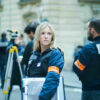




There’s a moment in “WTO/99” that seems both incredibly quaint and quite prescient of years to come when “Democracy Now” host Amy Goodman can be seen on the streets of Seattle in 1999 asking a heavily armed police officer about what type of nonlethal artillery is being used against the demonstrators that had come to protest the World Trade Organization event in town. The officer politely responds that he doesn’t know the details of what’s in his gun as he wears a gas mask and as if he were a waiter going back to the kitchen to ask about the ingredients in a given dish, he obliges Goodman’s request to find out if it’s chemical gas or rubber bullets with unnerving civility.
The fact the officer didn’t know what he was capable of unleashing becomes a statement in itself and if Ian Bell and Alex Megaro thought they were going back in time to make the all-archival documentary about the controversial international convention that was set to reshape the economies the world over, they end up seeing the future as the film brings into stark relief an increasingly militarized police that quelled dissent with their weapons, a media that framed the largely peaceful protests as violent to grab attention and a corporate class that pushed for the sweeping international trade deal that garnered bipartisan support at a government level, but that’s adverse effects on the lower and middle class was evident enough that a coalition that ran the gamut from blue collar workers to environmental activists rallied against it.
The event was ultimately cut short when opposition raised their voices loudly enough and flooded the streets of the city to prevent business from taking course, but as Bell and Megaro piece together a tick-tock account that places local and national news broadcasts next to amateur footage, there is quite literally a different view of the inequities that would only grow larger over time and the forces that would come to dominate the world we know today were taking root. After having worked together on the Vice series “Source Material” to offer a panoramic view of a widely covered event from a variety of the different sources to determine where the truth was, the filmmakers find an inflection point in the Pacific Northwest just before the turn of the century where a more siloed media environment would take hold as social media gained in popularity and cable news would become more brazenly biased to attract an audience, yet those already distrustful of police and mass media in general were wielding DV cams as a defense.
That offered a bounty to Bell and Megaro as they sorted through the archives of the Independent Media Center and they vividly recreate the atmosphere where there was considerable fear in the air about rerouted supply chains that would likely eliminate jobs in America and accelerate climate change even before protestors were met with armed guards around every corner of downtown Seattle. Having the urgency of a political thriller, “WTO/99” also is energized by the notion of hope when it shows people taking advantage of the rights they have in a democracy and that there is less distance between them when engaged with one another, though the film is nonetheless sobering about the threats to preserving such freedom in a society. A recent winner of the International Documentary Association Award for best editing, the electrifying film is coming off a festival run that began earlier this year at True/False and in the midst of heading west from its ongoing stand at the DCTV Firehouse in New York to series of special screenings along the Pacific coast this week, Bell graciously took the time to talk about the Herculean effort required to create such a living document, how his own connection to Seattle informed his perspective and how “WTO/99” has become even more timely than he could’ve imagined.
 How did this all come about?
Yeah, originally I started thinking about it because I left Seattle, where I was born and raised, a few months before WTO took place, and living in Japan. I had a dear friend that was thoughtful enough to send me letters from his dispatches from the streets, so it really stayed in my mind as a 19-year-old. [I thought] how does the world come to my city and I’m not there to experience it and understand it for myself?
Then I didn’t come home until after 9/11 and the nation changed a lot. Having that two-year blank spot in my political history, my understanding of the way the nation was evolving and changing, it just always stayed with me that there was a part of it that I didn’t understand. People were different when I got home. As the election of 2016 came around, Alex [Megaro] and I, who had already been working together, were talking a lot about the shift in the labor vote and [we thought] maybe there was a way to understand this through previous events. It seemed very new and unexpected to a lot of people, understandably, but we had been working at Vice together for a while and as we got deeper into our archival work, at some point I said, “I think there’s something to be understood by looking back at this archive [of WTO], if we ever find one.”
And after the first year of the pandemic, my family and I moved back to Seattle and as you do, when you get to a new town, you reach out to see who’s around. I tried to meet the archivists I could find and get a sense for the archival landscape and I lucked out and met some people from the Moving Image Preservation of Puget Sound, MiPoPs. And Rachel Price and her team were leading up a digitization process of tapes that the [Independent Media Center] had organized of roughly 400 hours of footage that video producers and videographers had captured that week.
 What boggled my mind was how many angles you could have for any particular scene and it seemed to me you must see a moment and it could be another year before finding another piece of the same scene if you’re digging through various sources. What was it like literally seeing a new angle on the story as you were working through this?
Yeah, our first job is to watch everything and to watch it a few times and as we watch it, Alex and I take slightly different approaches. He’s taking a lot of notes. He builds out our Bible so that we can always go back and keyword search to find where that footage is. Maybe it’s because I’m from there and I know what the streets look like and that it’ll look like midnight when it’s 4 p.m. in November, so as I’m watching, I’m starting to construct out the moments. Then Alex and I work on that together.
We’ll split up the days and if we see something [similar], we can time it because someone showed us their watch or we saw a clock down the street, so we know the time of day and we see a sync point. Sometimes that sync point is a traffic cone flank in the air. Sometimes it’s the same puppet guy on stilts. There was one scene after the violence begins where you see a column of police officers rush through a bunch of people sitting down on Sixth and University, and for that scene in particular, it probably took a week to sync up just that one moment. and it was only because we had seven angles on that moment and one police officer was sleeveless that day. Everyone else was in full cover S.W.A.T. gear, but he just was sleeveless under his gear, so his shirtless arm went up and three cameras caught it and that enabled us to sync that out with a high degree of confidence.
Were there pillars you could start building around?
Yeah, once we have what we consider the block of clay, which is a three-hour sequence that just looks at a part of the morning [for example], we had a bunch of those we could watch and we’re also collecting themes as we go through, so Alex and I were both listening for different things that were bringing people to the streets and different concerns that the city was having. Whoever was talking, we wanted to understand the thematics and as we cut down the film from the six- or eight-hour cut we first assembled down to 100 minutes, we were looking for the mechanics of the events, what moments led to the next moment and what was the relationship so that we could give you the spine of the week, but that we weren’t losing themes that were prominent in the footage as we were trimming it down. Even if it’s a minor theme, if we could fit it in and present it in a way that wasn’t too confusing, we wanted to make sure those themes were all intact. It’s an impossibility to represent the experience of 70,000 people, especially an event that was so monumental to so many in 100 minutes, so we know that the format of the film is always going to fail that endeavor. But if we could get the mechanics right of the spine of the events and include the themes that seemed to be emerging from the footage, that felt like the way to create an artifact that could present it back to people.
Was it obvious to restrict yourself to the four days of the World Trade Organization event in Seattle? From what I understand, there may have been a time when you were also tracking what was going on in China.
There’s a day before the day we started, which was not an official day of the WTO, but it was the first day of the protests. We cut that out for a number of reasons and then we had initially, because this [event] was building up to the inclusion of China in the following ministerial, which did [eventually] happen, we had two really great archival producers working on our behalf, looking at footage in China to try to understand the sentiments on the street and in the workplace, the factories, about the state of their economy [similar to the footage we had in the States]. Were they talking about the WTO? Were they talking about global economics? Did they have concerns about inclusion? We found some footage, but not enough to make that happen. But i will say that um there is a person at the end of the credit coda where we give you a little bit of the contemporary context of where things went and he speaks to the trade wars, the battling economies and how in the end it is the worker who suffers. That segment had the spirit of what we intended to do, but we’re unable to given the limitations.
 This obviously speaks so much to contemporary times. Was it much of an influence on what the focal points would be?
Yeah, when we set sail, we were really interested in trade policy and the impact on our politics around trade. We had a sense that maybe there was a prophetic nature to the environmental side of the protest. Again, being from Seattle and having had cousins and friends both participate and having a lot of friends and family not participate and learn everything they know from local media, I heard conflicting stories about when and why the police acted the way they did. Maybe it’s just the nature of an archival filmmaker, but if I can watch a thousand hours to understand it for myself, that’s what I’m going to do. We live in a world where it seems like a lot of people make their living off opinions. But I felt really fortunate that I could live with this footage and see for myself the timing of these events and not rely on these conflicting opinions that people have formed in the last 26 years about what happened. You can see it blindly.
One of your producers was half-joking and half-serious about how the theatrical tour for this so far as coincided with a number of protests unintentionally. What’s it been like putting it out into this moment?
It’s funny. We premiered it as the trade war erupts, and then the first No Kings protest coincided with our screening of Full Frame. Then we had DC/DOX the day of the military parade and D.C. was shut down. It’s been surreal to see so many of the themes in the film, the themes that were bringing people to the streets 26 years ago, so prominent today. At the risk of editorializing, In my work, I look at different historical events. I think a lot about the problems that we’re seemingly able to fix and how distracted we get. But I’ve felt very fortunate being able to have as many conversations as I’ve had so far because making a film in this way, living with the footage as long as you do, you end up making something that you can still learn from. There are things in the film that I’ll watch and I’ll see a different pattern or a different meaning for a first time and I feel like I’ve learned from the audiences a lot in the way they’ve seen it too.
“WTO/99” is now playing in New York at the DCTV Firehouse through December 11th. It will next screen on December 10th in Los Angeles at the 2220 Arts and Archive and in Columbia, Missouri at the Ragtag Theater, the Indiana University Cinema on December 12th, the Northwest Film Forum in Seattle on December 13th and 14th, the Basie Center Cinemas in Red Bank, New Jersey on December 14th, the Oklahoma Film Exchange in Oklahoma City on December 14th and the Plaza Theater in Atlanta on December 16th. A full list of screenings is here.