

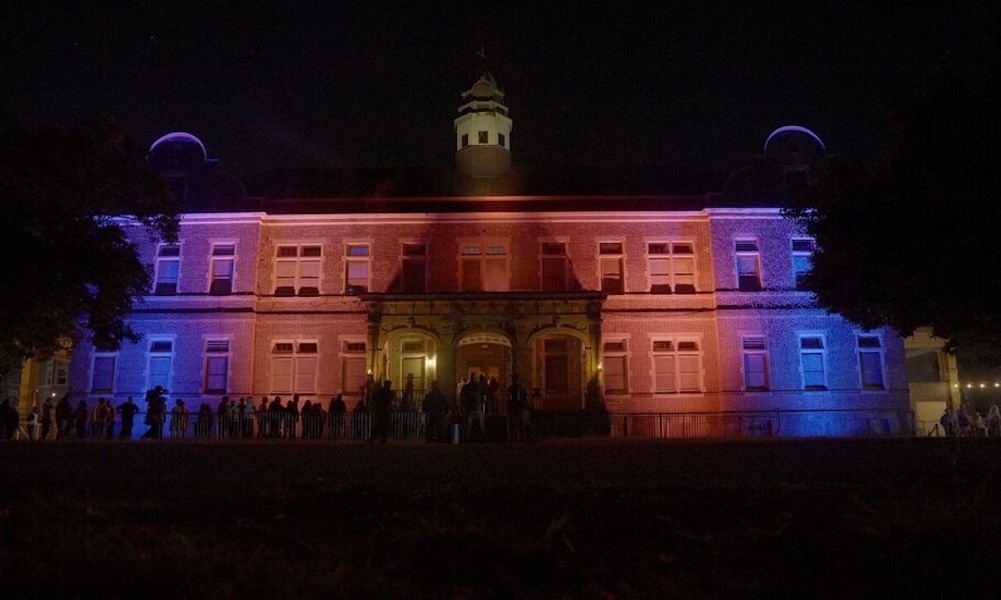

“Here at Pennhurst, we have a very different situation than every other haunt,” Emily Wunder says in “The Haunting of Pennhurst” as she gives an orientation to those who might want to join her as a haunt actor on the grounds of a former mental institution in Pennsylvania, running down the rules to abide by as they scare the living daylights out of visitors during the Halloween season. Much of that work is already done for them when the reputation of Pennhurst precedes it, shut down in 1987 after the horrific treatment of its patients with intellectual and physical disabilities was exposed and the century-old building with its brick facade and deteriorating corridors was ripe for a spooky reinvention by some savvy entrepreneurs.
Both the best and worst of humanity are presented in equal measure in Nathan R. Stenberg, Mike Attie and Katarina Poljak’s unusual bid at a horror documentary, which deeply unsettles with a history of the infamous location as it also offers the optimism of Emily and others’ steady work towards giving it a different meaning for future generations. As Emily tells the aspiring seasonal workers who are curious about joining this year’s crew, there is no doctor on patient violence allowed to be depicted in the haunted house given its history, but is quick to actually encourage the opposite should be part of the show, as she along with Autumn Werner, who gives tours on the premises, have been attacking the memory of the misguided staff that previously ran the place with plans to eventually establish a museum on the property dedicated to offer perspective on how disability has been handled by society at large over the years and to do so, they attempt to raise money with the attraction of a haunted house.
“When people don’t understand things, they’re scared of it,” Emily says, a statement that cuts both ways when she and Autumn lure paying customers with the promise of being frightened by all the dark corners of Pennhurst inhabited by actors behaving irrationally, but the film actively acquaints audiences with those who have signed up to work at Pennhurst, many of whom reveal themselves to be an outsider in some way, whether they’re neurodivergent or deaf or trans, and can use the way in which they’re seen as different to the benefit of the cause. Stenberg, Attie and Poljak’s strict vérité approach allows for its subjects to introduce themselves on their own terms – it isn’t until Werner herself describes how crawling on the floor to entertain guests is a way to use her physical disability to her advantage that it even might be noticed – but the freedom that is offered the seasonal workers to do what they will with the characters they play stands in stark contrast to how the disabled have been defined by others. With floor plans for Pennhurst from the turn of the 20th century coldly laid out in the film’s opening sequence, the film contrasts the present-day activity with a parallel history where educational videos from the 1960s aimed at creating compassion, bluntly asked the question, “What if you were mentally retarded?” (albeit in colorful and inviting animation) and Roland Johnson, a late former inhabitant of Pennhurst, can be heard grimly recalling the abuse that took place there in audio recordings taken before his death.
Although the chilling testimony of abuse sends shivers down the spine, “The Haunting of Pennhurst” may be slightly uneasy in ways the filmmakers might not have entirely intended when the film conspicuously showed up in the midnight section of Tribeca for its world premiere and to go into “Pennhurst” with the same expectations as actually visiting a haunted house may disappoint as something far more ruminative. Then again, making assumptions at all is what “The Haunting of Pennhurst” would seem to warn against when it now appears there was little interest in learning to care for the disabled rather than to simply remove them from public sight based on nothing more than appearances and while Emily, Autumn and others may contend with an uphill climb to pay for rebuilding Pennhurst into a monument that could stand against such disregard occurring again as well navigating the moral grey zone of turning tragedy into entertainment, the film succeeds in realizing the alternative image that would seem to be their ultimate hope, recognizing its subjects in all their dimension and acknowledging the past as opposed to sweeping it under the rug where it could likely be repeated.
“The Haunting of Pennhurst” does not yet have U.S. distribution.