


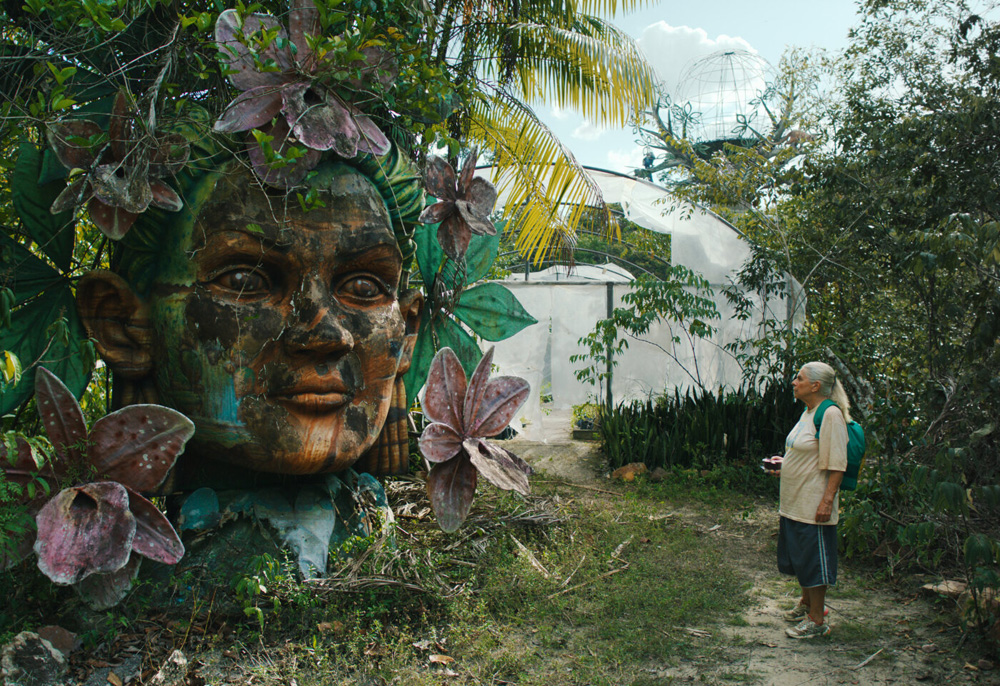

Tereza (Denise Weinberg) is too smart to see the laurels that have been placed outside the door or her home as an honor in “The Blue Trail,” loathe to let in the government agent that just wants “to ask a few questions” as they want to acknowledge her 80th birthday. She’s actually 77 and despite a new promotional campaign in Brazil touting “The future is for everyone,” she can see the writing on the wall as seniors are being encouraged leave civilization for a more controlled environment out of the public view, relieving younger generations of any burden they may place on them in a bid to boost their productivity as the country seeks to turn around its flagging economy. The celebratory ornamentation put up around her house may as well be a notice for termination and while she’d like to leave what seems to be her fate, to travel anywhere would require her to register with the government when an ID is required to get on any vehicle and if she’s caught straying, she’d be placed on another that’s colloquially known as “the Wrinkle Wagon” where seniors punch a one-way ticket to an unpleasant final destination.
Still, even at her advanced age, Tereza knows there must be some adventure for her out there and she won’t go into the sunset quietly in Gabriel Mascaro’s marvelous drama where the director sets sail on the Amazon River as the septuagenarian attempts to elude officials and fly for the first time, hoping to hop on a hobbyist’s aircraft that won’t require any authorization to take off. Since first picking up a camera to make the documentaries “KFZ-1348” (with Marcelo Pedroso) and “High-Rise” filmed from the vantage point of a Volkswagen Beetle and the top of a luxe skyscraper, Mascaro has long sought out a unique perspective to look at society and subsequently broke through internationally as a narrative filmmaker with “Neon Bull” where the bold colors of the rodeo-set drama underlined the progressive ideas at its core about traditional gender roles. His follow-up “Divine Love” also boasted a huge imagination when it was set a few decades in the future, though it might not have been all that required as his homeland was swept up by a wave of evangelical Christianity that led to the disastrous election of Jair Bolsonaro and that sentiment could serve as the backdrop for the tale of a government worker who finds herself engaging in more and more depraved behavior as her work obliges her to keep couples in bad marriages and she puts the wishes of the state over her personal happiness in her own life.
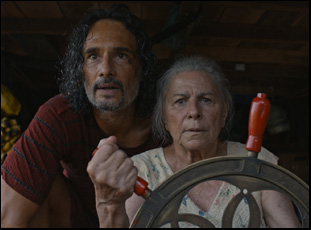
There is one foot firmly in the present reality even as Mascaro imagines what the days ahead will look like in “The Blue Trail” as Tereza finds there’s always something new to be discovered in the world that’s been around for centuries before she entered it. (In fact, a snail that secretes a blue substance that can offer psychedelic trips into the future is what gives the film its title.) The wonder in her eyes as she is ferried down the Amazon at first by a reluctant captain (Rodrigo Santoro) and eventually charting her own path into the wilderness extends to an audience not only with the natural beauty that Mascaro is able to capture in places that are so rarely accessed, but when it’s expected that Tereza has seen everything and still can be undone and reawakened by what she hasn’t before. The film offered the same sense of revelation to those that first caught it at Berlinale last year where it picked up a Golden Bear and now is arriving on U.S. shores this week and Mascaro graciously took the time to talk about the inspiration of his own family in putting together this work of speculative fiction, having locations physically change up on him when filming on the Amazon and how rebellion isn’t only the province of the young.
 How did this come about?
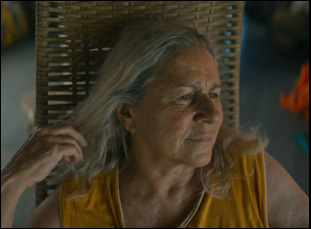
It was very special how this project came to me because when my grandmother was eight years old, she started painting, just after my grandfather passed away. It was very inspiring to see someone finding new meaning for life in that late age, [where] something tragic happened, but the reaction was so beautiful in terms of how can you recreate meaning for life. I try to investigate movies about elderly characters and I realized that there are only a few about elderly characters and in general the the conflicts are associated to death. The characters or some friend of the characters has some kind of terminal illness or are [tortured by] nostalgia about the past, so I was really aiming to make something different, [wondering] how can we observe and look at the elderly as part of the present? Where they’re able to take risks and find new meaning for life, experiencing new stuff — desire, new friendships, passion. So that that became part of my investigation.
From what I understand, this has been in the works for nearly a decade and when in particular, the pandemic happens, did the ideas change?
Yeah, it changed and it was quite a difficult project because when I would share the screenplay with friends, there would be some lack of empathy with the character because people aren’t used to being empathetic to an older character that leaves their family. In a few versions the character used to live in the same house of the nephew and when she left the nephew behind, the expectation was always that there’d be a condemnation of her. People wouldn’t identify with her, so in the later version of the screenplay, I just moved her from a house [that didn’t have her nephew in it] and something different happened. I discovered how we as a society have domesticated elderly bodies. We tend to not be empathetic for someone old. If, for instance, your grandpa or grandma said, “Oh, I have a new friend. I’m going on a trip with him,” you’d say “Whoa, what’s going on?” [laughs] It can be scary. Even progressive people do not consider the desire, the dreams or the capacity of experiencing the new when you are old, so that was the big challenge for me.
When I discovered the tone, and I discovered also elderly people aren’t accepted in sci-fi cinema because dystopia is reserved for young. [And I thought] why can’t elderly be rebels?”Coming of age is [an idea] reserved for young bodies because nobody wants to see a rite of passage for elderly people because in general they are associated to death. And I started to look at the elderly body as something like a dissident for the cinema and for the genre tradition. Becoming older was like a reflection about how to be a rebel, fun with humor, where you can laugh with the character, but in the end you have this very serious alert about the issues they are facing. This feeling that [what’s on screen] is not real but it could easily be real is very challenging for the audience.
 You’ve got such a great setting to create that feeling when you’re filming on the Amazon and from what I understand, many of the people that Tereza comes into contact with really live there. How much did the story develop from your own travels there?
Yes, when I finished my college, I wanted to work as a teacher giving lessons for indigenous communities to become filmmakers. It was a great NGO project, and a really amazing part of my experience as a filmmaker, so it was easy for me to to write the screenplay in that context. Of course when I came back to do a tech scout of locations [years later], it was quite challenging because the Amazon changes so much as an environment. A few locations that I scouted with the photos when the river was high, I was back there [filming] when the rivers were down and sometimes [the same location] would be one kilometer away, like the floating house, [because of] the ebb and flow, so it was challenging to make this kind of movie where not even the GPS works. So you really must be open to improvise with what nature offers to you. We had to figure out a new way to organize the shoot.
Was it interesting imagining the future outdoors? Typically, with your past dystopias, you can lean on small details in production design to suggest the decades that have passed. Is that harder here when it’s so much exteriors?
Yeah, what’s important was to make this playful movie where you have different genres and the soundtrack is very special because it really helps to switch between these different tones to allow this character to go through these different expectations of genres and what she was going to do in the journey. It was very special for me as well to be able to take on this dystopic, but very utopian movie. It’s really passionate about life, so it was beautiful to see this location — this very sinuous river where you can be hidden but you can find yourself in a new way — and this blue snail element was really exciting for me as well to be able to to create that because it’s slow in its movement, but infinite in its possibilities and it really allows the character to find the utopian side of this.
Instead of playing with high-tech gadgets or some futurism connected to technology, I really was excited to make a movie about this speculative vision where you have this absurdist change in the cultural behavior of society more than in the disruptive technology, so it’s not a high-tech movie. It’s really cultural displacement where you normalize a Wrinkle Wagon that takes away the elderly from society and this huge meat processing factory to [manufacture] alligators, so it’s world building where the small elements can make the tone suspended and it’s not about futurism or about the past or present, but a displacement of reality.
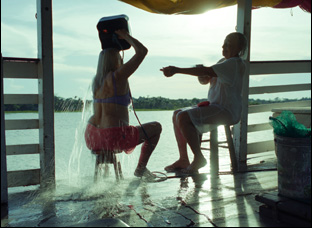 You’ve got a strong lead performance from Denise Weinberg to ground it. She generally works in the theater, so what made you think she could carry a film?
When I start writing the screenplay, I tend to not think about actors and this was a curious [process] because the first generation of famous actresses in Brazil, there was so much pressure from the industry to hide the aging and [many] had a lot of procedures in the face that to hide the age. I really needed someone proud of her aging and I found this amazing actress, Denise Weinberg not in the cinema or TV, but she comes from theater and was so special to have this really conscious actress, proud of her wrinkles and knows that they are very important to reveal her emotions, so it was a really beautiful encounter with this amazing actress, very confident and smart.
And I remember one of the most important moments in pre-production was in the rehearsal when Miriam [Socarrás], the other actress came from Havana, Cuba, and it was such a beautiful encounter between the two ladies. I realized how strong their relationship would be and one of my references for the screenplay was “Before Sunrise.” When I saw that these two old ladies had this equivalent feeling in the big boat in the middle of the Amazon, it was so powerful. For me, it’s a movie about this old lady that wants to fly, but in the end she learns that she can fly even higher than she imagines she’ll be able to from inside of herself and [seeing the two actresses together] really gave me confidence that the movie would have this power.
Is it true that you got to take your grandmother to the premiere in Brazil?
It was amazing because just after the Silver Bear at Berlinale, I was excited to share [the film] with her and asked if she wanted to watch it on the computer, but she said, “No, no, no, no. I want to see it in the cinema. But [I told her] it’s going to take a long time, sometimes it takes six, seven months to go to cinemas [in Brazil]. And [she said], “Oh no, I waited my whole life. I can wait a little bit more.” So it was beautiful to have her and the premiere in Recife was actually in the same cinema that is in “The Secret Agent.” It was a beautiful cinema for us. So it was very powerful to be able to share the movie with her and she made a joke with me. “Oh don’t say that the movie was [based] on me. You are you are lying to everyone so because I didn’t have these blue snails near my eyes. Don’t lie to people.” [laughs]
“The Blue Trail” opens on April 3rd at the Angelika Film Center in New York and the Nuart Theater in Los Angeles and expands nationally in the weeks to follow. A full schedule of the cities and dates is here.