


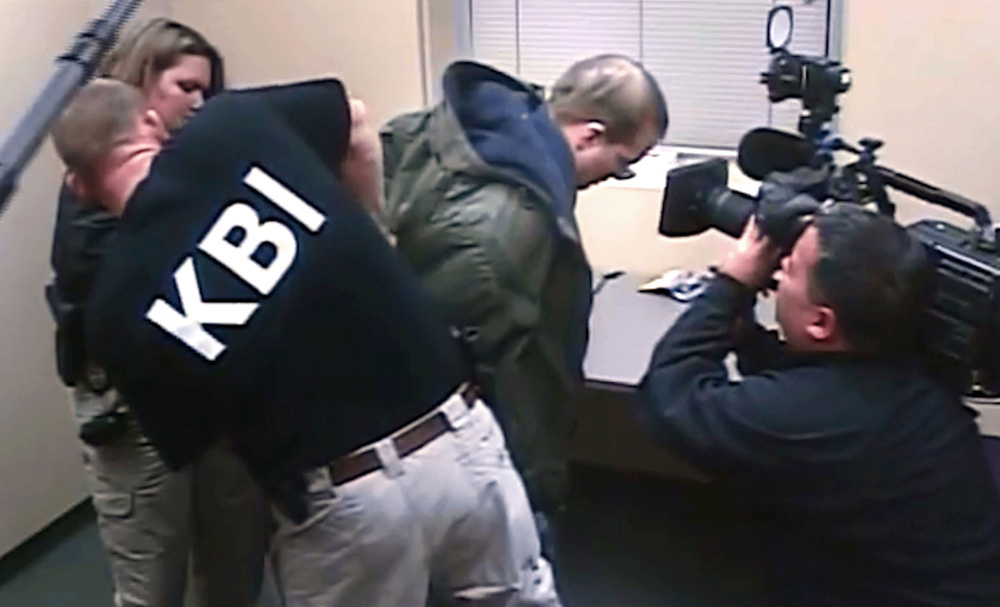

There’s more than one trap being set at the start of “Predators” as Chris Hansen, the host of “To Catch a Predator” can be seen pacing around an empty chair during the show’s heyday in the early 2000s, awaiting someone who has made arrangements with a minor for sex and finds Hansen and the local authorities instead with a different date with destiny in mind. What was seen on television by millions offered the perverse pleasure of a familiar formula as the unsuspecting male could not know what the audience did about his fate and as the man was hauled off by the police at the end of the episode, it offered a tidy form of justice when he would be heard from no more as the closing credits rolled. However, as much lurid appeal as this held for David Osit when he was growing up as it did for so many others to unwind on a Friday night, the director could understand later that something far more complicated was going on when Hansen and a crew from NBC News was coordinating with police for a fusion of entertainment and law enforcement where any notion of rehabilitating obviously psychologically ill individuals was secondary to boosting statistics or ratings.
Osit pulls back the curtain on what was happening behind the scenes in his remarkable second feature when he has the raw footage from many of the surprise arrests, much of which was compiled online by the massive fan communities that grew around “To Catch a Predator” and likeminded copycats that were inspired by it, and revisits participants in the process, from the actors whose youthful appearance allowed them to fit the bill as decoys who could lure would-be pedophiles to an agreed-upon location to local officials and even Hansen himself as he’s setting up to launch a new subscription service with endless hours of his post-“To Catch a Predator” true crime shows. It doesn’t appear to be a bad business to get into, at least from a financial standpoint when Osit sees that there remains an insatiable appetite for such programming when he attends events such as Crime-Con where Hansen is greeted like the cast of “The Avengers” at Comic-Con and finds more than a few (much-less well-financed) competitors even now, leading the director to join one of their ambushes in a seedy motel for YouTube.
While “To Catch a Predator” offered escapism to everyone but its weekly guest star, “Predators” shows that there was a cost for all that easy gratification when it inured society to the real issues at the heart of the crimes it was purportedly preventing and gave rise to a thriving cottage industry where the intentions of those pursuing the child predators hardly look any more noble than those they ensnared. By creating the space for such thoughtful analysis to occur, Osit offers something as riveting as the show that inspired his inquiry when instead of hanging on every word of Hansen’s signature closing interrogation of a suspect, the viewer does not know what will come next in their own mind about how they feel about all that’s being presented. The film is a stunning followup to Osit’s exceptional 2020 film “Mayor” about Musa Hadid, the man carrying the weight of the world on his shoulders as the mayor of Ramallah in the middle of Israel and Palestine, and after its premiere at Sundance earlier this year, “Predators” is now set to spark conversations all over the country as its commences its theatrical run and recently, Osit generously took the time to talk about how he took a genuine interest in the legacy of one of the main progenitors of the true crime era we live in now, having the power of an interview break through and avoiding cliches in all the forms “Predators” would seem to align with.
This seems a lot to take on. What gave you the permission to say to yourself, “I should do this”?
For years, I just really didn’t think there’d be enough there. I didn’t want to make a true crime movie and I didn’t think that there could be anything to the story of “To Catch a Predator” more than it being a true crime movie. But then one day I found all of this raw footage through a couple of online fandom communities that have been collecting the footage over the years and I was so struck by this material. I just remember watching it and having this incredibly emotionally complex reaction to what I was seeing. The show feels like it’s cut like a dark comedy [compared to] the raw footage [where it’s] 70, 80 minutes with one shot and over that period of time, you’re watching someone’s life end. And I would find myself going back and forth between watching that and the show and feeling disgust for these guys and then tremendous sadness. It was a real mix of human emotions and that’s when it occurred to me, what if I could make a film that wasn’t about “To Catch a Predator,” but about how “To Catch a Predator” makes us feel and how shows like it make us feel and about how we treat people. Not about defending predators or about predator hunting. That’s a total misread of what the film is to me. It’s about being interested in how we treat people in a society that we all share, especially the people at the bottom.
When you’re on message boards to find this footage, what’s it like to have that context of others’ reactions around it?
There are times when I would see behavior that I could describe as doxing on the message boards or delighting in the continued schadenfreude of some of these men’s inability to continue to resume their lives after appearing on the show. I saw a lot of humor and meme culture continuing in this siloed world of fans of the show. Then the first people I ever spoke to were people who were active on the message boards, who were all really lovely people who have just been able to delight in this show and creating a community out of it. I found that interesting – these were people who were able to find the humor and the joy in connecting over watching this program 20 years on. And while I personally could no longer find the joy that I felt watching it as a teenager, I was intrigued at the idea of what do we get out of watching true crime? What is it about that and this show particularly that engaged certain people’s frontal lobes in the way that it did? So I was definitely thinking about that as I went out to ask people questions and talk to them, ironically asking the same question that Chris would ask people, “So why are you here? Why are you fans of this? Tell me more.” I never wanted to punch down or make fun of anybody, even if I disagreed with them. There’s many people in the film I disagree with, but I didn’t see it as my job to put my opinions front and center in the film. That came later.
How did you figure out what your presence in the film would be? I understand it wasn’t at all in your initial plans to include yourself.
No, it wasn’t. My presence in the film wasn’t something that I imagined would be integral to the film’s narrative. But the way I make a movie is I’m thinking about what questions are interesting to me and the themes I want to explore and then I film what I film. Eventually. I start putting stuff onto a timeline and I have a three-hour string out of a film at some point. And what I started to notice that was making it into the string out was stuff where the fourth wall would break on occasion. There would be an invitation for the audience to be considering who is the author of this story about how do we author stories and it started to make sense that I just showed up in the movie at a certain point. But it wasn’t my choice, ironically.
Did you know this would be as much of a present-day story as it was with events like Crime Con and Chris Hansen’s network upstart?
Yeah, I had never heard of Crime Con when I first started making the film. That wasn’t something I had in my mind. But I was talking to Chris early on in the production and I think he was the one who mentioned to me that he was going there, so I went for the first time without a camera and was just gobsmacked by the “To Catch a Predator” fandom community, and just the true crime fandom community at large. I think the numbers were 92% female of the attendees of Crime Con the year I went the first time and there was a hero’s welcome for anyone who’s ever graced the stage of “Dateline” and tons of podcasts I’d never heard of. And it was an incredibly vibrant community oriented around safety and delighting in the details of grisly murders and stuff that I’m sure is normal. It’s just not my world. But I was interested in seeing if there’s a world where I could peel back some of the layers of that and potentially see a connection between how these days modern true crime fans are maybe just descendants of all the vigilantes who worked on “To Catch a Predator” 20 years earlier who themselves were inside of their own true crime story when they began.
You really do come to this with a remarkable lack of judgment, which seems endemic to simply how you compose shots for your interviews with airiness of the frames and leaving the space in the edit for their comments to settle in. What was it like to figure out that as a tone?
For me, that’s a golden rule. It’s not about figuring it out. Especially for a film like this, I couldn’t have let myself make the film if I wasn’t genuinely trying to meet everyone with curiosity. I needed to feel like I wasn’t committing the same sin as the original show, which was that this is not a curious show. It’s a lot of things. It was a well-intentioned show. It was an entertaining show. But it was not a curious show ultimately, or at least the curiosity would hit a wall at a certain point, and that wall would be the wall of law enforcement officers.
Was it difficult to put together sequences where you weren’t falling into the same rhythm as those shows even though ultimately you’re conveying the same series of events?
Yes. There were many sequences that felt that way and I’d like to think that I put the complexity of those sequences into the movie. One in particular is a moment around the middle of the film when we’re spending time with modern-day predator hunters, and I’m really wondering what I’m doing there in some ways. I think I’m seeing myself through the eyes of the man that has been caught and being filmed by the predator hunting group that we’re with and I’m filming as well and I realize in that moment that through that man’s eyes, as far as he’s concerned, I’m just the B-cam. I don’t know who he is. I don’t know his name. But that was an alienating thought [for me] and I found myself in the edit room feeling like, “Okay, I need to show how I tried to be different.”
But the act of doing that made me deeply insecure and a lot of elements in the film made me really question what I think a lot of people take for granted about documentary film, which is that, of course, we’re also trading in people’s lives many times. We just have good intentions is what we tell ourselves. But so does Chris [Hansen] So it’s it’s not about good or evil here or about one of us is right and one of us is wrong. It’s about kind of, A, what our duty of care is, which for me was important to think about in terms of the film, and the people that agreed to be in the film. And then, B, what is the goal and what am I trying to illuminate here? Why am I making the film? I think a lot of documentaries hide behind the anonymous wall of being a filmmaker and that’s why we’re here because the filmmaker just wants to make the film. But for what reason? Being able to include some of that in the film is not something I expected that I would do. But once I did, I finally felt like I could finish it.
Knowing how verite-driven “Mayor” was, was doing something with much more archival a lot different in building?
This was definitely a departure from my last film in in terms of what made the final film was 100% verite. I filmed things that weren’t Verite for that film, but they didn’t make it into the movie and then this film, when I first imagined it, I was imagining that it would be really a combination of these interviews and archive. But I always imagined from the beginning that the interviews needed to feel like they were verite as well. And I love interviews. I feel like my generation of documentary filmmakers is weirdly dogmatic about being anti-interview, probably because we came of age during the proliferation of a lot of talking heads documentaries. And then we all discovered Pennebaker, Wiseman and Maysles and [thought],”Oh yeah, that’s the real way to make a movie.” But of course, interview-based filmmaking is extraordinary. “Shoah” and early Errol Morris stuff is extraordinary because those interviews are alive. That’s the difference. They’re not talking heads. They’re humans being interviewed and I wanted to do that, so I always wanted to make the film verite, but I just saw it as controlled verite and using the interview form to actually become something that lives and breathes and changes over time.
What’s it been like to start getting this out into the world?
I’m excited for it to actually be in the world. It’s been on the festival circuit, which is more of a siloed community than anything you could find on the internet now. But I’m excited for people who are expecting a true crime documentary to watch it by accident.
“Predators” is now open in New York at Film Forum and opens in Los Angeles on September 26th at the Laemmle Royal.