





“I don’t know why he wants to tell his own story,” laughs Lisa Herbert in “The King of Color,” dutifully sitting for an interview about her father Larry, but perhaps surprised that after all the years he spent behind the scenes developing the universal color organization system Pantone, he was eager to put himself front and center for a film. Even Lisa cops to admitting she could benefit from one when she didn’t know much about his childhood, but it turns out that “Wordplay” director Patrick Creadon’s efforts are hardly in vain when in fact Larry Herbert’s influence is legion as he made it possible for everyone in the world to pick a particular shade of their favorite color whenever the choice comes up when he created a standard for everyone in the world to abide by with a numerical method and was behind several innovations in print technology.
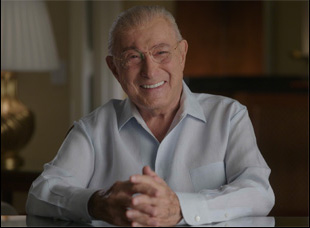
Herbert’s profession may be an obscure one for a compelling film, but Creadon finds that it isn’t only his work that’s colorful, sitting down now with the feisty nonagenarian at his house in Palm Beach, Florida where he still clearly retains the moxie required to survive the streets as the son of immigrants in Brooklyn coming out of the Great Depression. Though he drives a Bentley now, he recalls his days of just scraping by and taking classes on typeset and printing presses where the encouragement for having a sharp eye led him to decide against pursuing a career in a more obviously lucrative path in medicine after attaining a biology and chemistry degree. Instead, Herbert put his scientific knowhow into the printing business, first inventing a split fountain press that could print up to 28 colors simultaneously and subsequently establishing the Pantone system that would be honored by designers internationally to match colors to one another, creating a consistency that had eluded the industry.
When Herbert fondly remembers how inspired he was by the experience of seeing his first film “The Charge of the Light Brigade,” he isn’t about to let anyone down who comes to see him share his own life story, getting candid about his many dead ends before finding the right way forward and a longtime marriage that grew unhappy, leading to what Lisa terms as “your typical male midlife crisis,” only he got to have his frequenting Studio 54 in the ‘70s. Remarkably, he is just as engaging talking about printing when he has such passion for it, and the film is bolstered by sequences only slightly more animated than he is, illustrating the techniques he pioneered with a sense of style befitting of what he ultimately achieved. After premiering this fall at the AFI Film Fest in Los Angeles, “The King of Color” is now rolling out into theaters and Creadon and color expert Sean Adams, who appears in the film, kindly took the time to talk about why Herbert deserved a documentary portrait, what made the director comfortable with the film being commissioned by its main subject, and making a profile that would be as full of vim and vigor as Herbert.
 How did this come about?
Patrick Creadon: A friend of mine introduced me to Larry, who was 95 years old when we met, and he said “We don’t have a lot of time, but I really want to tell my story.” I already knew Pantone and the invention was always interesting to me, but the more I got to know Larry, I knew I wanted to work with him because I just love his energy and his charisma. He is a guy who has experienced a tremendous amount of failure in his life and to me that’s really inspiring he never ever let a single strikeout discourage him. He just bounced right back up and kept going. And he’s a 95-year-old man who is sharp and funny and tenacious. And he reads the newspaper every day — he reads several newspapers every day. He’s really engaged with the world around him. We’ve made a lot of movies and there’s something about this that’s really, really special.
It actually was refreshing to me that you make plain upfront that he was the driving force behind the movie as well. Was that much of a decision to be as transparent as you are?
Patrick Creadon: It definitely was. This is my ninth movie and every movie that we’ve made is different and how they come to be is different. Sometimes people pitch us an idea and other times it’s an idea that we want to do. This was an idea that was pitched to us and we’ve never really had a subject come to us and say, “I want to tell my story and I want to work with a filmmaking team to do that.” But when I flew to Palm Beach to meet [Larry], I brought him a present, the book “Steve Jobs,” which was written by Walter Isaacson, a terrific journalist who used to be the editor-in-chief of Time Magazine. I gave Larry that book, and told him the story behind that book, which is that Steve Jobs came to Walter Isaacson and said, “I want you to write my story. And Walter Isaacson [said], “This isn’t really how I normally work, but [I’ll accept] if you give me 100% creative control and you can fund the effort, but I’m in charge.” And Steve Jobs said, “Yeah, I’ll do that.” That’s kind of what we did with Larry.
I made it very clear, if you want me to take this out into the world as a documentary film, it has to be my film and I have to tell it the way I want to tell it. This film has the same amount of journalistic integrity that all of the other movies that we’ve made because at the end of the day, I have final cut. In this case, the subject had pulled together the financing for this and frankly as long as Larry understood the ground rules, it didn’t matter to me where the money came from, whether it was from a streamer or from donors or a large grant. I really reject the notion that streamers or studios or institutions that make documentaries are the only ones who can decide what gets made. And I think in a world where autobiographies are very much accepted as books, I really like this idea of an autobiography film. I don’t think this model applies to a lot of different stories. There’s a lot of documentaries that are really hard-hitting, investigative journalistic pieces where the filmmakers have no relationship with the subjects. That is not what this film is. This is a profile of someone who lived a really extraordinary life is still living it.
But I thought about that a lot and about “Steve Jobs,” which I read and which I loved. I’m glad that that book is in the world and I really feel the same way about our film.
It’s not just Larry who thinks the story who should be told, but Sean, you make a compelling case early on in the film that it should too. What was it like to be approached for this?
Sean Adams: It was great. Patrick’s an amazing filmmaker and when he first called, I’m like, “No way. He doesn’t want to talk to me. I’m just a nitwit.” But it was fantastic and I am a color evangelist, so [I’ll take] any chance I can promote the idea [to take] notice of the world in color and pay attention to color. It’s not [because] this is going to make you a better human being, but It’s the thing that makes life worth living. I love that [idea] and it was my opportunity [to express it] and also reinforce the amazing work that Larry did and how impactful it was to industry and to corporate America post-war. It was a driving force in design, not just graphic design, but product design and transportation design and it touches every part of our life.
 You’re able to make a film that gets that across without ever getting too technical. Was that a difficult balance to achieve?
Sean Adams: That’s Patrick’s amazing talent, that he’s able to take something that could be very technical like, “Let’s discuss the values of CMYK” and make it into something incredibly understandable and compelling. That’s true genius.
Patrick Creadon: I appreciate you saying that, Sean. You know what? Have you ever been in a room with someone who’s super smart? Like they’re the world’s leading expert on something, but the more they talk, the more incredibly boring it is for you because you can’t even really keep up with them? They’re talking way above you or beneath you, but they’re not talking with you. But then you meet other people… like Warren Buffett is a good example of this. He was in a film that we made years ago about the national debt. He was wonderful to work with, but he can be talking about some really intricate things in the world of finance or in the economy and he does it in a way that if you were there with a 10-year-old kid or even someone who’s an expert like he is, he’s interesting to listen to. He makes sure everyone feels included in the conversation. That’s always what we try to do with our stories, because ultimately Larry’s story is appealing to people who work in design, but at the same time, I think Larry’s story is really amazing to people who have never heard of Pantone.
It is a bit of a balancing act. Christine [O’Malley] and I have an amazing team. William Neal and Julia Szromba were the two editors on this film. Adam Lawrence was our archive producer. Kanae Lowry and Jess Hutchison were our graphics team and they have teams of their own. Those are people we’ve worked with a lot and together, we always try to dig really deep into the character piece and into whatever their world is, the technical stuff that they do, and then we try to talk to people like Sean, who are really expert, and can engage people about this thing that Larry does. The whole movie could be about the Split Fountain Press and how that works, but seeing Larry driving his Bentley through Palm Beach and people honking at him is as much a part of this story as him figuring out how to crack the code on color and color communication, so [the goal was to] create a complete portrait of Larry. It’s hard to do that in 90 minutes, but that’s what we always try to do.
The story does lend itself to a lot of flair when it involves color. With something like the animation, was it fun to get creative?
Patrick Creadon: Yeah, a lot of how to tell the story was pretty easily accessible and this whole film really started with a conversation that took place over three or four days with Larry in his home. We got to know each other. He got to know me. I got to know him. And we just built it out from there. There’s a lot of footage and photos and archival that go back to the 1950s and ‘60s, but part of Larry’s story is a bit of a black hole — [from] the 1920s and ’30s and early ’40s, and that’s why we did animation. Larry was a big comic book fan, so this idea of creating really colorful drawings of his childhood was something that Kanae Lowry came up with. She and her team did an amazing job with those drawings of his early life, and especially with the story of Pantone, I wanted the story to be filled with color. I wanted it to be fun to look at. I think there’s going to be a lot of designers who are going to enjoy just the way the graphics were done…
Sean Adams: And I know, Patrick, you did a [screening] at MoMA this week, and I got 10 e-mails from really amazingly well-known designers that were like, “Whoa, dude, what’s this about? This was the best thing I ever saw.” And one of the things that I found really exciting is we did an early screening of it at Art Center and I have tried to explain this to students multiple times how [Pantone] works and their eyes just glaze over and go on their phones. But after the film, so many of them came up to me and said, “Now I get it. I understand what you’ve been trying to explain to me.” And I [think], “Well, okay, I guess I’m not that good.” [laughs] But I was thrilled by that. That was the best part of it is being involved with this and then having this remarkable tool.
 Patrick, what’s it like getting the film out there so far?
Patrick Creadon: We’re just getting started, but what we always try to do with all of our work is to capture the essence of the person that we’re profiling and hopefully tell a story in a way that the audience feels like they’ve spent time with that subject. With Larry, [we didn’t only want to impart] his story, but just Larry’s energy. He really lights up the screen. I love his obsession, his creativity, his tenacity, how good he is with his hands and fixing things and solving problems. He’s just an amazing character and with Pantone, it’s a story that, as Sean mentions in the film, his creation touches everyone every day in this world. They may not know it, but Larry and his work has had an effect on them. And for people who live in America or live in cultures where there’s commerce and where there’s mass communication and there’s travel and there’s branding, That is very, very much the world that Larry taught [us all] how to talk to each other [in].
Pantone at the end of the day is a universal language, and as we were making the film, we thought to ourselves, is there any other individual in history who alone created their own language? I still haven’t thought of who that is. Now, there are other languages like computer coding, math and certainly music. But the fact that a single man created this language of color is remarkable to me and it still astonishes me that he did what he did and that’s why as as Sean says really eloquently in the film, this is exactly the right time to tell his story. He’s still with us. He’s still healthy. And Larry was really happy to stand in the background as Pantone was growing. He did not want to be the face of Pantone. The face of Pantone is the language of color, as it should be. But now is a moment in time where we can celebrate his accomplishments and he can frankly be on the receiving end of that celebration. And it’s really satisfying to know that people are going to learn his story while he is still around.
“The King of Color” opens on December 12th in New York at the Village East and Los Angeles at the Regal Paseo in Pasadena.