




Although Jane Elliott would come to be known for her ideas about race, her thoughts about equality stemmed from her experience teaching a class of dyslexic students at Riceville Elementary School in her hometown of Iowa where other faculty pitied her for having to take on the seemingly futile task of educating kids that they had given up on themselves, but as she describes in “Jane Elliott Against the World,” she believed she could “teach a chair to read if only it had a mouth.” The proof of Elliott’s determination and tough love approach actually is presented before you become conscious of it in Judd Ehrlich’s engaging profile of the academic and activist when former students of hers come across in interviews no differently than her peers for whom education was never an issue, and only when one does and it’s actually seen as some kind of dividing line, Elliott’s point about how prejudice is taught rather than something you’re born with is made without her having to say a word.
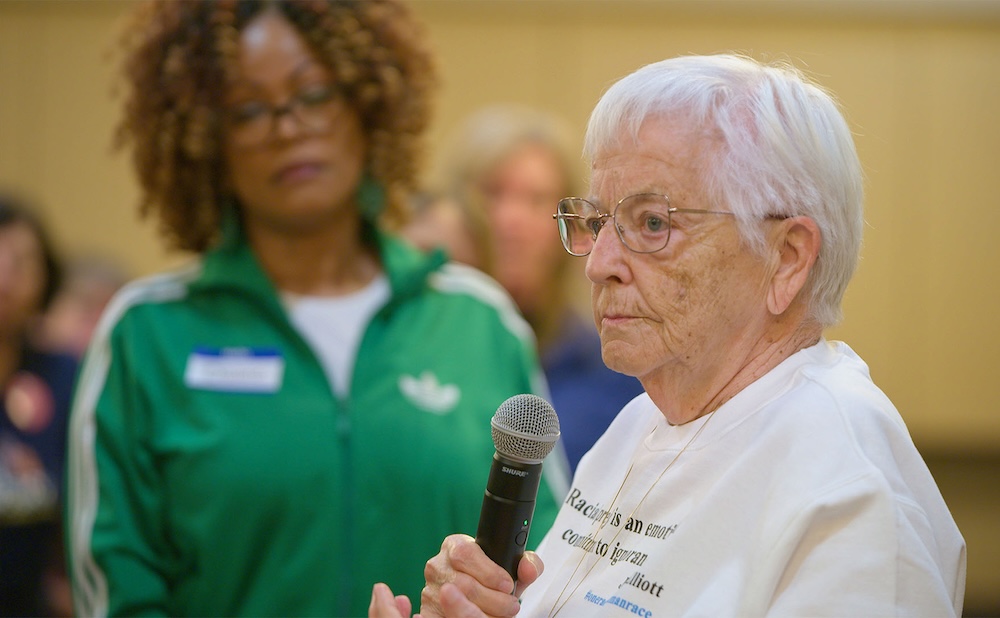
Elliott is rarely without them in a film that mirrors her aggressive personality, often obliging its subject to directly address the camera in a confrontational style that you come to see has been her approach to changing hearts and minds. The bluntness is bound to turn off some as it does in real life, but prove refreshing to even more as she breathlessly introduces herself at public speaking events as a “resident bitch” and has people holding onto their seats discussing matters of race that usually clear out rooms. As her daughter Mary describes her, “She’s a very small package of C4,” and Erhlich finds a compelling narrative thread beyond traveling with Elliott on her continually busy travel schedule of public engagements when her children have varying opinions of her, with most feeling she’s been more dedicated to a cause than to them.
However, it’s been a righteous one after her awareness of segregation grew as she did in Iowa, seeing firsthand from the grocery store that her husband ran in what was considered the seedier part of town with its largely Black population that what she had been conditioned to believe simply wasn’t true and developed in her own classroom an exercise called “Blue Eyes/Brown Eyes” that was meant to show the absurdity of discrimination in a way a third grader could understand as the class was divided into those who held certain privileges and those that didn’t based on their trivial genetic makeup. The lesson may seem quaint by contemporary standards, but sadly the necessity for Elliott to continue to talk about it 60 years later hasn’t diminished, particularly when she settles into see Mary and her grandson in Temecula, California and learns the local school board is attempting to remove books deemed controversial, which includes most anything that challenges a white heterodoxy.
While Elliott has never lowered her voice in opposition to such efforts to gaslight the public as she felt in Iowa, her efforts to raise others’ is renewed, gathering teachers in the area to playfully call them “cowards” and rallying a proper response to the threat of censorship. The film’s great strength is reframing the conversation as Elliott has without relying exclusively on her own stump speech to do so, instead weaving in her own gradual awakening as well as those she’s helped convince by meeting them where they are rather than where she expects them to be. (For all her bluster, the underlying empathy that led to her position is also there for those she feels are simply waiting to be enlightened now.) What Elliott discusses may be incredibly important and frightfully relevant, considering how long she’s been at it, but just as she found a way to connect with people on issues that intimidate, the mere example of someone willing to start the conversation in the first place seems to be what will open the door to even more in “Jane Elliott Against the World,” where getting loud has a surprising amount of nuance in it.
“Jane Elliott Against the World” does not yet have U.S. distribution.