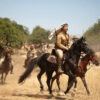



“You need to endure so you can win in the end,” a priest tells a child in “Palestine 36,” shaking off the possibility that he might be embarrassed by some British guards at a checkpoint that have been extra invasive with their search of him. Being stopped is still relatively new in Palestine in August of 1936 shortly after the British empire asserted greater control over the region after assuming administrative responsibilities for it following the First World War, yet the man of the cloth can see what’s coming as roads are increasingly subject to blockades and local residents are asked to register their land, indicative of threats to personal liberties that don’t even account for the kind of behavior of those that have been sent as enforcers. (The boy accompanying the priest is all ears when one of the soldiers takes any loose change off of him, suggesting it’s stolen without any justification.)
1948 is often considered the most pivotal year in Palestinian history when the State of Israel was created and debate over who had the right to live in the holy land of Jerusalem led to civil war, yet writer/director Annemarie Jacir always saw the events of 1936 as equally crucial. The epic scope of her fourth narrative feature would seem to underline its importance, yet it is mostly contained to the fate of a single village. The film immediately stands out with an uncommon view of Palestine cinematically where wealth can be seen in a variety of ways from beautifully decorated homes to simply being in the presence of families where generations live under one roof in peace, but change is clearly coming as the British High Commissioner Wachope (Jeremy Irons) sweeps into town with plenty of pomp and circumstance, promising greater connectivity with a new broadcast system that will spread language and culture across the land, though the officers who accompany him seem intent on drawing up partitions.
Jacir, who is known for intimate dramas such as “Salt of the Sea” and “Wajib,” shrewdly employs the aesthetic and narrative parlance of historical dramas of generations past, compete with a star-studded cast including legendary Palestinian actors Hiam Abbass and longtime collaborator Saleh Bakri and rising British stars such as Billy Howle and Robert Aramayo, to observe how the ongoing cycle of violence and persecution against Palestinians began. Yet she breaks a cycle herself in offering a deeper sense of what was lost by showing a rare glimpse of what once existed. The director and her crew had spent 10 months ahead of the production planting crops that generally no longer can be expected to survive in the conflict-ridden region but were once bountiful and spared no detail in restoring Bethlehem and East Jerusalem to their original splendor. With a production start in the fall of 2023, however, “Palestine 36” would be filmed in parallel with the ongoing genocide in Gaza with the war frequently upending any plans Jacir could make — including having to abandon the village set that she invested so much energy in building — and tending to a cast and crew that would have the surreal experience of acting out the same story in front of the camera as they recounted how Palestinians fought for their survival in the Arab revolt as their land and livelihoods were taken by force.
The mere existence of “Palestine 36” now is something to be marveled at as its own tale of perseverance, but as it primarily follows Yusuf (Karim Daoud Anaya), who observes the encroachment of colonial rule spreading from the urban center of Jerusalem to the village where much of his family resides as a chauffeur working for a businessman (Dhafer L’Abidine) and his wife Kholoud (Yasmine Al Massri), it breaks through in other ways as it bears witness to how Palestinians were systematically being stripped of their way of life, providing a view that has all too rarely reached the big screen. Ahead of a general release in February, the film was recently shortlisted for an Oscar for Best International Feature as Palestine’s official selection and Jacir generously took the time to talk about pushing ahead with the powerful drama against all odds.
 I’ve heard you say that you knew when starting down this road 10 years ago, this was going to be the most important thing you were ever going to make. What it’s like approaching a project to having that in the back of your mind?
When I said that, I knew it was going to be the biggest, most ambitious, biggest and most important thing I ever made, but I didn’t think it was going to be this difficult. Approaching it, I guess there was this willful ignorance of all of those obstacles. We have to be free in life and when I wrote it, I was free. I didn’t think about financing. I didn’t think that we’re not going to ever be able to fund something this like, with all the complications of it – a period piece in the ‘30s and the British army. I just didn’t think about that.
Then I took that into preproduction [thinking] “Let’s pretend we don’t live under military occupation. Let’s pretend there aren’t borders and checkpoints and everything is impossible. All of the things that make everything we do in Palestine so difficult, let’s just be free and pretend we can do anything we want. We can work with other people in the world and just make a film in a way that we want. I was thinking like that. Let’s just not accept that we can’t and let’s just do, as stupid as that may sound. That’s how we made it. I do what I do because I want to find freedom and freedom is in art, freedom is in life, freedom is in everything, so you sometimes just have to create the world that you wish was.
When creating this ensemble drama, did one character lead to another as you were developing this or did this community come to mind in its entirety?
It came to me automatically as an ensemble film, unlike the way I usually write where a character developed in a way over time. I can say that Yusuf was probably first into the story. For me, it’s a story of a young man who wants to leave his village and it’s a modern world, and you can become somebody else. He’s attracted to that and that was a main thread. And Kholoud, this journalist, was a big part of that and how those two interact. I imagined Yusuf, what if in all this possibility, there’s also a woman – a mother who’s like a widow – and there’s the possibility of a romance there, but because of the times, there [can’t be]. She’s the wife of a martyr and there’s a certain heaviness that comes with that, and she has a child. “No, it can’t be, but maybe it could be.” All of that [uncertainty].
Slowly, the other characters started to be born from that – the husband and wife in a marriage that’s about to be very challenged, the daughter of this woman that could be somebody to Yusuf and has a friend in the village who’s this boy, the son of a priest, then these generations of women in the daughter, the mother and the grandmother. It’s a huge moment, historically and politically, but in all my films, whether historical or not, I’m interested in the reality of the world that we live in. And with this, I was being very true to the history and pulling apart that history, talking about mistakes that were made and the whole historical context of our life, but at the same time [acknowledge] these things happen to regular people. History puts an imprint on us and it changes us, but I don’t think anybody goes looking for that. I stayed focused on that fact, which is so personal and familiar.
 I wanted to ask a little bit more about Khaloud in particular because her adaptability is fascinating. Of course, she adopts a male pen name to get her work published but will also change her language or even accent, depending on the situation. Was there an influence for that character?
I was looking at a lot of archival images, especially photographs. Of course, we have the archival moving image in the film, but photographs were very important to me and I saw a photo from the ‘30s of this Arab woman wearing a man’s suit, and smoking her cigarette and there’s so much attitude in that picture. It was beautiful and then I saw another of a woman in a suit and again, there’s things going on. There were female journalists in Palestine, Syria, Lebanon, and Egypt who were writing under male names because they were taken more seriously when their names appeared. Unfortunately, I think things have not changed so much in the world. Also, they were writing under colonial governments and if you were critical, you were in danger, so having a different name was also a way to protect themselves.
I was interested in these female journalists. In Palestine, there’s a woman who founded a newspaper and women were very much at the forefront of the national movement. There was a feminist Congress, a group of Arab women who went to Cairo in the early ‘30s. I was looking at photographs of that and there was so much personality. That’s a lot how Khaloud was born.
When you speak of personality, this film really bursts with color – from the archival interstitials, which you bring color to after the fact, to working with “La Chimera” cinematographer Helene Louvart on these vibrant compositions of life in Palestine, which is so different than how it’s generally depicted. How did that become such a part of this?
Yeah, Helene is just an incredible partner and it’s the second time we collaborated. The idea of the colorizing the archives was something I really insisted on and had to fight for because the archives are all black-and-white, which is expensive [to use in the first place] but then I wanted to also colorize them. But [I thought] how do you show this world? If it’s black-and-white in the film, you’ll just be thrown backwards. As the filmmaker, I’m reminding you of what existed, and now we move on with the story and I wanted it really integrated [where] we keep it archive, but the color would make it really feel alive and real. It would show us the world of the characters — what did Jerusalem look like, what the villages looked like and what the army looked like? Sometimes I’d be working with my editor and she said, “Sometimes I forget if this is archive or something you shot.” And the colorizing was really important. Maybe subconsciously I wanted to reclaim those archives for us.
 Even though you were obviously involved every step of the way in meticulously recreating what these villages looked like, what was it like to step on set for the first time?
It was amazing. We really restored a village in the way that a village would be restored, using traditional means and not doing it like a film set where it just looks good, but if you touch it, it falls apart. It was a place that is real and alive and it was important also for the way I was shooting. I would be everywhere, like in the village courtyard where we’re going to see everything. There’s no set. And I think it’s very important for the actors to feel that this is a living place. Some of the actors wanted to sleep there. They didn’t want to be in the hotel. Some of the actors are villagers and some of them are not and to create that space was important. They wanted to actually be like in their home in the village. And that was incredible.
We started to plant the crops, and we had a real struggle. Sometimes they failed because we don’t plant those crops anymore in Palestine., but sometimes they succeeded. And it was an experiment in some ways. I also remember very distinctly, one of the first shooting days was in the train station. After so much discussion about what this like busy train station would look like in 1936, I remember coming to set that morning. And when I saw all the extras in their costume and the trains and the light, I was stunned. I was so moved. It was suddenly alive and it was a beautiful moment.
From what I understand, there were four separate production shutdowns because of forces out of your control…
At least four, yeah.
What was it just like to keep the momentum alive for this? Did anything actually come out of having those pauses to rethink things?
That’s an interesting question because we always talk about the negative and how much we lost. There were some positives. I didn’t lose any of my cast and I feel like the fact that it was so difficult made us really understand how important it was to continue. We really became a family [where the feeling was] “Let’s just do it.” It brought us together very close. And now we see it and everybody is so proud of it and all of the detail in it. I had to rewrite certain things because of the conditions or an actor was prevented from coming into a city, and I was affected by what was happening politically around us. I had to think all the time about what is necessary? What is the minimum necessary to capture this poetic feeling? If I can’t have this or that, what do I really need? So constantly, you have to stay on your toes, and that’s a great thing for an artist. You don’t get the privilege of being lazy about anything because everything is going to be a fight. You have to will it to happen and if you’re lazy, that means actually you don’t really need it. These are things that keep everybody on their toes.
 You’re certainly seeing that with audiences now with how engaged they are. What’s it been like sending out into the world in this moment?
Yeah, it’s been amazing. Right now we’re in our 11th week in cinemas in the UK and I never expected that because of course it’s tough on the British, but I’m feeling a lot of love from the U.K. for this film and interactions with audiences there have been really incredible, asking a lot of questions [with the film] taking people out of their comfort zone and [showing] that there’s another point of view of this story that needs to be told. I think it’s a story that people can understand from many, many communities. A lot of people tell me, the British also colonized us or the French and it’s definitely a story that many of us can relate to. Then within my own community, the fact that Palestinians are reacting so beautifully to the film, not just by choosing it to represent Palestine for the Oscars, but a lot of people are going to the cinema with their parents or grandparents and they’re watching it as a family.
Just the other day, a woman wrote to me saying, “My father has never talked about our past, all the trauma he lived through, that he became a refugee. And he watched your film and suddenly it’s unlocked something. He’s talking all the time, telling the family all these stories that we’ve never heard before.” I’m getting a lot of feedback like that from people [whose] parents or grandparents are suddenly talking about something that generation never talked about because it’s hard with any generation to talk about trauma. So that’s been really special.
“Palestine 36” will open on February 13th in Los Angeles and New York before expanding in the U.S. and Canada.